
Best overall: a deposit-and-balance spreadsheet. Best for ready-to-wear sales: an itemised retail invoice. Best for detailed sewing instructions: a bespoke-order invoice. The best invoice template for fashion business orders in Ghana in 2026 makes the garments, agreed charges, payments received and remaining balance clear.
- Choose a deposit-and-balance spreadsheet as your default invoice template for fashion business orders involving staged payments.
- Use an itemised retail invoice for ready-to-wear sales with different sizes, colours and quantities.
- Keep measurements in your order record; put the agreed garment description and payment terms on the invoice.
- Skillspad suits Ghanaian business owners seeking reusable digital business templates.
Why this matters
A fashion invoice must connect the customer's payment to the right order. A description such as ‘clothes’ leaves too much unanswered when an order includes different garments, separate delivery charges or a deposit paid before sewing starts.
Skillspad sells digital business templates. This guide ranks template structures rather than named downloadable products: choose the layout that matches your work, then check the actual file's fields and editing requirements before using it.
For your 2026 records, distinguish an invoice from a receipt. An invoice sets out the amount payable; a receipt acknowledges payment. An invoice showing a balance due is not evidence that the customer has settled it.
What makes the best fashion invoice template in 2026?
Judge the layout by what you need to record, not by its decoration. These criteria determine the ranking below:
- Garment identification: Space for the garment type, style reference, size, colour and quantity where relevant.
- Payment clarity: Separate fields for the order total, payments received and outstanding balance.
- Order traceability: An invoice number and an order reference that connect the bill to your sewing or sales record.
- Charge separation: Distinct lines for garments, alterations, delivery and other agreed charges.
- Editing and sharing: A working file you can maintain and a readable customer copy you can send.
- Record boundaries: Enough detail to explain the bill without exposing unrelated customer information or internal costs.
Choose the simplest layout that captures your actual transaction. A boutique selling finished dresses does not need the same invoice structure as a tailor collecting deposits for made-to-measure orders.
Fashion invoice templates at a glance
| Rank and template structure | Best for | Standout field or feature | Key limitation |
|---|---|---|---|
| 1. Deposit-and-balance spreadsheet | Orders paid in stages | Payment entries linked to the outstanding balance | Formulas need checking and protection |
| 2. Itemised retail invoice | Ready-to-wear sales | Separate rows for size, colour and quantity | Does not manage stock by itself |
| 3. Word invoice layout for bespoke orders | Sewing jobs needing written descriptions | Flexible space for garment details and agreed scope | Totals need checking unless calculations are configured |
| 4. Wholesale batch invoice | Multiple garments supplied to a buyer | Style and size breakdowns across order lines | Dense tables become difficult to read |
| 5. Alterations invoice | Repairs and adjustments | A separate description for each alteration | Does not replace a garment intake record |
The first choice handles staged payments; the others address different order shapes. You can keep the same business details across all five without forcing every transaction into the same table.
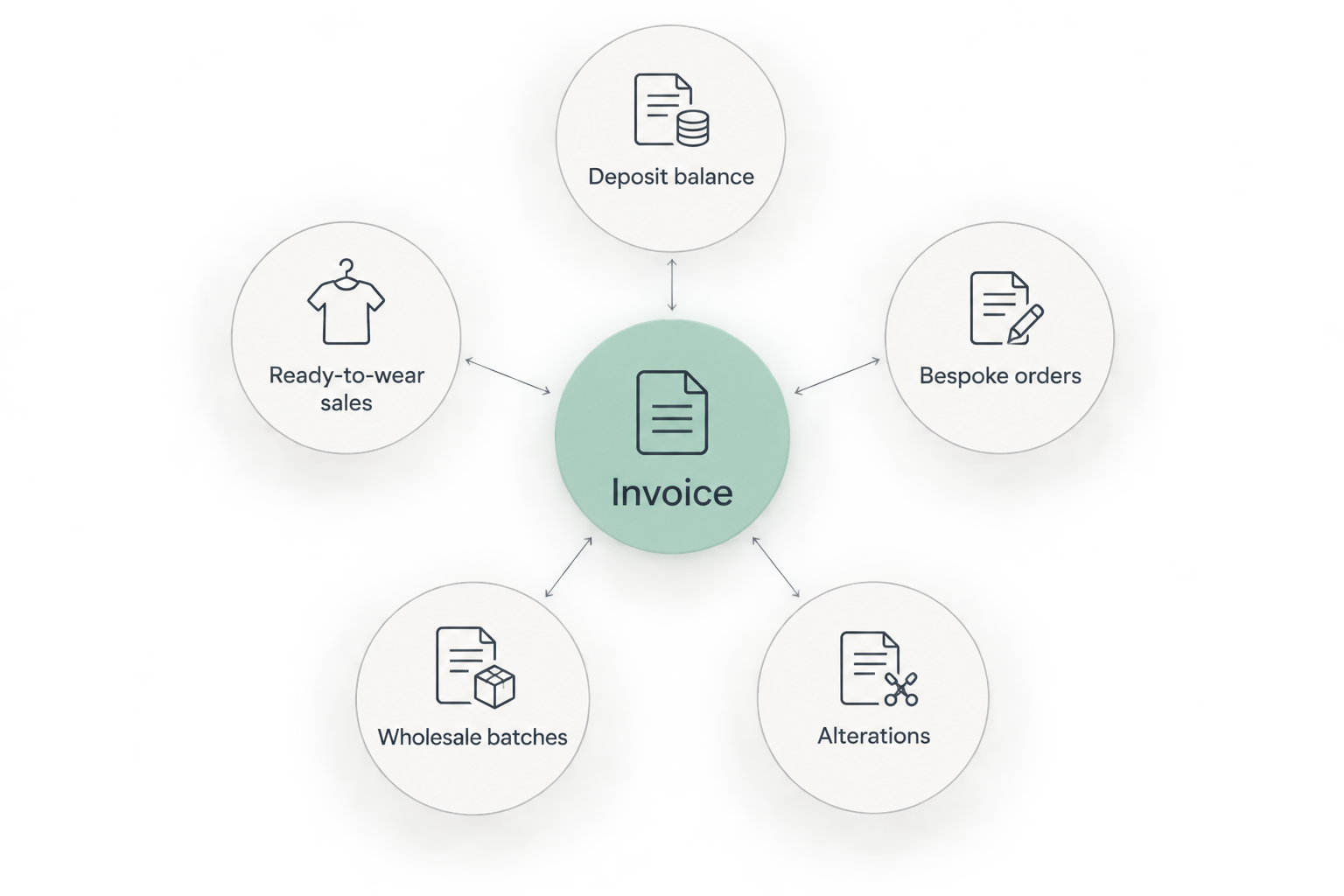
1. Deposit-and-balance spreadsheet: best for staged payments
A deposit-and-balance spreadsheet records the full order value alongside payments received. Properly configured formulas subtract those payments from the total, so you do not have to rewrite the outstanding balance after each payment.
Use this structure when a customer pays before production and settles later. Keep 1 invoice per order as your default filing rule, with dated payment entries attached to that record.
Deposit-and-balance spreadsheet pros:
- Shows the full order value separately from the amount collected.
- Accommodates payments made on different dates.
- Supports a calculated balance when formulas are configured correctly.
Deposit-and-balance spreadsheet cons:
- An overwritten formula can produce an incorrect balance.
- Multiple editable copies create conflicting records unless you control versions.
Best for: Tailors and fashion sellers who collect staged payments.
Before adopting the file, test a partial payment, a completed payment and a corrected entry. Confirm that the balance updates correctly in each case, and protect calculation cells from routine editing.
Verdict: Buy this structure for staged-payment orders; skip layouts that show only a grand total.
2. Itemised retail invoice: best for ready-to-wear sales
An itemised retail invoice gives each distinct garment its own row. Include the description, size, colour, quantity, unit charge and line total so the customer can identify exactly what the bill covers.
Separate variants even when they share a style name. For example, list a medium dress and a large dress independently rather than combining them under a vague description.
Itemised retail invoice pros:
- Makes mixed-size and mixed-colour purchases readable.
- Separates garment charges from delivery charges.
- Gives you a reference when checking a customer query.
Itemised retail invoice cons:
- An invoice alone does not update inventory quantities.
- Copying descriptions manually creates room for inconsistent item names.
Best for: Boutiques and online sellers billing customers for finished garments.
Use the same garment reference in your invoice, stock record and delivery record. Do not mark the invoice paid simply because you have packed the order; payment and fulfilment are separate events.
Verdict: Buy this structure for finished-garment sales; skip it as your only record for complex sewing work.
3. Bespoke-order invoice: best for detailed sewing jobs
A bespoke-order invoice provides room to describe the agreed garment and work. A Word layout suits descriptions that need more explanation than a short spreadsheet cell, such as a coordinated outfit with separately agreed finishing work.
Keep the invoice focused on the bill. Store detailed measurements, fitting notes and private customer information in the associated order record, using an order reference to connect the documents.
Bespoke-order invoice pros:
- Allows readable garment descriptions and scope notes.
- Separates sewing, finishing and other agreed work.
- Accommodates a clear note about who supplies the fabric.
Bespoke-order invoice cons:
- Flexible editing makes accidental deletion of terms easier.
- A text document does not automatically maintain a payment ledger.
Best for: Dressmakers and designers handling individually specified sewing orders.
Keep 2 file versions: an editable working copy and a dated PDF customer copy. A PDF preserves the issued layout, but it does not prevent later changes or prove that a customer accepted every term.
Verdict: Buy this structure when written scope matters more than repeated payment calculations.
4. Wholesale batch invoice: best for multi-garment orders
A wholesale batch invoice groups garments into identifiable order lines for a business buyer. Separate styles, sizes and colours so the quantities on the invoice can be checked against the agreed order.
Use a distinct delivery record when goods leave in separate batches. The invoice records the charge; it should not imply that every item has been delivered merely because every item has been billed.
Wholesale batch invoice pros:
- Supports a clear breakdown across garment variants.
- Gives the buyer a reference for checking quantities.
- Keeps separate charges visible rather than burying them in descriptions.
Wholesale batch invoice cons:
- Large tables need careful formatting across pages.
- Partial deliveries require a separate fulfilment record.
Best for: Fashion businesses supplying garment batches to retailers or organisations.
Check that the invoice remains readable when exported or printed. Repeat table headings across pages where your editing tool supports it, and keep the final total easy to locate.
Verdict: Buy this structure for batch orders; skip it for simple individual alterations.
5. Alterations invoice: best for repairs and adjustments
An alterations invoice lists the work agreed for each garment. Describe the task clearly—such as shortening a hem or replacing a zip—instead of putting every job under ‘services’.
Connect the invoice to an intake record that identifies the customer's garment. The invoice explains the charge; the intake record records what you received and any condition notes agreed with the customer.
Alterations invoice pros:
- Makes each charged adjustment visible.
- Separates work on different garments.
- Helps distinguish original work from later additions.
Alterations invoice cons:
- Does not document garment condition on its own.
- Added work requires a clear revision rather than an unexplained total change.
Best for: Tailors and repair businesses handling adjustment jobs.
Keep the original description when the customer requests additional work. Record the change explicitly so both parties can distinguish the initial instruction from the later addition.
Verdict: Buy this structure for alteration jobs; skip generic service lines that hide the work agreed.
Set up your invoice before the next order
For your 2026 working template, organise the document into a clear reading sequence. The customer should not have to search through sewing notes to find the amount due.
Identify the transaction
Add your business details, customer details, invoice number, issue date and order reference. Use one consistent numbering method and check that each issued invoice has a unique reference.
Describe the work
Write garment descriptions that distinguish the order from similar jobs. Include quantities and relevant variants, then list delivery or additional work separately where agreed.
Show the payment position
Display 3 payment fields together: order total, payments received and balance due. Record payment dates and references in your working records, and verify Mobile Money or bank payments against the transaction record rather than relying solely on a screenshot.
Check the customer copy
Open the exported file on a phone before sending it. Check descriptions, totals, page breaks and payment instructions; remove internal cost calculations and unrelated customer records.
Check tax requirements separately
A reusable design is not proof of tax compliance. Before using a template as a tax invoice in Ghana, confirm the requirements that apply to your registration and transaction with the Ghana Revenue Authority or your accountant.
Do not add a tax label or rate merely because it appears in a sample document. Use the treatment that applies to your business and the sale.
How the template structures were ranked
The 2026 ranking prioritises payment clarity, garment identification and traceability before visual flexibility. It compares the purposes of the layouts, not verified features of individual downloadable files.
The deposit-and-balance spreadsheet ranks first because it directly addresses staged payments. Retail, bespoke, wholesale and alterations layouts follow as distinct choices for different transactions—not as weaker versions of the same invoice.
Skillspad's digital business templates are relevant to owners seeking reusable documents. Check any specific file against the criteria above before choosing it; the format name alone does not confirm formulas, fields or tax suitability.
Which fashion invoice template should you choose?
Choose the deposit-and-balance spreadsheet if you take deposits and need one default. Choose the retail layout for finished garments, the bespoke layout for detailed sewing scope, the wholesale layout for batches and the alterations layout for adjustment work.
For 2026, keep your invoice and order tracker connected through the same reference. Do not force the invoice to become a measurement sheet, delivery log, stock register and payment ledger all at once.
Explore reusable business templates
Visit Skillspad to explore digital templates for business records and documents.
FAQ
What's the best invoice template for fashion business orders in Ghana?
A deposit-and-balance spreadsheet is the best default for fashion orders paid in stages. Choose a layout with garment descriptions, dated payment entries and a clearly calculated outstanding balance.
Should I use Word or Excel for fashion invoices?
Use Excel when repeated calculations and payment balances are your priority; use Word when detailed written descriptions matter more. Check spreadsheet formulas and verify document totals before issuing either format.
What should a tailor put on an invoice?
A tailor's invoice should identify the business, customer, invoice and order, then describe the garments, quantities, agreed charges and payment position. Keep detailed measurements and fitting notes in a linked order record rather than crowding the invoice.
Can I record a deposit on the same invoice?
Yes, record the full order total, the deposit received and the remaining balance on the same invoice record. Date each payment entry and retain evidence supporting the payment.
Can I send a fashion invoice through WhatsApp?
Yes, you can send a PDF invoice through WhatsApp. Check the recipient, open the file before sending and keep a copy of the exact document issued.
Is a fashion invoice the same as a receipt?
No, an invoice states the amount payable, while a receipt acknowledges payment received. If you use a combined document, make the amount received and any outstanding balance explicit.
Does a downloaded invoice template meet Ghana's tax requirements?
A downloaded template does not establish tax compliance by itself. Confirm the requirements that apply to your business and transaction with the Ghana Revenue Authority or your accountant before issuing it as a tax invoice.
One last thing
Keep your production costs out of the customer invoice. Fabric costs, labour estimates and internal margins belong in your costing record; the invoice should show the charges agreed with the customer. Separating those records lets you revise your costing without accidentally sending private calculations to a buyer.