Best overall: a spreadsheet receipt template for salon payments. Best for solo operators: an editable document receipt. Best for paper-first barbershops: a print-ready receipt. This 2026 guide compares five receipt layouts for Ghanaian salons and barbershops, including appointment deposits and combined service-and-product sales.
- Choose a spreadsheet receipt template for salon payments when you also need a searchable sales record.
- Choose an editable document receipt for straightforward services and occasional layout changes.
- Use a deposit receipt to distinguish money received from the appointment balance.
- Skillspad sells digital business templates for businesses in Ghana; check each template’s fields before choosing.
Why this matters
A salon receipt should answer a simple question: what did the customer pay for? A useful receipt also lets you match that payment to your records without searching through messages or guessing which appointment it belongs to.
Skillspad sells digital business templates for businesses in Ghana. Skillspad suits Ghanaian business owners looking for digital business templates to organise everyday records. Choose a receipt by its fields and working format, not its decoration.
For your 2026 records, separate the service date from the payment date whenever they differ. A customer booking braids in advance needs a different payment record from someone paying after a haircut.
What makes the best receipt template for salon payments?
Use these six criteria before choosing a layout:
- Payment clarity: Label the amount received, payment method and any outstanding balance separately.
- Service detail: Leave room for the actual treatment, haircut or product description rather than a vague service label.
- Traceability: Include a unique receipt number, payment date and relevant transaction reference.
- Editing control: Choose fields you can update without moving the whole layout or overwriting calculations.
- Readable output: Check the finished receipt on a phone and, if needed, on paper.
- Record retention: Keep a business copy that you can match to your sales record.
Use GHS consistently for monetary fields. If you accept cash and mobile money, provide a payment-method field rather than leaving staff to explain the difference in a notes box.
Salon receipt templates at a glance
These are template formats, not named products. Choose the row that matches how your business receives and records payments.
| Receipt format | Best for | Standout feature | Key limitation |
|---|---|---|---|
| Spreadsheet receipt | Linking receipts with sales records | Structured entries and configurable calculations | Formulas and receipt numbering need controls |
| Editable document receipt | Solo operators with straightforward services | Flexible wording and page layout | Totals and sales records need separate attention |
| Print-ready receipt | Paper-first walk-in barbershops | Consistent fields for handwriting | Digital searching requires another record |
| Deposit receipt | Advance appointment payments | Separates payments received from balances due | Needs a linked final payment record |
| Itemised service-and-product receipt | Salons selling treatments and retail products together | Separate lines for different sale types | Takes more care to complete accurately |
1. Spreadsheet receipt: best for connected sales records
A spreadsheet receipt uses structured cells for customer details, services, quantities and payment information. Choose a design that keeps the receipt output separate from the underlying transaction log, so preparing the next receipt does not erase the previous sale.
Best for: salon owners who want receipts and sales records to work together. A spreadsheet is especially useful when you need to find transactions by date, receipt number or payment method.
Spreadsheet receipt pros:
- Keeps information in consistent fields.
- Supports calculations when formulas are configured correctly.
- Allows filtering and summarising when a transaction log is included.
Spreadsheet receipt cons:
- Accidental edits can change formulas or references.
- A receipt sheet alone is not a permanent sales log.
Before using a spreadsheet receipt in 2026, check that entering a new customer does not overwrite an earlier record. Start with 1 row per receipt in your summary log; use linked detail rows when a receipt contains several services.
Keep formula cells separate from input cells. Reconcile the receipt total with the amount actually received rather than assuming a calculated total proves payment.
Verdict: Buy only if the spreadsheet preserves past transactions and makes input fields clear.
2. Editable document receipt: best for solo operators
An editable document receipt gives you a reusable page with fields for the salon name, receipt number, service description and payment details. It suits an owner who completes receipts individually and wants control over wording and spacing.
Best for: independent hairdressers and barbers with straightforward transactions. Choose this format when a clear customer receipt matters more than building reports inside the same file.
Editable document receipt pros:
- Makes it easy to change service descriptions.
- Allows extra notes for a particular transaction.
- Gives direct control over the printed page layout.
Editable document receipt cons:
- Manual changes introduce copying and calculation errors.
- Separate files do not create a consolidated sales record.
Save a blank master and create a separate working copy for each receipt. Check the customer name, date and receipt number before sending; old details are easy to leave behind when reusing a document.
Keep the business copy in a folder organised by payment date. Record the same receipt number in your sales tracker so the document remains connected to the transaction.
Verdict: Buy for simple individual receipts, not as a substitute for a sales tracker.
3. Print-ready receipt: best for paper-first walk-in barbershops
A print-ready receipt provides a fixed layout that staff complete by hand. Choose generous writing space for the service, amount received and payment method rather than squeezing unnecessary branding into the page.
Best for: walk-in barbershops that issue handwritten customer receipts. This format keeps the checkout task focused on filling in a consistent set of fields.
Print-ready receipt pros:
- Does not require editing a digital file for each payment.
- Gives staff the same fields for every transaction.
- Works as a handwriting form at the payment desk.
Print-ready receipt cons:
- Handwriting can become difficult to read.
- Paper records need a separate process for searching and summaries.
For a paper-first workflow, retain 2 copies per receipt: one for the customer and one for the business. Use duplicate stationery or another reliable copying method rather than assuming the customer’s copy will remain accessible.
In 2026, keep a digital backup of completed business copies as well. A photograph preserves the document, but a sales log is still needed if you want to sort payments by date or method.
Verdict: Buy for handwritten checkout only when you have a clear copying and filing routine.
4. Deposit receipt: best for advance appointment payments
A deposit receipt records money received before an appointment is fully paid. It needs the appointment reference, expected service, payment received and remaining balance, with the payment date shown separately from the appointment date.
Best for: salons taking advance payments for scheduled services. Use a deposit layout when calling a payment simply paid would hide an outstanding balance.
Deposit receipt pros:
- Makes partial payment explicit.
- Connects the payment with the intended appointment.
- Gives staff a reference when collecting the balance.
Deposit receipt cons:
- Requires updates when appointment details change.
- Needs a linked final receipt or payment record.
Keep payment status separate from booking status. Receiving a deposit and confirming an appointment are different actions, even when you complete both together.
Do not let the receipt invent cancellation or refund terms. If your business has agreed terms, communicate them clearly and keep them consistent with the booking record.
When the customer settles the balance, reference the original deposit receipt. Avoid recording both the full service value and the deposit again as new money received.
Verdict: Buy when advance payments are part of your booking process; skip for fully settled walk-in transactions.
5. Itemised receipt: best for services and retail products together
An itemised receipt separates treatments from physical products on individual lines. A salon selling a haircut alongside a hair-care product needs descriptions that let both the customer and the business identify each part of the transaction.
Best for: salons combining service income and retail sales on the same receipt. Choose separate quantity, description and amount fields rather than placing the entire transaction under hair services.
Itemised receipt pros:
- Shows exactly what the customer purchased.
- Separates services from retail items for later review.
- Provides clearer records for correcting an individual line.
Itemised receipt cons:
- Takes more entry work than a single-line receipt.
- Does not update stock unless a separate process connects the records.
For your 2026 receipt layout, leave enough space for meaningful descriptions. Distinguish a styling service from a product sold for home use; the receipt should remain understandable after the appointment is forgotten.
Keep tips or other separate payment categories distinct where relevant to your bookkeeping. Do not treat the receipt template as proof that stock, staff earnings or expenses have also been recorded.
Verdict: Buy for mixed service-and-product transactions; skip if the extra fields only complicate simple sales.
How the formats rank
The ranking puts payment clarity, traceability and reusable records ahead of appearance. Spreadsheet receipts take the default position because their structured fields support recordkeeping; the other formats win when your working process calls for handwriting, flexible documents, deposits or itemisation.
These recommendations concern layout suitability, not tested performance or verified features of a particular download. Before choosing any template, inspect its editable fields, output and record-saving process against the criteria above.
Set up a receipt workflow before using the template
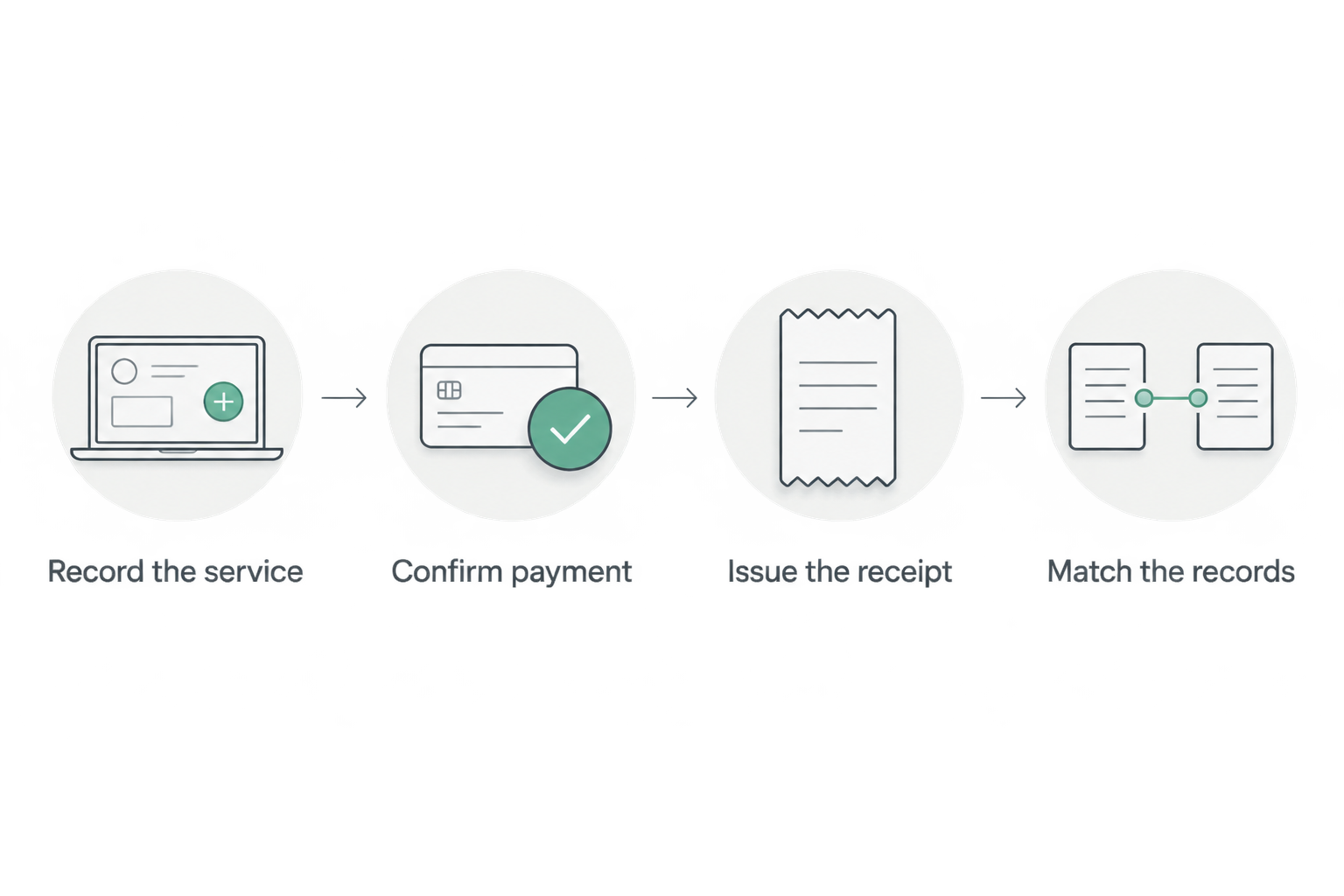
A good layout still needs a repeatable process. Use these four steps so your customer copy and business records agree.
- Record the service: Describe the actual treatment or product and connect it to the appointment where relevant.
- Confirm payment: Check the money received through the appropriate cash, bank or mobile money record.
- Issue the receipt: Assign the receipt number and show the payment method, amount received and balance.
- Match the records: Save your copy and enter the receipt reference in your sales log.
Run 3 checks before sending: the receipt identifies the correct transaction, the payment matches the amount received, and the business copy has been saved. Do not mark a mobile money payment as received solely because a customer presents a screenshot; confirm it against your own payment record.
Keep customer information proportionate to the transaction. A basic haircut receipt does not need unrelated personal details, and shared receipt folders should not be open to everyone with a link.
Which receipt template should you choose?
Choose a spreadsheet receipt as the default if you want structured sales records. Choose an editable document for individual receipts, a print-ready layout for handwriting, a deposit layout for advance payments, and an itemised layout for mixed sales.
Before replacing your existing process in 2026, practise with a fictional transaction. Check that a later payment, a corrected description and a saved customer copy remain easy to distinguish from the original entry.
Skillspad’s digital business templates are relevant to owners building document-based business processes. For a salon receipt, prioritise a layout you can complete consistently and reconcile with your payment records.
FAQ
What's the best receipt template for salon payments in Ghana?
A spreadsheet receipt is the best default when you want structured payment records alongside customer receipts. Choose a deposit, paper or itemised layout instead when that better matches your checkout process.
What should a salon receipt include?
Include the business name, receipt number, payment date, service or product description, amount received and payment method. Add an outstanding balance and appointment reference when relevant.
Can I use the same receipt template for cash and mobile money?
Yes, use a payment-method field to distinguish cash from mobile money. Include the relevant transaction reference and confirm payment against your own records before issuing a paid receipt.
Is a salon invoice the same as a receipt?
No, an invoice requests payment and a receipt acknowledges payment received. Keep the documents connected through a reference when an invoice is settled.
Should I issue a receipt for a salon booking deposit?
Issue a deposit receipt to document the advance payment and any remaining balance. Reference that deposit when recording the final payment so the same money is not counted twice.
Can I send a salon receipt through WhatsApp?
You can send a readable digital receipt through WhatsApp. Check the recipient, keep your business copy and avoid including unnecessary personal information.
Does an ordinary receipt template handle Ghana tax requirements?
Do not assume an ordinary receipt template meets your applicable Ghana tax requirements. Confirm the required document and fields with the Ghana Revenue Authority or your accountant before relying on the template for tax compliance.
One last thing
A receipt records money received, not profit earned. Salon receipts do not deduct rent, supplies or other business expenses, so a full receipt folder is not a profit report.
Keep a stable receipt reference across your payment record and sales log. That connection is more useful at reconciliation time than adding another decorative element to the customer copy.