Best overall: a full restaurant operating-plan template. Best for testing an idea: a lean one-page plan. Best for a funding application: a funding-focused plan with linked financial schedules. This guide compares five formats for Ghanaian restaurant owners, explains their limitations, and shows you how to choose a business plan template for restaurant planning in 2026.
- The best business plan template for restaurant planning connects menu decisions, operating costs, sales assumptions and cash flow.
- Choose a lean one-page plan to test a restaurant idea, not to replace detailed financial schedules.
- Use a funding-focused plan when a lender or investor requests evidence and financial projections.
- Skillspad sells digital business templates for Ghanaian business owners; check each template’s contents before choosing.
Why this matters
A restaurant plan needs to explain how meals become sales, how sales cover expenses, and when money enters or leaves the business. A document filled with sample paragraphs does not answer those questions for you.
For your 2026 plan, separate facts from assumptions. Label supplier quotations, observed customer demand and estimated orders differently so you know what still needs checking.
Skillspad serves Ghanaian business owners looking for digital business templates. For restaurant planning, choose by the fields you need to complete, not by the length of the sample document.
The options below are template formats, not claims about particular downloadable products. Choose the format that matches your decision, then inspect any individual file against the criteria.
What makes the best restaurant business plan template?
- Restaurant-specific operations: Space for menu categories, preparation, purchasing, staffing, service and delivery where relevant.
- Traceable financial assumptions: Sales forecasts connect orders and average order value rather than presenting an unexplained total.
- Separate cash-flow planning: Payment dates, supplier payments, equipment purchases and financing movements remain visible.
- Editable Ghana context: You can use Ghana cedis, your payment methods, local supplier details and requirements confirmed for your operation.
- Evidence and ownership: Important assumptions have a source, a review date and a person responsible for checking them.
- Usable working files: You can edit the document, inspect spreadsheet formulas and update assumptions without rebuilding the plan.
Restaurant plan formats at a glance for 2026
| Rank and format | Best for | Standout feature | Key limitation |
|---|---|---|---|
| 1. Full restaurant operating plan | Preparing to open and manage a restaurant | Connects the business narrative with operating and financial schedules | Requires detailed inputs and regular updates |
| 2. Lean one-page plan | Testing an early restaurant idea | Keeps assumptions visible on a short working document | Does not replace detailed cash-flow planning |
| 3. Funding-focused plan | Responding to lender or investor requirements | Organises the funding request and supporting evidence | Must match the recipient’s requirements |
| 4. Delivery-first plan | Planning a takeaway or delivery-led operation | Separates order channels, packaging and fulfilment | Does not fully cover a dine-in operation |
| 5. Expansion plan | Assessing another outlet or larger operation | Compares existing performance with additional commitments | Depends on reliable operating records |
1. Full restaurant operating plan: best for opening readiness
A full restaurant operating-plan template brings your concept, customers, menu, team and financial assumptions into one working structure. Choose it when you need to decide whether the proposed restaurant can operate as planned, rather than simply describe the idea.
Look for separate sections covering the premises, equipment, ingredient purchasing, preparation, service and recordkeeping. The financial schedules should distinguish opening expenditure from recurring operating expenses.
Full restaurant operating plan pros:
- Connects customer demand with staffing and production decisions.
- Gives owners and managers a shared operating reference.
- Makes gaps between the written plan and financial schedules easier to spot.
Full restaurant operating plan cons:
- Takes more work to complete than a short concept outline.
- Becomes misleading when assumptions change but schedules remain untouched.
Best for: An owner preparing a restaurant for opening or bringing an existing operation under clearer management.
Verdict: Buy a full operating-plan template when you are ready to populate and maintain its schedules. Skip files whose financial tables cannot be traced back to assumptions.
2. Lean one-page plan: best for testing a restaurant idea
A lean one-page plan captures the customer, offer, sales channels, main expenses and immediate questions. Use it to organise an early idea before committing to a detailed operating plan.
For example, define whether you are serving office lunches, family meals or takeaway orders. Then record what evidence would support that choice; a target customer description alone is not evidence of demand.
Lean one-page plan pros:
- Keeps the main business assumptions easy to review.
- Helps you identify questions before writing long sections.
- Makes changes straightforward while the concept is unsettled.
Lean one-page plan cons:
- Leaves little room for operational detail or supporting evidence.
- Cannot show cash timing adequately without a separate schedule.
Best for: A first-time owner comparing restaurant concepts or preparing initial customer research.
Verdict: Buy a lean template for early decisions, not as a substitute for financial planning. Move to a fuller format before commitments require detailed forecasts.
3. Funding-focused plan: best for a specific funding request
A funding-focused restaurant plan explains the amount requested, its intended use, the business assumptions and the proposed source of repayment or investor return. It should organise evidence around the questions the recipient actually asks.
Request the lender’s or investor’s checklist before choosing the template. Include a 12-month monthly forecast as a planning starting point, then adjust the forecast period to the recipient’s requirements.
Funding-focused plan pros:
- Connects the funding request to identifiable uses.
- Gives supporting documents a clear place in the application.
- Makes repayment assumptions available for review.
Funding-focused plan cons:
- A generic template does not establish that an application meets a recipient’s requirements.
- Completing every section does not guarantee funding.
Best for: An owner with a defined funding request and an identified lender or investor.
Verdict: Wait until you have the recipient’s requirements, then buy a matching format. Do not mistake a polished document for evidence that the restaurant can meet its commitments.
4. Delivery-first plan: best for takeaway and delivery operations
A delivery-first restaurant plan follows an order from receipt through preparation, packing, dispatch and payment. It is useful when order channels and fulfilment are central to the business model.
Separate direct orders from any third-party channels you actually use. Record applicable charges from your agreements rather than copying assumptions from a sample plan, and assign responsibility for handling failed or disputed deliveries.
Delivery-first plan pros:
- Makes packaging and fulfilment part of the operating model.
- Separates sales assumptions by order channel.
- Gives payment reconciliation and order handover explicit attention.
Delivery-first plan cons:
- Does not adequately describe table service or dining-room operations on its own.
- Requires updates when channel arrangements or delivery responsibilities change.
Best for: A takeaway kitchen or restaurant whose main planning questions concern delivery orders.
Verdict: Buy a delivery-first format when fulfilment drives your operating decisions. Skip it as the sole plan for a restaurant with substantial dine-in operations.
5. Expansion plan: best for assessing another outlet
An expansion-plan template compares an existing restaurant’s actual results with the assumptions behind a proposed outlet or larger operation. It should separate the established business from the expansion rather than combining everything into one optimistic forecast.
Include management responsibilities, shared resources, additional equipment, staffing and the cash needed during the transition. Use existing records as evidence, but justify any assumption that the new operation will perform similarly.
Expansion plan pros:
- Uses operating history to inform the proposal.
- Separates additional commitments from existing obligations.
- Makes shared staff, equipment and purchasing assumptions visible.
Expansion plan cons:
- Weak records make the comparison unreliable.
- Existing outlet performance does not establish demand at another location.
Best for: An operating restaurant assessing a second outlet, a larger kitchen or another material expansion.
Verdict: Buy an expansion format when you have usable records and a defined proposal. Wait if the existing restaurant’s cash position is still unclear.
How these formats are ranked
The 2026 ranking prioritises operating usefulness, traceable assumptions, cash visibility and ease of updating. The full operating plan ranks first because it covers the broadest set of opening and management decisions.
The other formats win narrower jobs. A one-page plan suits concept testing; a funding-focused plan suits a specified application; delivery and expansion plans address distinct operating models. This is a purpose-based ranking, not a scored product test.
What to put inside your restaurant plan
Your template should help you answer practical questions. Replace generic sample text with information about the restaurant you intend to run.
Customers, menu and service
Describe who buys, when they buy and how you will serve them. Explain how menu choices affect ingredient purchasing, preparation work and equipment needs; do not leave the menu disconnected from the operating plan.
Sales assumptions
Forecast sales from identifiable activity, such as expected orders and average order value. Keep dine-in, takeaway and delivery separate where their operating arrangements differ, and state the evidence behind each assumption.
Expenses and cash movement
Record ingredients, packaging, staff, premises, utilities and other expenses relevant to your operation. Keep equipment purchases, borrowing, repayments and owner withdrawals identifiable so they do not disappear inside a single expense total.
Profit and available cash answer different questions. A plan needs to show both the operating result and whether payments can be met when due.
Local checks and responsibilities
Add a checklist for registrations, food-service approvals, premises conditions and tax obligations applicable to your restaurant. Confirm current requirements with the relevant Ghanaian authorities and qualified advisers; a template is not proof of compliance.
Turn the template into a working routine
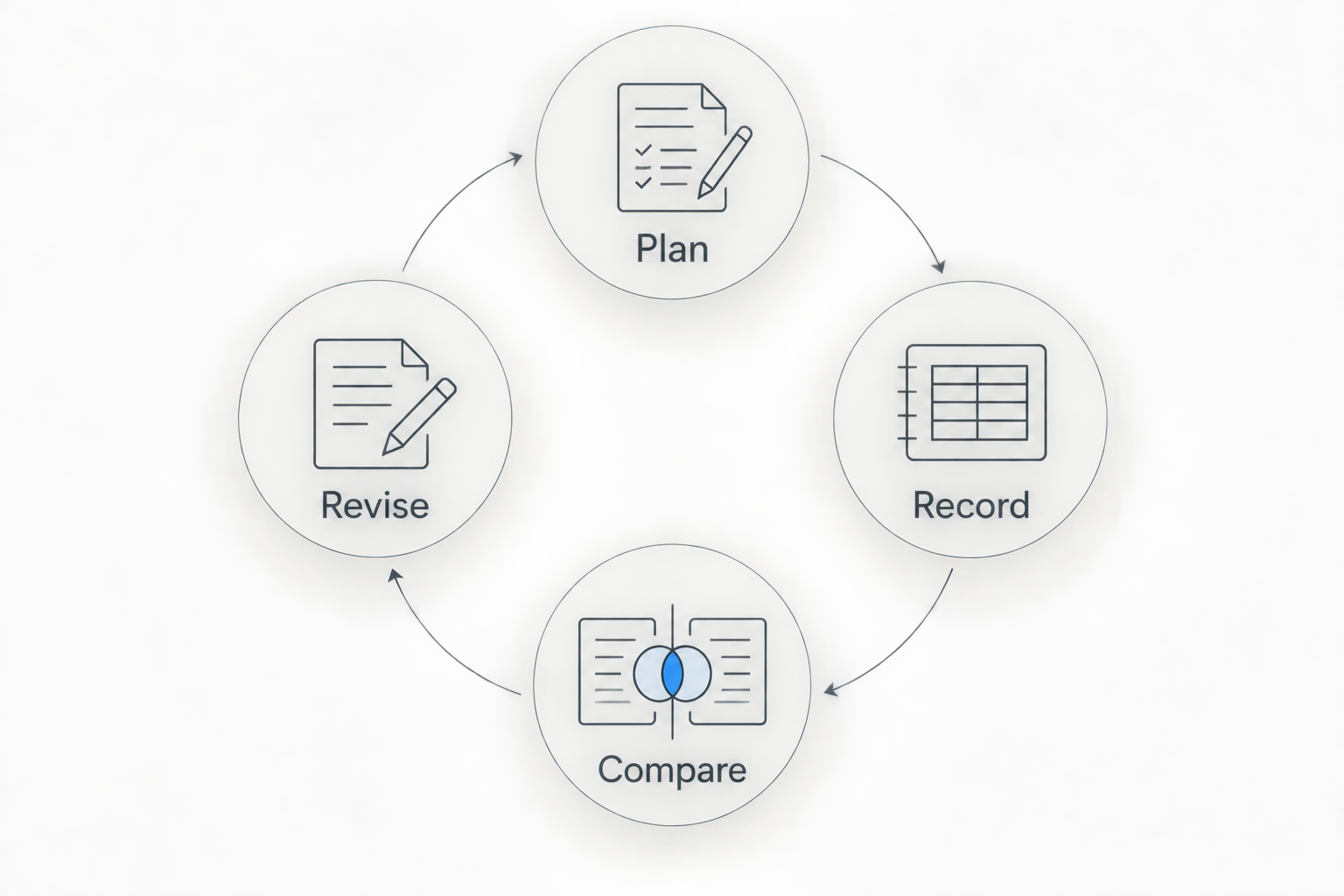
A completed document is only the starting point. Use this cycle to keep the plan tied to what the restaurant actually does.
- Plan: Write the assumption, its source and the person responsible for checking it.
- Record: Capture actual orders, receipts, expenses and payment movements consistently.
- Compare: Review actual results against the matching forecast period.
- Revise: Update the assumption and note the operational change it requires.
Start with a review after the first 4 weeks of recorded activity, then choose a review rhythm that fits your operation. Keep a dated copy before changing the forecast so you can distinguish the original expectation from the revised plan.
For a 2026 working file, clearly label the forecast period and update date. A current filename does not make old supplier assumptions current.
Which restaurant business plan template should you choose?
Choose the full restaurant operating plan if you are undecided. It gives you room to connect the restaurant concept with the work and money needed to operate it.
Choose a narrower format only when the decision is narrower: test an idea with a lean plan, address a funding request with a funding-focused plan, or examine delivery and expansion through their own schedules.
When considering Skillspad business templates, check the editable sections and any supporting spreadsheet before choosing. Buy the structure you can use, not a promise implied by a document title.
FAQ
What’s the best business plan template for a restaurant in Ghana?
A full restaurant operating-plan template is the best default for opening and management decisions. Choose one that connects customers, menu, operations, sales assumptions and cash flow, then adapt it to your Ghanaian operation.
Is a one-page restaurant business plan enough?
A one-page plan is suitable for organising and testing an early restaurant idea. Add detailed operating and financial schedules before using it for decisions that require those details.
Can I write my restaurant business plan myself?
Yes, you can write your restaurant business plan yourself using a suitable template and your own evidence. Get qualified help for legal, tax or financial questions you cannot resolve confidently.
Will a restaurant business plan template guarantee a loan?
No, a restaurant business plan template does not guarantee a loan. Ask the lender for its requirements and support your application with the requested records and evidence.
Should my restaurant plan use Ghana cedis?
Use Ghana cedis for local operating forecasts and clearly label the currency. If you have foreign-currency commitments, identify them separately and document the conversion assumptions.
Do I need a spreadsheet as well as a written restaurant plan?
Use a spreadsheet when you need to calculate and update sales, expenses and cash-flow forecasts. The written plan explains the assumptions; the spreadsheet shows how those assumptions affect the figures.
Does Skillspad provide restaurant consultancy?
Skillspad’s stated offering is digital business templates for Ghanaian businesses. Evaluate the template contents rather than treating a template purchase as restaurant consultancy.
One last thing
Before adopting any template for 2026, change one sales assumption and follow the result through the financial schedules. If linked totals do not change, identify which calculations require manual updates before relying on the forecast.
A shorter plan with traceable calculations is more useful than a longer plan with disconnected totals. Make the template explain your restaurant, not the other way round.