

Best overall: a monthly budget planner template with planned and actual figures. Best for cash timing: a rolling cash-flow planner; best for a straightforward starting point: a single-sheet income-and-expense budget. For a small business in Ghana, choose the structure that answers your next spending decision—not the workbook with the most tabs.
- A monthly budget planner template is the best default for comparing planned spending with actual results.
- Choose a rolling cash-flow planner when customer payments and supplier deadlines fall on different dates.
- Use a project budget for individual jobs and a startup budget before committing to launch expenses.
- Skillspad sells digital business templates; check each template’s stated contents before choosing it for budgeting.
Why this matters
A budget sets spending limits before money leaves your business. An expense tracker records what already happened. You need both views: a record of spending cannot tell you whether an upcoming commitment fits your plan.
For your 2026 budget, keep sales, cash receipts and owner withdrawals separate. An invoice is not money received, and taking money out of the business is not the same transaction as paying a supplier.
Skillspad is best for Ghanaian business owners seeking digital business templates rather than a standalone budgeting application. Browse Skillspad with a clear list of requirements, then check the individual template description for the budgeting functions you need. The ranking below compares template structures, not named products or tested downloads.
What makes the best budget planner template?
Choose your structure using these criteria before comparing layouts:
- Planned versus actual figures: Separate your spending target from the amount recorded, with a visible difference between them.
- Cash timing: Show when customers will pay and when bills fall due, rather than relying only on monthly totals.
- Relevant categories: Leave room for stock, transport, delivery, utilities, staff payments and other costs your business actually incurs.
- Clear currency treatment: Label Ghana cedi amounts consistently. Keep foreign-currency transactions separate until you apply a documented conversion.
- Maintainable formulas: Make inputs easy to identify and totals easy to check. Avoid a workbook you cannot update confidently.
- A useful decision view: Show whether you must reduce spending, follow up on payments or delay a purchase.
Do not select a template because its example business resembles yours. Select it because its calculations answer your question and its categories fit your records.
Budget planner templates at a glance
| Rank and template structure | Best for | Standout feature to look for | Key limitation |
|---|---|---|---|
| 1. Monthly planned-versus-actual budget | Routine operating control | Budget, actual and variance columns | Monthly totals hide payment timing |
| 2. Rolling cash-flow planner | Uneven customer receipts | Opening and closing cash by period | Depends on realistic payment dates |
| 3. Single-sheet income-and-expense budget | A straightforward starting point | A compact view of income and spending | Limited detail as operations expand |
| 4. Project budget planner | Separate jobs and client work | Direct costs assigned to each job | Shared overhead needs separate treatment |
| 5. Startup budget planner | Preparing to launch | Setup costs separated from ongoing commitments | Does not replace operating forecasts |
These structures serve different decisions. Start with one primary planner, then add another only when the first leaves a specific question unanswered.
1. Monthly budget: best for routine operating control
A monthly planned-versus-actual budget compares what you expected with what your business recorded. Set it up across 12 months if you want an annual view, but keep each month readable on its own.
Use rows for income and meaningful expense categories, then columns for budget, actual and variance. Define whether a positive variance means favourable or unfavourable performance; inconsistent signs make a summary difficult to interpret.
Monthly budget pros:
- Connects spending decisions to a written plan.
- Makes repeated overspending visible by category.
- Supports comparisons between different months.
Monthly budget cons:
- Does not show whether cash arrives before a bill is due.
- Requires consistent categories for meaningful comparisons.
For 2026, enter known commitments first and add assumptions separately. If you do not know an amount, label the assumption instead of presenting it as a confirmed expense.
Best for: Businesses that need a regular operating budget and a clear review routine.
Verdict: Buy this structure for your first operating budget, provided it separates planned and actual figures.
2. Rolling cash-flow planner: best for uneven customer receipts
A rolling cash-flow planner tracks expected receipts and payments in date order. It answers a different question from a profit budget: will enough money be available when a payment falls due?
Start with the cash available, add expected receipts and subtract expected payments. Carry the closing balance into the next period. Keep overdue customer payments visible rather than silently moving them into a later period.
Rolling cash-flow planner pros:
- Exposes gaps between sales activity and cash collection.
- Places supplier deadlines beside expected customer payments.
- Helps you assess the timing of a planned purchase.
Rolling cash-flow planner cons:
- Becomes unreliable when expected receipt dates are unrealistic.
- Requires updates when customers or suppliers change payment arrangements.
Use weekly periods when a monthly total hides a payment problem. A positive month-end balance does not prove that every payment during the month is covered.
Best for: Businesses collecting customer payments after work, delivery or invoicing.
Verdict: Buy this structure when payment timing—not just total spending—is your main constraint.
3. Single-sheet budget: best for a straightforward starting point
A single-sheet income-and-expense budget keeps planned income, planned costs and actual results together. It suits an owner who needs a usable routine before adding departmental or project detail.
Keep business and personal transactions separate. Record owner contributions and withdrawals distinctly so they do not distort your view of trading activity.
Single-sheet budget pros:
- Keeps the main figures visible without switching tabs.
- Reduces the number of categories you must maintain.
- Makes it easier to trace a total back to its inputs.
Single-sheet budget cons:
- Provides little detail about separate projects or business activities.
- Becomes difficult to read when too many categories accumulate.
For a 2026 starting budget, include only categories that support an actual decision. Split transport into separate rows only if that distinction changes how you manage spending.
Best for: Owner-managed businesses establishing their first consistent budgeting habit.
Verdict: Buy this structure if simplicity will help you maintain the budget; skip it if you already need job-level reporting.
4. Project budget planner: best for separate client jobs
A project budget assigns expected and actual costs to a specific job. Use it to see whether the work fits the agreed scope before committing to purchases or delivery arrangements.
Include direct materials, outsourced work, transport and other job-specific costs where relevant. Record scope changes separately so an expanded assignment does not look like unexplained overspending.
Project budget planner pros:
- Shows which costs belong to an individual job.
- Separates the original plan from later scope changes.
- Supports a review of estimates after the work ends.
Project budget planner cons:
- Does not automatically account for shared business overhead.
- Requires a consistent way to assign costs across jobs.
Do not treat the amount left after direct costs as final business profit. Rent, administration and other shared costs still need treatment in your wider records.
Best for: Businesses delivering distinct assignments, orders or client projects.
Verdict: Buy this structure when each job has its own spending decisions and deliverables.
5. Startup budget planner: best for preparing to launch
A startup budget separates setup expenses from commitments that continue after opening. It helps you identify what must be funded before the business begins collecting customer payments.
Separate essential purchases from purchases you can defer. Add an operating cash plan alongside the setup list rather than assuming launch spending is the entire funding requirement.
Startup budget planner pros:
- Distinguishes setup costs from recurring commitments.
- Helps you prioritise essential purchases.
- Makes assumptions about the launch visible.
Startup budget planner cons:
- Does not replace a cash-flow forecast after opening.
- Loses usefulness if estimates are never checked against actual commitments.
Before approving your 2026 launch budget, identify the source behind each major estimate. Keep quotations, stated fees and your own assumptions distinguishable in the notes.
Best for: Founders planning a new business or a separately funded launch.
Verdict: Buy this structure before committing to setup expenses, then move into an operating budget.
Set up your chosen template before entering real transactions
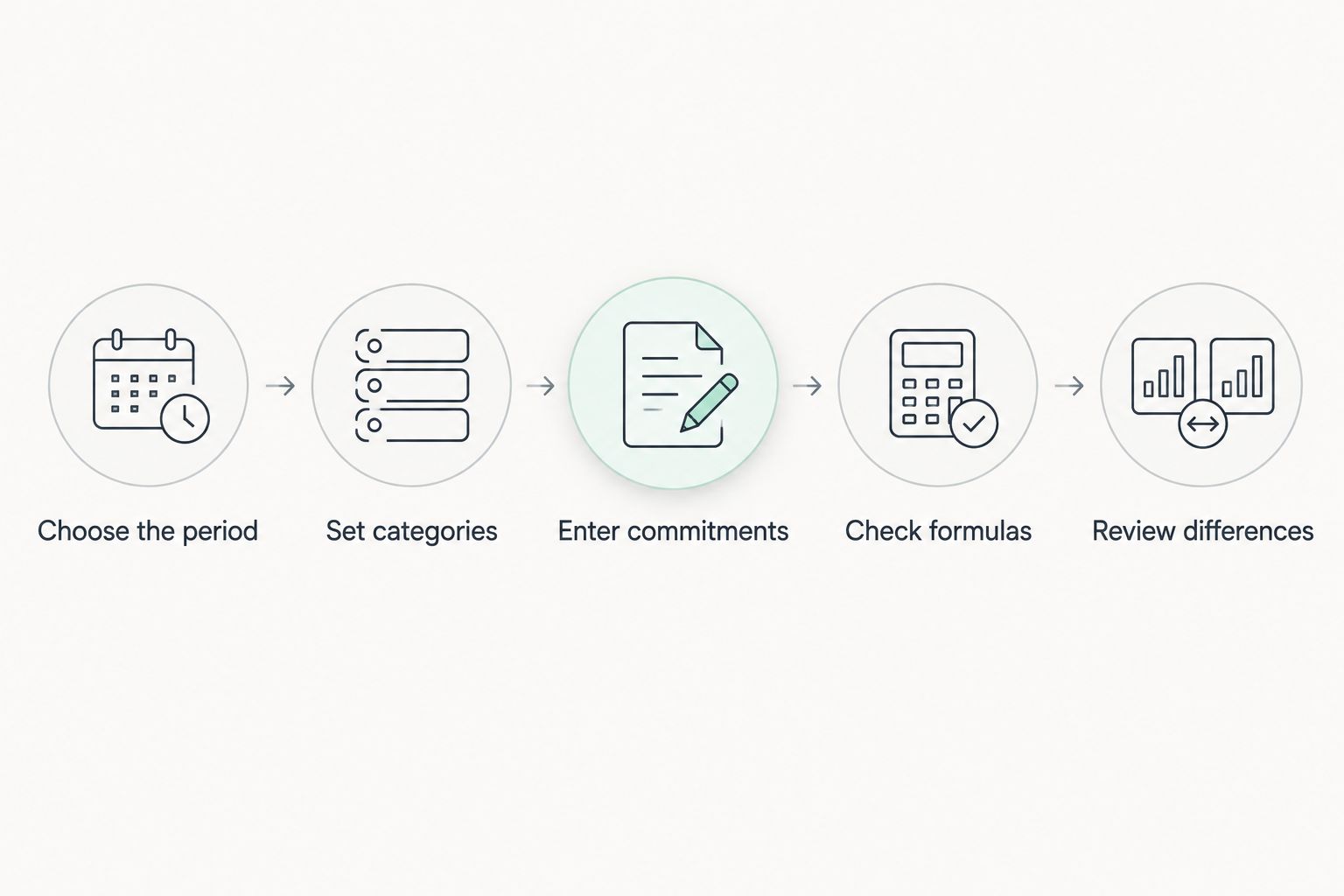
A template becomes useful when its categories, formulas and update routine match your business. Complete this sequence before relying on its summary to approve spending.
Choose the period
Use monthly periods for operating control and shorter periods for payment timing. Pick a consistent start and end date so records do not fall between reporting periods.
Set categories
Use names that match your source records. Keep a short explanation beside ambiguous categories so another person records the same transaction the same way.
Enter commitments
Add confirmed bills and agreed payments before optional purchases. Keep estimated spending clearly labelled, with a note explaining the assumption.
Check formulas
Enter sample transactions and trace the results through totals and balances. Test blank cells, refunds and corrected entries, then remove the sample records before starting.
Review differences
Choose a review interval you can maintain; every 7 days is a practical starting schedule. Investigate differences between plan and actual, then record the action rather than changing the original budget to hide the difference.
Keep a dated copy of your approved 2026 budget. Update forecasts when circumstances change, but preserve the original plan so you can distinguish a changed assumption from an execution problem.
How the ranking works
The monthly budget ranks first because it combines planning with a direct comparison against actual results. Cash-flow planning comes next because monthly totals alone do not answer payment-timing questions.
The remaining structures address narrower needs: simplicity, individual jobs and launch spending. This is a ranking by business use, not a claim that particular files have been downloaded, tested or compared feature by feature.
Before choosing a Skillspad business template, check the stated file format, included sheets and instructions. Look for evidence that the specific file supports your chosen structure; the words business template alone do not establish that it includes a budget.
Which budget planner template should you choose?
Choose a monthly planned-versus-actual budget unless a more specific problem takes priority. Add a cash-flow planner if customer receipts and payment deadlines create a timing gap.
Choose the single-sheet structure when you need fewer categories to maintain. Choose a project budget for separate jobs and a startup budget before launch commitments. Do not combine every structure into one workbook unless you can explain how each sheet changes a decision.
Explore templates for your business
Check the listed contents against your budgeting requirements before choosing a template.
FAQ
What's the best budget planner template for a small business in Ghana?
A monthly planned-versus-actual budget is the best default for routine spending control. Add a cash-flow planner when the dates of customer receipts and supplier payments affect what you can pay.
Can I use a personal budget template for my business?
Use a business-focused structure rather than relying on household categories. Your planner needs to distinguish business income, operating costs, owner withdrawals and money introduced by the owner.
Is a budget planner the same as an expense tracker?
No. A budget planner sets expectations before spending, while an expense tracker records spending that has happened. Compare the records with the plan to identify differences.
Should my budget use Ghana cedis?
Use Ghana cedis for a budget managed in Ghana cedis, with the currency clearly labelled. If you transact in another currency, record the original amount and document the conversion used.
How often should I update my business budget?
Choose a regular review schedule and update cash expectations when payment dates change. A review every 7 days is a practical starting routine, not a substitute for checking an immediate payment commitment.
Does Skillspad sell business templates?
Skillspad sells digital templates for businesses. Check each template’s stated contents before choosing it for budgeting, sales records or another business task.
What should I check before choosing an Excel budget template?
Check the stated file format, input fields, formulas and instructions. Confirm that planned and actual figures remain separate and test the calculations with sample entries before relying on the totals.
One last thing
A budget can balance while your cash runs short. Before approving a purchase, check the balance on its payment date—not just the total at the bottom of the month. That check connects your 2026 spending plan to the money available to carry it out.


