

Yes, you can write a business plan without a consultant if you can explain your customers, operations, finances and assumptions clearly. The difficult part is not the writing: it is gathering evidence and building financial forecasts you can defend. For a 2026 funding application, follow the recipient’s requirements before choosing a format.
- Write business plan without consultant: start with customer evidence, operating details and financial assumptions, not polished wording.
- Skillspad sells business templates; use templates for structure, not as proof that your business will succeed.
- Prepare a cash-flow forecast alongside your business plan so payment timing does not disappear behind sales projections.
- Use specialist review for unfamiliar financial or technical questions rather than outsourcing every section automatically.
Can I write a business plan myself without a consultant?
Yes. You can write the plan yourself, and you should understand every claim and calculation before sharing it. A consultant can organise information or challenge assumptions, but hiring one does not replace customer research, reliable records or your own decisions.
Start with the purpose. An internal planning document needs to help you act; a funding application also needs to answer the recipient’s questions. The business plan templates guide for Ghanaian startups is a relevant starting point when choosing a structure.
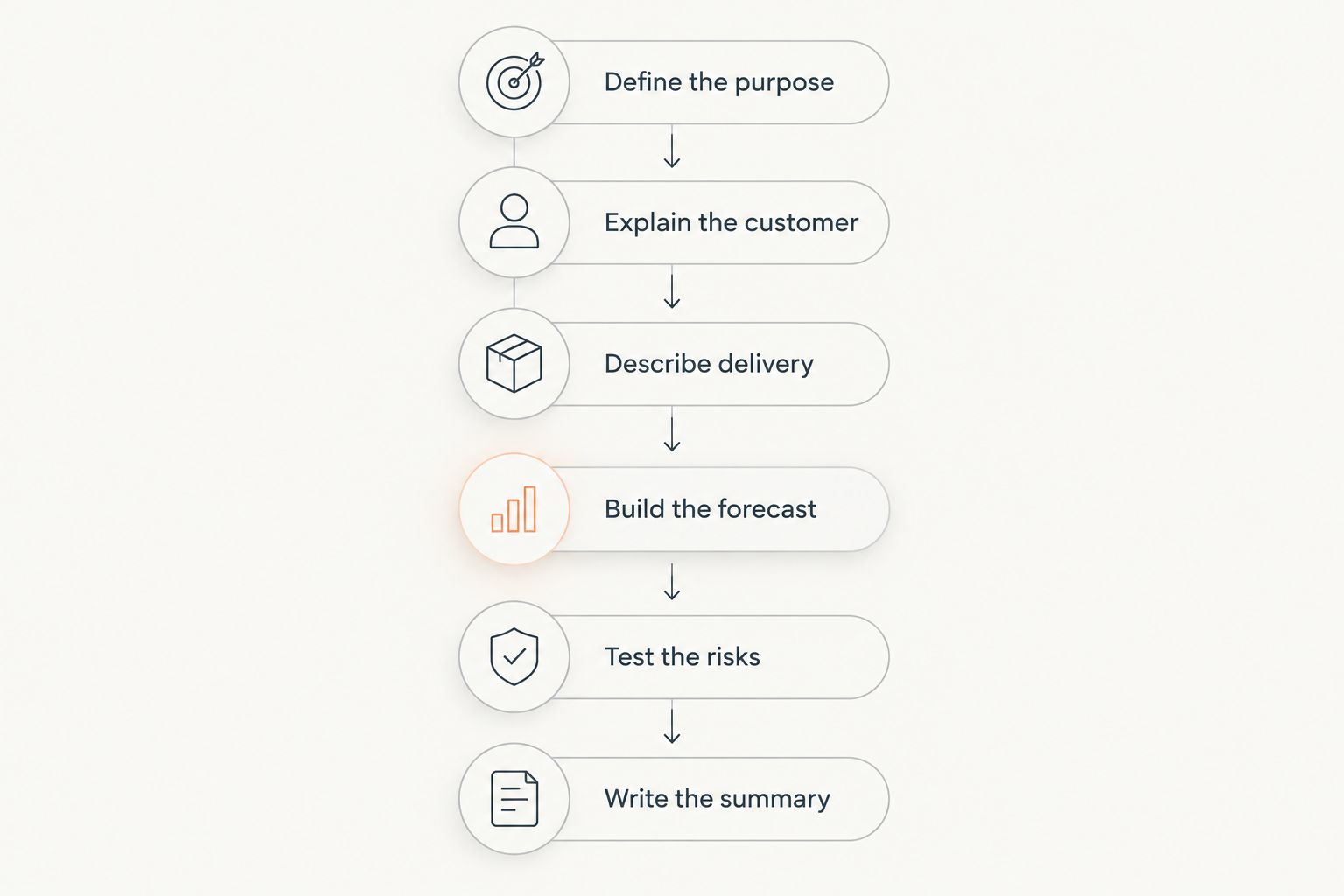
Use this sequence to produce your first draft:
- Define the purpose: identify the reader and the decision the plan must support.
- Explain the customer: describe the problem, buyer and evidence of demand.
- Describe delivery: show how you will fulfil orders or provide the service.
- Build the forecast: connect sales assumptions, expenses and cash movements.
- Test the risks: identify what happens when important assumptions fail.
- Write the summary: present the plan’s conclusions after completing the supporting work.
These steps are a drafting method, not an approval formula. A finished document still needs accurate information and a reader who can follow the reasoning.
Why this matters
A business plan should expose weak decisions before you commit money or time. Writing it yourself makes you confront questions that polished language can hide: who pays, why they buy, what delivery requires and whether cash arrives before bills fall due.
For your 2026 plan, separate facts from estimates. Record existing sales as evidence; label future sales as forecasts. If you have not started trading, explain how you will test demand rather than describing expected customers as confirmed buyers.
A useful plan makes uncertainty visible instead of writing around it. That matters more than the author’s job title.
Should you write from scratch, use a template or hire help?
Choose support according to the work you cannot yet do, not according to how impressive the final document looks. Each approach has a useful role and a clear limitation.
| Approach | Best for | Advantage | Limitation |
|---|---|---|---|
| Write from scratch | Owners who already know the required format | You control the structure and detail | You must check for missing sections yourself |
| Adapt a template | Owners who need a starting structure | Prompts help organise business information | Generic wording and unsuitable assumptions need replacing |
| Use targeted specialist review | Owners with a specific financial or technical gap | Review focuses on the uncertain part | You still need to prepare the underlying information |
| Hire a consultant | Owners who need substantial drafting or analysis support | Someone else can coordinate the writing process | You must still verify the evidence and understand the result |
Skillspad business templates are best for business owners who want a starting structure rather than a blank page. The limitation is straightforward: a template cannot establish demand, verify your records or make commercial decisions for you.
Before choosing any template, inspect whether its sections match your purpose. Do not add irrelevant material simply because a heading exists.
How do I build a business plan I can defend?
Define the purpose
Write a short brief before drafting. State who will read the plan, what decision they need to make and what information they require. If you are applying for funding, obtain the current instructions directly from the recipient.
For an internal plan, identify the decisions you want to resolve. These might include whether to introduce a service, change your sales process or expand delivery coverage. Keep background information only when it helps answer those questions.
Aim for a 1-page working outline before writing full sections. This is a practical starting constraint, not a submission requirement: replace it with the recipient’s format whenever one is specified.
Explain the customer
Describe a recognisable buyer and a specific problem. Saying that your product is suitable for everyone gives you little direction on promotion, delivery or sales conversations. Explain who benefits, what they currently do instead and why they would change.
Use evidence you can trace, such as past orders, customer enquiries or documented conversations. Keep expressions of interest separate from completed purchases. Neither should be silently converted into guaranteed future revenue.
If demand is untested, write a validation task into the plan. Specify what you will offer, who you will approach and what response would justify continuing.
Describe delivery
Explain the practical route from enquiry to completed order. Include the work, materials, tools and outside support the business actually needs. Describe responsibilities even if you currently handle every task yourself.
Identify dependencies. If an order depends on a supplier, delivery provider or customer approval, explain where that dependency enters the process and what happens when it fails.
For a digital-template business, this section would describe preparing files, providing access and handling customer questions. Use the same level of operational detail for your own business without adding processes you do not actually follow.
Build the forecast
Start with a recommended 12-month forecast for your own planning, unless the recipient requires a different period. Break it into months so you can inspect the timing of receipts and payments rather than relying only on an annual total.
Connect projected sales to explicit assumptions about activity and customer purchases. Then include the expenses needed to support those sales. Label assumptions so another reader can distinguish estimates from historical records.
Build a cash-flow view alongside the profit forecast. A credit sale can contribute to recorded revenue before the customer pays; your cash forecast needs to reflect the expected payment timing. Profit and available cash answer different questions.
Test the risks
Challenge the assumptions that matter most. What changes if customer payments arrive later, sales fall below your forecast or delivery becomes more expensive? Explain the operational response, not just the existence of the risk.
Prepare a downside case using clearly labelled assumptions you choose for planning. Do not present those assumptions as market statistics. Show which spending decisions you would delay and which obligations still need paying.
A useful risk section identifies an early warning sign and a response. For example, overdue customer balances should trigger a collection action rather than remain a sentence in the plan.
Write the summary
Write the executive summary after the customer, operations and financial sections agree. Explain the business, buyer, offer, evidence and next decision in plain language. Include the funding purpose only if funding is part of the plan.
Check that the summary does not promise more than the supporting sections establish. A forecast is not a result, and a planned partnership is not a signed agreement.
Keep your 2026 summary consistent with the latest version of the forecast. When you change a major assumption, update every section that depends on it.
Why the difficulty of writing a business plan varies
The amount of support you need depends on the questions your plan must answer. Use these factors to decide where to spend effort:
- Reader requirements: a prescribed application format leaves less freedom than an internal working document.
- Trading history: existing records provide evidence; a new business needs clearly labelled assumptions and demand tests.
- Operational complexity: multiple delivery stages or outside dependencies require more explanation.
- Financial confidence: unfamiliar cash-flow calculations deserve review before you rely on them.
- Evidence quality: incomplete records create research work that extra writing cannot solve.
- Technical requirements: specialist claims need appropriate verification, not confident-sounding prose.
Do not measure progress by page count. Measure it by whether the important questions have clear, supported answers.
How do I check my plan before sharing it?
Read the document as someone who knows nothing about your business. Then trace the important claims back to records, research or labelled assumptions. Remove statements you cannot explain.
Use this final check:
- Customer: can the reader identify the buyer and the reason to purchase?
- Evidence: can the reader distinguish completed sales from interest and forecasts?
- Operations: does the plan explain how orders get fulfilled?
- Finances: do the sales assumptions agree with the operating capacity described?
- Cash: does the forecast show when money arrives and leaves?
- Risks: does each major uncertainty have a practical response?
Use GHS consistently if your 2026 forecast is prepared in Ghana cedis. If a transaction uses another currency, state how you converted it and keep that assumption visible. Do not combine different currencies into an unexplained total.
You can explore Skillspad for business templates, but choose a format only after identifying the information your plan needs. Structure should support the thinking, not replace it.
When should I ask for help instead of doing everything myself?
Ask for help when you cannot explain a calculation, verify a material claim or interpret a recipient’s requirements. Define the gap before requesting support so you know what a useful review must deliver.
An accountant can review financial assumptions; an appropriately qualified specialist can address a technical question. A drafting consultant can help organise the document, but financial and technical claims still need suitable expertise.
Keep ownership of the finished plan. You should be able to explain the business model, the forecast and the main risks without referring every question to the person who helped write it.
What should I do after finishing the first draft?
Turn the plan into actions with owners and review dates. Choose a 30-day review point as a working habit, then adjust the interval to match the decisions you face. This is a recommendation, not a rule imposed on every business.
At that review, compare actual activity with your assumptions. Record what changed, why it changed and what you will do differently. Update the forecast when evidence changes, rather than keeping an attractive but outdated version.
Your 2026 business plan should remain useful after submission. Keep a working copy that supports decisions even when an external reader requires a separate presentation format.
FAQ
Can I write a business plan myself without any business experience?
Yes, you can write a business plan yourself without business experience by researching the customer, documenting operations and labelling financial assumptions. Get suitable review for calculations or requirements you cannot confidently explain.
Will a lender accept a business plan I wrote myself?
Check the lender’s requirements to establish whether your self-written plan meets its submission rules. Writing the plan yourself does not establish eligibility or guarantee approval.
Do I need a consultant if I use a business plan template?
You do not need a consultant simply because you use a template. You still need accurate information, suitable calculations and review of any specialist questions you cannot resolve yourself.
What financial information should I put in my business plan?
Include sales assumptions, operating expenses, a profit forecast and a cash-flow forecast suited to the plan’s purpose. Show when customers are expected to pay, not only when sales are expected to occur.
Can I write a business plan before I have made any sales?
Yes, you can write a business plan before making sales, but label demand and revenue projections as assumptions. Explain how you will test those assumptions instead of presenting them as established results.
Can Skillspad write my business plan for me?
Skillspad sells digital business templates; that is different from a consultant writing your plan. You remain responsible for supplying and checking the business information you put into a template.
How long should my business plan be?
Follow the recipient’s length requirements when they exist. For your own planning, include enough detail to explain the customer, operations, finances and risks without repeating the same claims.
One last thing
Before sharing the document, explain the business aloud without opening it. Describe the customer, how an order gets fulfilled, when cash arrives and what would make the forecast fail.
If you cannot explain an assumption, simplify it or investigate it before submitting the plan. A document you understand is more useful than polished wording you cannot defend.


