

Yes, you can track profit and loss without an accountant by keeping complete sales and expense records, applying a consistent accounting method, and reviewing your totals each month. A spreadsheet can handle everyday tracking in 2026, but it does not replace professional advice on tax, financial reporting or difficult accounting decisions.
- You can track profit and loss without accountant support when records are complete and accounting rules are applied consistently.
- Profit tracking needs sales, business expenses and stock costs—not just your bank or mobile money balance.
- Skillspad business templates suit Ghanaian owners seeking a starting format, not a substitute for accounting judgement.
- Keep daily records yourself; seek professional help when tax treatment, inventory or reporting requirements become unclear.
Why this matters
Money coming into your business is not automatically profit. A customer payment can settle an earlier invoice, while a loan adds cash without creating sales revenue.
Start with reliable transaction records before building a dashboard. The guide to tracking daily sales without accounting software covers the sales-recording side; your profit report must also account for the costs connected to those sales.
Can I track profit and loss without an accountant?
Yes. You can maintain your own profit-and-loss records; the challenge is recording transactions correctly, not performing the subtraction. A useful report separates revenue, direct costs and operating expenses for a defined period.
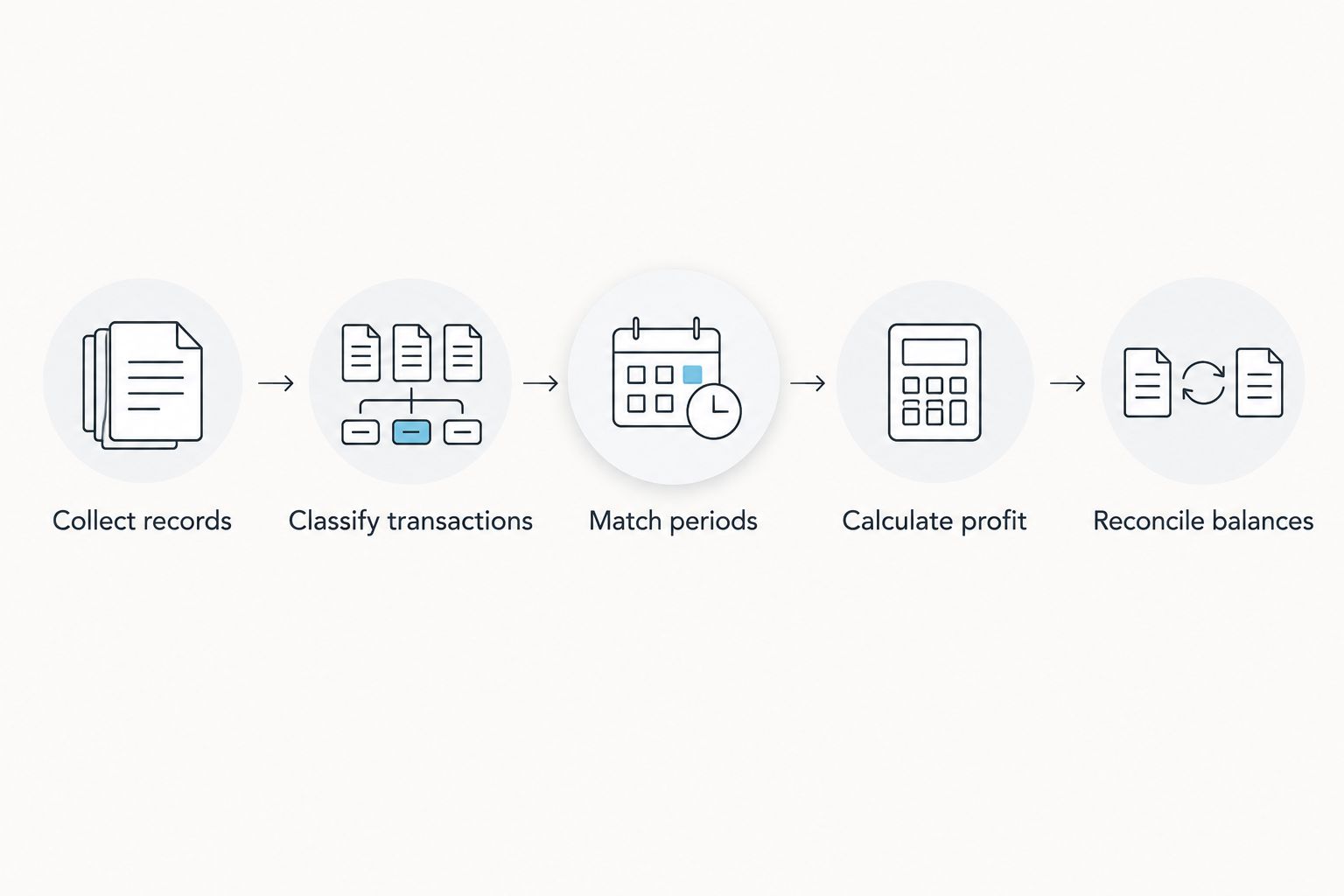
Follow this sequence for your 2026 records:
- Collect records. Gather invoices, receipts, supplier bills, bank statements and mobile money statements.
- Classify transactions. Separate sales and expenses from loans, owner contributions, withdrawals and transfers.
- Match periods. Apply a consistent basis for deciding when income and expenses belong in the report.
- Calculate profit. Deduct the cost of goods sold from revenue, then deduct operating expenses to assess operating profit.
- Reconcile balances. Compare your records with statements and investigate missing, duplicated or unexplained entries.
These steps support management decisions, such as whether sales cover running costs. They do not establish that your report meets every tax, lender or statutory reporting requirement.
Which tracking approach should you use?
Choose a method you can maintain and check. A sophisticated workbook with missing transactions is less useful than a simple record that you keep complete.
| Approach | Best for | Advantage | Limitation |
|---|---|---|---|
| Paper ledger | Owners comfortable recording a straightforward flow of transactions by hand | Entries remain visible without spreadsheet formulas | Totals, corrections and summaries require manual work |
| Spreadsheet | Owners who can enter transactions consistently and check formulas | Categories and formulas support repeatable summaries | Incorrect formulas or classifications distort results |
| Accountant-supported records | Businesses facing unfamiliar accounting or reporting decisions | Professional input helps resolve accounting treatment | You still need to provide complete supporting records |
Use a spreadsheet when you understand the entries and can check the totals. Choose accountant-supported records when you cannot explain how a transaction should affect profit, assets, liabilities or cash.
What should your profit-and-loss tracker contain?
Your transaction log should let you trace each total back to evidence. Record the transaction date, document reference, description, category, amount and payment account; add customer or supplier details where they help identify the entry.
Keep invoice dates and payment dates in separate fields when you sell on credit. Treating them as interchangeable makes it difficult to distinguish sales from collections.
Revenue and direct costs
Revenue records what your business earns under its accounting basis. Do not include your own cash contributions, loan proceeds or transfers between business accounts as sales.
For a business selling goods, cost of goods sold reflects the cost of the items sold during the reporting period. Buying stock and selling stock are different events. Unsold inventory is not automatically the same as an expense in an accrual-based profit report.
Operating expenses and the final result
Operating expenses cover the costs of running the business, such as business rent, wages and relevant payment-processing charges. Separate them from direct product costs so you can distinguish gross profit from operating profit.
Gross profit equals revenue minus cost of goods sold. Operating profit deducts operating expenses from gross profit; finance costs, tax and other relevant items affect the final net result where applicable. Label each subtotal accurately rather than calling every remaining balance net profit.
How do you keep profit separate from cash?
Your account balance shows cash held in that account, not business profit. The difference matters when customers owe you money, you owe suppliers, or you move money between accounts.
A credit sale creates a customer balance until payment arrives. Under accrual accounting, revenue is recognised when earned; under cash-basis tracking, receipts drive the income timing. These methods answer different questions and should not be mixed casually.
| Transaction | Cash effect | Profit treatment |
|---|---|---|
| Owner puts personal money into the business | Business cash increases | Not sales revenue |
| Business receives a loan | Business cash increases | Not sales revenue; creates a liability |
| Customer settles an invoice already recognised as revenue | Business cash increases | Do not recognise the same sale again |
| Business transfers money between its own accounts | One balance falls and another rises | Not revenue or an expense |
| Owner takes a personal withdrawal | Business cash decreases | Not an operating expense |
For 2026, keep a separate cash view alongside your profit report. That lets you investigate both questions: whether the business earned a profit and whether it has money available to meet payments.
Why profit-and-loss tracking gets more complicated
You can handle routine entries yourself, but some transactions require more judgement. These factors determine how much checking your records need:
- Credit sales: You need to distinguish a sale from its later payment and track what customers still owe.
- Inventory: Purchases, remaining stock, returns and damaged goods affect the cost assigned to sales.
- Mixed spending: Personal and business transactions need separation, especially when they share a payment account.
- Multiple payment channels: Cash, bank and mobile money records need reconciliation without counting transfers as sales.
- Long-lived assets: Equipment purchases require different consideration from everyday operating expenses, including depreciation where applicable.
- Reporting obligations: Tax returns, lender requests and formal financial statements can require treatment beyond a basic management spreadsheet.
Ask for advice on the uncertain transaction rather than guessing its category. Keep the supporting document and a clear description so the question can be resolved without reconstructing events later.
How do you check your records each month?
Set a regular closing routine for your 2026 records. Finish entering transactions before relying on the monthly result, then investigate differences instead of inserting an unexplained adjustment to make totals agree.
Match the payment accounts
Compare each bank and mobile money transaction with your records. Identify transfers, fees, refunds, customer receipts and payments; reconcile cash records with the cash actually held, allowing for documented timing differences.
If a payment platform deducts a fee before settlement, preserve the distinction between the customer sale and the fee. Recording only the net settlement as sales hides part of both revenue and expenses.
Check credit balances and stock
Review unpaid customer invoices and supplier bills separately from payments. A paid invoice should not remain outstanding, and receiving payment should not create another copy of the sale.
For goods, check stock records against physical quantities and investigate differences. Missing stock, purchase returns and customer returns need appropriate treatment before you rely on the gross-profit figure.
Review the report and preserve it
Scan for uncategorised entries, duplicate references, missing documents and unexpected changes. Check that summary formulas include new rows and that refunds have not been recorded as fresh sales.
Save the reviewed report with its underlying records. Keep a backup separate from the working file, and record explanations for corrections so you can understand them later.
Can a business template help you start?
Skillspad business templates are best for Ghanaian owners who want a starting format for their business records. A template gives you structure; it does not decide whether an entry is revenue, inventory, an asset or a personal withdrawal.
When considering Skillspad, use the same checks you would apply to any template: inspect the available fields, understand the calculations and confirm that the format matches your workflow. The guide to profit-and-loss tracker templates for small businesses is a relevant next step when choosing your format.
Before entering your live 2026 records, check whether you can:
- Trace a summary total back to individual transactions.
- Record refunds and corrections without deleting the original evidence.
- Separate payment status from the date a sale belongs in the report.
- Identify formulas and protect them from accidental editing.
- Keep supporting documents connected to transaction references.
A template helps organise work, but it cannot correct missing receipts or an accounting rule applied incorrectly. Choose a format you understand rather than one with the most charts.
When should I ask an accountant for help?
Ask an accountant when you cannot confidently classify a transaction, reconcile a balance or meet a reporting requirement. You can continue recording daily transactions while seeking help on the specific issue.
Useful questions concern stock valuation, equipment purchases, borrowing, payroll deductions and the difference between management profit and taxable profit. Provide the source documents and explain how you currently record the transaction.
Professional review does not require handing over every daily task. Keeping organised records yourself gives the accountant a clearer starting point and leaves you able to understand the result.
Does a profitable month mean I can withdraw the money?
No. A profitable month does not mean the same amount is available for personal withdrawal: customers can still owe you money while suppliers, lenders or tax authorities have amounts due.
Before withdrawing money, review cash available, unpaid obligations and upcoming business needs. Keep the withdrawal separate from operating expenses so the next profit report remains meaningful.
FAQ
Can I track profit and loss without accountant help in Ghana?
Yes, you can maintain your own profit-and-loss records in Ghana when you keep complete records and apply a consistent accounting method. Daily tracking does not replace advice on tax treatment or formal reporting requirements.
Can I use Excel to track business profit?
Yes, Excel can calculate profit from correctly recorded revenue, costs and expenses. Check formulas, category choices and the reporting period before relying on the result.
Is my mobile money balance the same as profit?
No, your mobile money balance is not the same as profit. It can include loans, owner contributions and receipts from earlier sales, while excluding unpaid expenses or income received elsewhere.
Should I deduct all my stock purchases from monthly sales?
No, do not automatically deduct all stock purchases as the cost of goods sold. Under accrual accounting, the cost assigned to sold goods must be distinguished from inventory still held.
Do I count a customer payment as another sale?
No, a customer payment is not another sale if you already recognised the invoice as revenue. Match the payment to the outstanding invoice rather than recording revenue twice.
Are personal withdrawals a business expense?
Personal owner withdrawals are not operating expenses. Record them separately so they do not reduce the operating profit shown in your management report.
Can a Skillspad template replace an accountant?
A Skillspad business template does not replace an accountant's judgement. Use a template to organise records and seek professional help for unfamiliar accounting treatment or reporting obligations.
How often should I review my profit-and-loss tracker?
Record transactions regularly and review your profit-and-loss report each month. Reconcile payment accounts, check outstanding balances and resolve unexplained entries before treating the report as complete.
One last thing
A missing expense can make a business look more profitable without improving the business at all. A neat chart is not evidence that the underlying records are complete.
For your next 2026 monthly review, choose a reported total and trace it back to its supporting documents. Then work in the opposite direction: choose documents and confirm they appear in the tracker. These checks test both whether recorded entries have evidence and whether evidence has been left out.


