

Best overall: a project-based business proposal template. Best for ongoing services: a retainer proposal. Best for a short, straightforward offer: a one-page proposal. This 2026 guide compares six proposal formats for small businesses in Ghana and explains which one fits the work you want to win.
- Choose a project-based business proposal template for work with defined deliverables, deadlines and acceptance criteria.
- Use a retainer proposal for recurring services and a supply proposal for goods orders.
- For Ghanaian small businesses, Skillspad sells digital business templates; check each template’s contents before choosing.
- Follow the buyer’s required format for tenders instead of substituting a general proposal.
A business proposal explains how you will solve a particular buyer’s problem. Skillspad sells digital business templates for businesses in Ghana; this guide ranks proposal structures by use case rather than presenting unverified product recommendations.
Why this matters
A buyer needs to understand what you will deliver, what the engagement includes and what happens after approval. An attractive document does not answer those questions by itself. Choose the structure before choosing the design.
The best business proposal template makes the buyer’s decision clear without hiding your responsibilities. For a Ghanaian small business preparing proposals in 2026, that means stating the currency, delivery location, payment terms and scope wherever they affect the agreement.
A proposal is also different from a business plan. A proposal addresses a specific customer or opportunity; a business plan explains how the wider business operates. Sending the wrong document leaves the buyer searching for an answer you have not provided.
What makes the best business proposal template?
Evaluate every template against these criteria before editing it:
- Buyer fit: The document addresses the buyer’s request rather than describing your business at length.
- Defined scope: Deliverables, exclusions and buyer responsibilities have separate spaces.
- Commercial clarity: The template accommodates your currency, payment schedule and relevant charges without ambiguous totals.
- Delivery logic: Milestones connect the work to review, delivery and acceptance.
- Editing control: You can change the text, tables and structure in a format you can actually use.
- Approval route: The buyer can see how to accept the offer, ask questions or request changes.
For your 2026 shortlist, reject a template that requires extensive rebuilding to explain your offer. A polished cover cannot compensate for missing scope or unclear terms.
Business proposal templates at a glance
These are document formats, not named products. Each recommendation serves a different buying situation.
| Rank and format | Best for | Standout feature | Key limitation |
|---|---|---|---|
| 1. Project-based proposal | Work with a defined endpoint | Connects deliverables to milestones and acceptance | Requires careful scope definition |
| 2. Retainer proposal | Recurring services | Defines the service period and recurring responsibilities | Needs explicit workload boundaries |
| 3. One-page proposal | A simple, narrow offer | Keeps the decision in a short document | Unsuitable for complex obligations |
| 4. Supply proposal | Goods supplied to a business | Organises specifications and delivery requirements | Needs precise product and logistics details |
| 5. Tender-response proposal | A formal procurement request | Maps the response to buyer requirements | Must follow the actual solicitation |
| 6. Partnership proposal | Joint projects between businesses | Separates contributions, responsibilities and outcomes | Requires negotiation beyond the document |
1. Project-based: best for defined deliverables
A project-based business proposal template describes a particular piece of work from agreement to completion. It separates the buyer’s objective from your deliverables, timeline and acceptance conditions. Choose it when you can describe what finished work looks like.
For example, a design engagement needs a clear list of outputs and a review process. The proposal should also explain which materials the buyer must provide before work starts.
Project-based proposal pros:
- Connects each deliverable to a recognisable outcome.
- Gives milestones a clear place in the agreement.
- Makes exclusions and change requests visible.
Project-based proposal cons:
- Vague deliverables still create a vague agreement.
- Additional requests need a separate approval process.
Best for: A defined assignment with a clear endpoint.
Verdict: Buy this format when you can specify the work, completion conditions and boundaries before starting. It is the default choice for an undecided reader, not a substitute for discussing the brief.
2. Retainer: best for recurring services
A retainer proposal describes services delivered over an agreed recurring period. Instead of treating every task as a separate project, it explains the ongoing arrangement, responsibilities and review process. Use it when the buyer needs continuing support.
For a 2026 service agreement, specify the reporting period, included activities and process for extra requests. Do not use an open-ended phrase such as unlimited support unless that is genuinely the agreement you intend to honour.
Retainer proposal pros:
- Sets expectations for recurring work.
- Separates routine services from additional assignments.
- Gives reporting and review meetings a defined place.
Retainer proposal cons:
- Unclear workload limits invite scope disputes.
- Renewal and cancellation arrangements need deliberate attention.
Best for: Recurring services with an agreed operating rhythm.
Verdict: Buy this format for continuing work; skip it for a single, self-contained assignment. Name the included work rather than relying on a broad service label.
3. One-page: best for a straightforward offer
A one-page business proposal template compresses the problem, solution, scope, commercial terms and next action into a short document. Choose it when the buyer already understands the context and the offer has few moving parts. Keep essential terms readable rather than shrinking the text to fit.
Treat 1 page as a recommended starting constraint, not a rule that overrides accuracy. Move to a longer format when the scope, dependencies or acceptance terms need more explanation.
One-page proposal pros:
- Makes the main decision easy to locate.
- Encourages specific, concise writing.
- Works as a summary of a straightforward discussion.
One-page proposal cons:
- Provides little room for technical specifications.
- Can hide important conditions if you compress too aggressively.
Best for: A narrow offer with limited dependencies.
Verdict: Buy this format only when the complete offer fits clearly. Skip it when brevity would leave the buyer guessing about your obligations.
4. Supply: best for business goods orders
A supply proposal explains the goods you intend to provide and the terms of delivery. It needs space for item descriptions, quantities, specifications, delivery arrangements and acceptance checks. Its job is to make the proposed order understandable before either party commits.
For a buyer in Ghana, identify the delivery location and agreed currency explicitly. State who handles transport and what happens when the buyer reports a discrepancy; do not leave those responsibilities buried in a general introduction.
Supply proposal pros:
- Keeps item details and quantities organised.
- Makes delivery responsibilities visible.
- Supports a clear inspection or acceptance process.
Supply proposal cons:
- Incomplete specifications leave room for disagreement.
- A proposal does not replace the documents required for fulfilment.
Best for: Businesses proposing to supply identifiable goods.
Verdict: Buy this format for goods orders, not as a default for professional services. Check that the item table accommodates the details your buyer actually needs.
5. Tender response: best for formal procurement
A tender-response proposal answers a buyer’s published procurement requirements. The solicitation determines the structure, submission method and supporting documents. A general template is useful only where it fits those instructions.
For any tender you pursue in 2026, read the actual request before drafting. Build a checklist from that request, then connect each requirement to its response and supporting evidence.
Tender-response proposal pros:
- Organises answers around stated buyer requirements.
- Keeps supporting documents connected to the response.
- Helps separate mandatory items from optional explanation.
Tender-response proposal cons:
- A generic layout can conflict with submission instructions.
- The document cannot replace missing qualifications or evidence.
Best for: An opportunity with formal procurement instructions.
Verdict: Hold any template purchase until you have read the solicitation. Use the buyer’s mandatory forms wherever required, and adapt only the parts you are allowed to change.
6. Partnership: best for shared business initiatives
A partnership proposal explains what each business contributes to a joint activity. It describes the shared objective, individual responsibilities, decision-making process and intended outcomes. Use it when both parties are contributing to the work rather than one simply buying from the other.
Separate the proposed collaboration from the final agreement. A proposal starts the commercial discussion; it should not imply that unresolved ownership, payment or exit terms have already been settled.
Partnership proposal pros:
- Makes each party’s contribution visible.
- Creates a place to discuss responsibilities and decisions.
- Keeps the shared objective separate from individual benefits.
Partnership proposal cons:
- Shared goals do not resolve conflicting expectations.
- Ownership and exit terms can require professional advice.
Best for: A joint initiative involving contributions from both businesses.
Verdict: Buy this format to structure a collaboration discussion. Skip it when the relationship is simply a customer purchasing a defined service or order.
How to adapt your chosen template
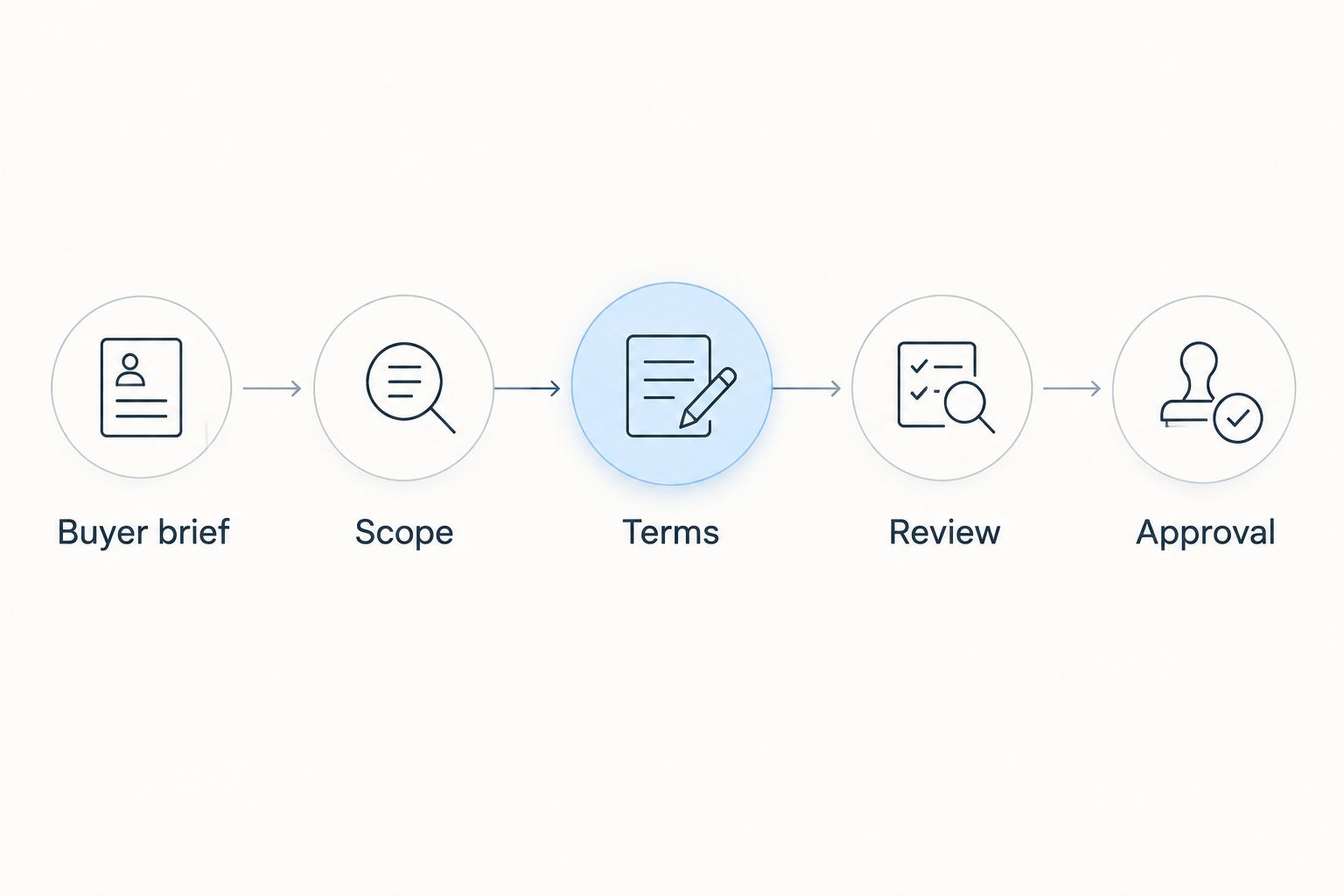
Use this sequence before sending your first proposal. The recommendation is to make the document buyer-specific, not merely replace the company name on its cover.
Buyer brief
Write the buyer’s objective in plain language. Identify the problem, intended outcome and decision-maker. Remove claims about the buyer that you cannot confirm.
Scope
List the deliverables and exclusions separately. As a practical drafting exercise, start with 3 deliverables and describe how each will be recognised as complete; add or remove items to match the actual assignment.
Terms
Specify the currency, payment conditions and buyer responsibilities. For your 2026 documents, check that copied wording has not carried over an unrelated client’s terms or an obsolete date.
Review
Read the document as if you were the buyer. Check every attachment reference, calculation and name. Use 2 review passes as a working routine: one for the offer itself and one for document accuracy.
Approval
End with an explicit next action. Explain how the buyer should accept, request a revision or raise a question, and identify the version being discussed.
Keep your reusable master separate from each customer’s proposal. That prevents an edit for one buyer from silently changing the starting document for the next.
How we ranked these formats
The ranking uses buyer fit, scope clarity, commercial clarity, delivery logic, editing control and approval route. These are structural recommendations, not scores from product testing or claims about conversion performance.
Project-based proposals come first because they provide a direct structure for defined work. The other formats win within their own situations. When considering Skillspad business templates, assess the actual template against these criteria rather than assuming every business document serves the same purpose.
Which business proposal template should you choose?
Choose a project-based proposal unless your buying situation clearly calls for another format. Switch to a retainer for recurring services, a supply proposal for goods or the required tender response for formal procurement.
Use a one-page version only when it preserves the full offer. Choose a partnership proposal when responsibilities run in both directions. For your next proposal in 2026, clarity about the transaction matters more than decorative complexity.
FAQ
What's the best business proposal template for a small business in Ghana?
A project-based business proposal template is the best default for a defined assignment. Choose a different structure when you are proposing recurring services, supplying goods or responding to formal procurement instructions.
What should I include in a business proposal?
Include the buyer’s objective, proposed solution, deliverables, exclusions, timeline, commercial terms and approval process. Add specifications, supporting evidence or responsibilities where the assignment requires them.
Is a business proposal the same as a business plan?
No. A business proposal addresses a particular buyer or opportunity, while a business plan explains how the wider business will operate. Choose the document that answers the recipient’s request.
Can I send a one-page proposal to a client?
Yes, when the offer is simple enough to explain completely on one page. Use a longer document when essential scope, specifications or terms would otherwise be omitted.
Should a proposal for a Ghanaian client use Ghana cedis?
Use the currency agreed with the buyer and identify it clearly. Do not assume that the client’s location alone establishes the currency for the transaction.
Can I use a general template for a tender?
Use a general template only where it complies with the tender instructions. Required forms, supporting documents and submission rules take priority over your preferred layout.
How do I choose a digital proposal template before buying?
Check the section list, editable file format and any stated usage terms before choosing. Confirm that you can explain your actual scope and approval process without rebuilding the document.
One last thing
Write the exclusions before polishing the introduction. If you cannot say what the offer leaves out, the scope is not finished. A useful template makes that boundary visible instead of encouraging you to hide it beneath persuasive language.


