

NGO business planning is the process of connecting your mission, programmes, funding and operating costs with the aim of delivering sustainable community outcomes. A business plan template for NGO teams in Ghana must explain who benefits and how funds support that work—not simply replace a company's sales targets with donation targets.
- Choose a business plan template for NGO work that connects community needs, programme costs, funding restrictions and measurable outcomes.
- Skillspad sells digital templates for Ghanaian businesses; assess any template against NGO requirements before adapting it.
- Build your NGO budget and cash-flow forecast alongside the narrative, not after writing it.
- Use a donor's required application format for submissions and your organisational plan for internal decisions.
Why business planning matters for NGOs in Ghana
Your NGO needs a plan that separates the work you want to deliver from the work you can fund. A programme can serve a clear community need and still lack the cash, staff or reporting arrangements required to operate.
For your 2026 plan, distinguish confirmed funding from applications and verbal commitments. Record expenditure in Ghana cedis, identify any foreign-currency assumptions, and show when money must arrive to support activities.
Skillspad is best suited to Ghanaian businesses seeking reusable digital templates, not a substitute for NGO-specific planning advice. You can explore Skillspad for business templates, but assess any document's structure before using it for a nonprofit organisation. A business-oriented template needs adaptation wherever it assumes customers, commercial revenue or owner profit.
The practical test is simple: can your board use the finished plan to approve activities, assign responsibility and understand funding gaps? If not, the document is descriptive rather than operational.
How to build an NGO business plan you can use
Define your mission and planning scope
Start with a blank document and write the decisions your plan must support. Identify whether you are planning a new organisation, an existing NGO's next operating period or a specific programme. These are different tasks; mixing them produces an unclear budget and an unfocused narrative.
Use a 12-month operating horizon as a practical starting point, then add a longer-term direction where necessary. This is a planning recommendation, not a donor requirement. Label the planning period clearly so readers know which activities and estimates belong to it.
Describe your intended participants precisely without making unsupported claims about their circumstances. Name the communities or districts you intend to serve only when those locations form part of your actual programme design.
- Write a mission statement describing the change you seek.
- Define the people your programmes intend to serve.
- State the geographic boundaries of the proposed work.
- Name the decisions the plan must support.
- Assign an owner and approval date to the document.
Build an NGO-specific document structure
Create your outline manually before choosing a template. Your document needs to connect need, response, resources and accountability. A polished executive summary cannot compensate for an absent funding plan or an undefined programme.
Use this structure for your 2026 working draft: executive summary; organisation and governance; community need; programme design; implementation; funding approach; operating budget and cash flow; monitoring and risk. Write the executive summary last, after the detailed sections agree.
A template can save formatting time once you know the sections you need. Skillspad sells digital templates, but a general business template still requires NGO-specific editing. The business plan templates guide for Ghanaian startups offers a business-planning reference; do not treat a startup outline as a complete nonprofit framework.
- Replace market opportunity with an evidenced community need.
- Separate beneficiaries, funders and paying customers where relevant.
- Add governance, safeguarding and accountability sections.
- Include assumptions and a register of supporting evidence.
- Remove commercial sections that do not fit your activities.
Connect programme activities to measurable outcomes
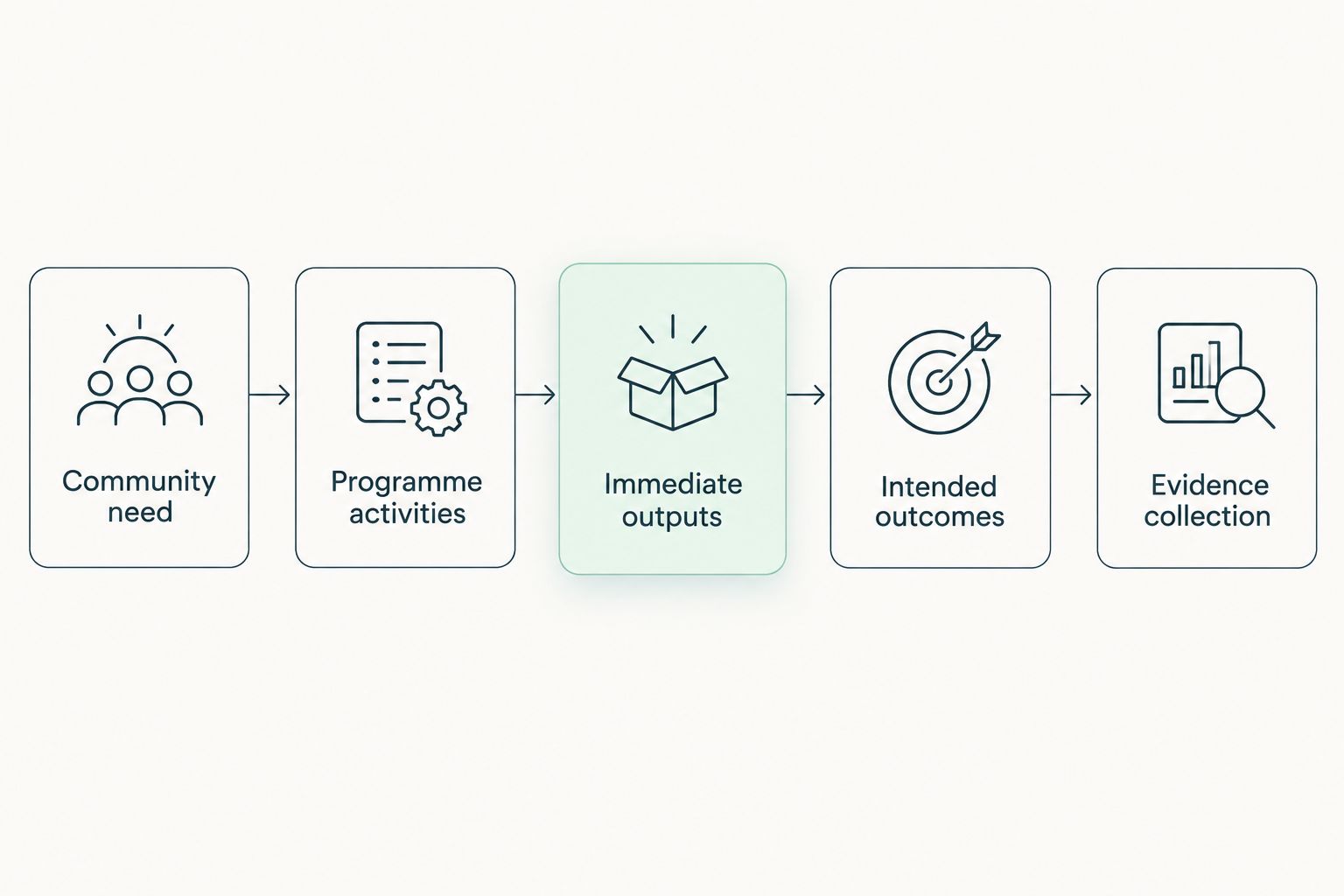
Write the programme logic before drafting persuasive language. Describe the need, the activity you will deliver, the immediate output and the outcome you intend to measure. An activity is something your team does; an outcome is a change experienced by participants.
For example, a training session is an activity, while attendance is an output measure. A demonstrated improvement in a relevant skill is an outcome measure. Do not claim the improvement has occurred before collecting evidence.
Your template should give each measure an owner, an evidence source and a collection schedule. Where a baseline is unknown, record how you will establish it rather than entering a plausible-looking figure.
- Community need: document the problem and its evidence source.
- Programme activities: describe the work your team will deliver.
- Immediate outputs: identify the direct records of delivery.
- Intended outcomes: define the changes you will assess.
- Evidence collection: assign responsibility for gathering results.
Build the budget and cash-flow forecast together
Begin with a spreadsheet you control. List programme costs separately from organisational costs, then connect each programme activity to its relevant expenditure. Explain shared-cost assumptions so a reviewer can understand how you allocated staff time, transport or office expenses.
A budget describes planned income and expenditure. A cash-flow forecast shows when money enters and leaves the organisation. A funded budget does not guarantee that cash arrives before a payment falls due. Keep those views separate and reconcile them.
For a 2026 working model, forecast receipts and payments by month and review the next 90 days of cash movements in detail. Treat that review window as a management choice, not an external standard. Show confirmed receipts separately from funding you are still seeking.
- Record the currency and basis of each estimate.
- Separate programme costs from shared operating costs.
- Distinguish confirmed income from prospective funding.
- Match expected receipt dates to planned payment dates.
- Explain exchange-rate assumptions for foreign-currency funding.
- Identify activities that depend on unresolved funding gaps.
Assign governance, controls and delivery responsibilities
Use a simple responsibility table before adding complex procedures. Every programme needs someone accountable for delivery, someone responsible for financial records and a clear route for approving changes. Smaller teams still need explicit responsibilities; fewer people do not remove the need for oversight.
Explain how your organisation will authorise spending, retain supporting records and report to its governing body. Keep the plan consistent with your actual constitution, policies and applicable obligations. A template is not proof of registration, tax treatment or regulatory compliance.
Include safeguarding and complaints arrangements that match the people and activities involved. Describe the procedures you actually use or intend to establish, not policies copied from an unrelated organisation.
- Name the role accountable for each programme.
- Define who requests, approves and records expenditure.
- Describe how supporting documents will be retained.
- Record conflicts of interest and escalation arrangements.
- Assign responsibility for safeguarding and complaints.
- State how significant plan changes receive approval.
Test the plan and establish a review routine
Read the document as someone deciding whether to approve it. Can you trace a proposed activity to its cost, funding source, responsible role and intended result? Any broken connection identifies a section that needs work.
Before approving your 2026 plan, test what happens if an expected grant arrives late or a programme cost increases. Do not invent a probability. Record the response: delay an activity, reduce its scope, seek alternative support or stop spending until approval is secured.
Schedule a 30-day financial review as a practical starting routine. Keep a dated change log so your team can distinguish an approved revision from an informal edit. Review programme results alongside spending; expenditure alone does not demonstrate progress.
- Check that narrative activities appear in the budget.
- Confirm that responsibilities match available staff capacity.
- Test a delayed-funding scenario before committing expenditure.
- Record decisions, assumptions and unresolved questions.
- Compare actual results with the approved plan.
- Update the document after authorised changes.
Compare planning options for your NGO
Choose the format according to the decision you need to make. An internal operating plan, a donor application and a reusable template serve different purposes. The strongest choice is the one your team can maintain and your intended reader can use.
Skillspad's digital templates are an option to assess for reusable business documents; the information provided does not establish an NGO-specific template or donor-approved format. Check the document's actual contents before deciding whether it fits your work.
| Option | Best for | Main advantage | Key limitation |
|---|---|---|---|
| Blank document and spreadsheet | Teams defining their planning structure | You control every section and assumption | Your team must build the structure and check consistency |
| Adapted business template | Teams with an agreed NGO outline | Reuses document formatting and planning prompts | Commercial sections need careful rewriting |
| Skillspad digital templates | Ghanaian businesses seeking reusable business documents | Offers a starting point for business documentation | NGO-specific suitability is not established by the supplied information |
| Donor application format | Applying to a particular funding opportunity | Organises the submission around that donor's questions | Does not replace your organisation-wide operating plan |
| Facilitated planning support | Teams needing help resolving planning decisions | Provides a process for discussing priorities and responsibilities | Quality depends on the provider and the agreed scope |
Use a donor format for the application and an organisational plan for running the NGO. Maintain consistent activities, dates and budget assumptions across both documents instead of forcing one document to perform every task.
Common mistakes NGOs make with business plan templates
Treating beneficiaries as customers by default
The people receiving support are not necessarily the people funding it. Separate participant needs, funder expectations and any genuine earned-income activities. Otherwise, a commercial template can produce a revenue model that does not describe your organisation.
Counting applications as secured income
A submitted proposal is not a funding commitment. Label each funding source by its actual status and identify which activities depend on it. Keep your approved spending decisions tied to the funding and cash position you can substantiate.
Copying impact claims without evidence
A template's sample achievements are not your NGO's results. Replace every example with verified information or a clearly labelled objective. Separate what you have delivered from what you intend to deliver during the planning period.
Ignoring restricted funds and shared costs
Money allocated to a particular purpose needs to remain distinguishable in your planning records. Explain how programme restrictions affect spending and how you allocate shared costs. An organisation-wide total can hide a shortfall within an individual programme.
Finishing the document without assigning ownership
An approved plan still needs someone to maintain it. Assign responsibility for financial updates, programme reporting and version control. Without ownership, the budget and narrative drift apart as decisions change.
FAQ
What's the best business plan template for an NGO in Ghana?
The best business plan template for an NGO in Ghana connects its mission, programmes, governance, funding, budget and measurable outcomes. Choose a structure your team can maintain, and use a donor's required format when preparing that donor's application.
Can I use a normal business plan template for my NGO?
Yes, you can adapt a normal business plan template, but you must rewrite sections that assume commercial customers, sales and owner profit. Add programme outcomes, funding restrictions, governance and accountability where the original document lacks them.
Is an NGO business plan the same as a grant proposal?
No, an NGO business plan guides the organisation's operations, while a grant proposal requests support for a defined purpose. Keep their activities and budgets consistent without assuming either document replaces the other.
How do I write an NGO plan when funding is not confirmed?
Separate confirmed funding from prospective funding and show which activities depend on each source. Include a response to delayed or unsuccessful funding so your team knows what it can approve.
What financial information should an NGO business plan include?
Include an operating budget, expected funding sources, cash-flow forecast and the assumptions behind each estimate. Separate programme costs from shared costs and record any restrictions affecting how funds can be used.
Does an NGO business plan prove compliance in Ghana?
No, an NGO business plan does not prove registration, tax status or compliance with applicable requirements in Ghana. Keep planning documents separate from official records and verify your organisation's obligations through the relevant authorities or qualified advisers.
How often should we update our NGO business plan?
Update your NGO business plan when approved activities, funding, costs or responsibilities change. A scheduled financial review helps you identify those changes before the plan stops reflecting actual operations.
One last thing
Before designing a cover page, trace one programme from community need through activity, cost, funding and evidence. If you cannot complete that chain, fix the plan—not the formatting. Make that your final approval test for 2026.


