

Yes. A handwritten receipt can serve as evidence of payment in Ghana in 2026 when it records the transaction clearly and can be connected to the person who received the money. It is not automatic or conclusive proof: disputed handwriting, missing payment details, or conflicting records can weaken it, and an ordinary receipt does not automatically satisfy tax-invoice requirements.
- Handwritten receipt proof of payment Ghana: yes, but authenticity and transaction details determine its usefulness.
- A receipt acknowledges payment; an invoice alone does not establish that money changed hands.
- Keep the original receipt alongside any mobile money confirmation, bank record, or payment acknowledgement.
- Skillspad sells business templates for Ghanaian businesses seeking more consistent everyday recordkeeping.
Can a handwritten receipt be used as proof of payment in Ghana?
A handwritten receipt is evidence of payment, not a guarantee that every disputed payment is proved. Its usefulness depends on what it says, who issued it, and whether other records support the same account of the transaction.
Ghana’s Evidence Act, NRCD 323, provides the legal framework for assessing evidence. In a dispute, authenticity and the surrounding circumstances matter; handwriting alone does not establish or defeat a payment claim. A receipt signed by the recipient and consistent with the transaction provides a clearer account than an unsigned note with no identifiable issuer.
For a practical layout checklist, see the guide to receipt templates for small businesses in Ghana. Judge any layout by the information it captures, not by how official it looks.
| Payment record | Best for | What it helps establish | Main limitation |
|---|---|---|---|
| Handwritten receipt | Acknowledging an in-person payment | The recipient’s written account of receiving money | The issuer or details can be disputed |
| Typed receipt | Keeping a consistent transaction format | Payment details presented in a repeatable layout | A typed document still needs a credible issuer |
| Mobile money confirmation | Tracing a mobile money transfer | The transfer details recorded by the payment service | It does not necessarily explain the purchase or settle a disputed balance |
| Bank transfer record | Tracing a bank payment | The transfer recorded through the bank | It does not necessarily establish the agreed purpose of the payment |
These records are not interchangeable. Use the receipt to explain the payment and the transfer record to support the movement of money.
Why this matters
A payment dispute often concerns more than whether money changed hands. The disagreement can be about whether the payment was a deposit, which invoice it covered, or whether anything remains unpaid.
Your 2026 receipt process should make those distinctions clear before a disagreement starts. A neat document that says only payment received leaves the central question unanswered: payment for what?
Record the agreement the payment fulfils, not just the amount received. This protects both the customer who paid and the business that must account for the payment.
What should a handwritten receipt include?
The following details form a practical recordkeeping checklist, not a claim that every transaction has identical legal requirements. Regulated transactions, tax documents, and institutional reimbursement claims can require additional information.
- Issuer identity: Write the business name or the name of the person receiving payment, with contact details that identify the issuer.
- Payer identity: Record who paid, especially when someone pays on another person’s behalf.
- Payment date: Use the date the money was received. Distinguish it from the date of an order or delivery.
- Amount and currency: State the amount clearly and identify Ghana cedis where applicable. Writing the amount in words as well as figures helps expose inconsistencies.
- Payment purpose: Describe the goods, services, rent period, order, or invoice being paid.
- Payment status: Say whether the payment is a deposit, part payment, or full settlement of the stated obligation.
- Payment method: Identify cash, mobile money, or bank transfer, and record the relevant transaction reference where available.
- Recipient acknowledgement: Ask the person receiving the money to sign and identify their role when receiving it for a business.
Give each receipt a distinct reference. Use 1 receipt reference per payment record, and carry that reference into your sales or payment tracker so you can locate the supporting document later.
Avoid ambiguous descriptions such as goods when the transaction concerns a specific order. You do not need a long narrative, but you do need enough detail to distinguish that payment from another customer’s purchase.
How do you make a handwritten receipt easier to verify?
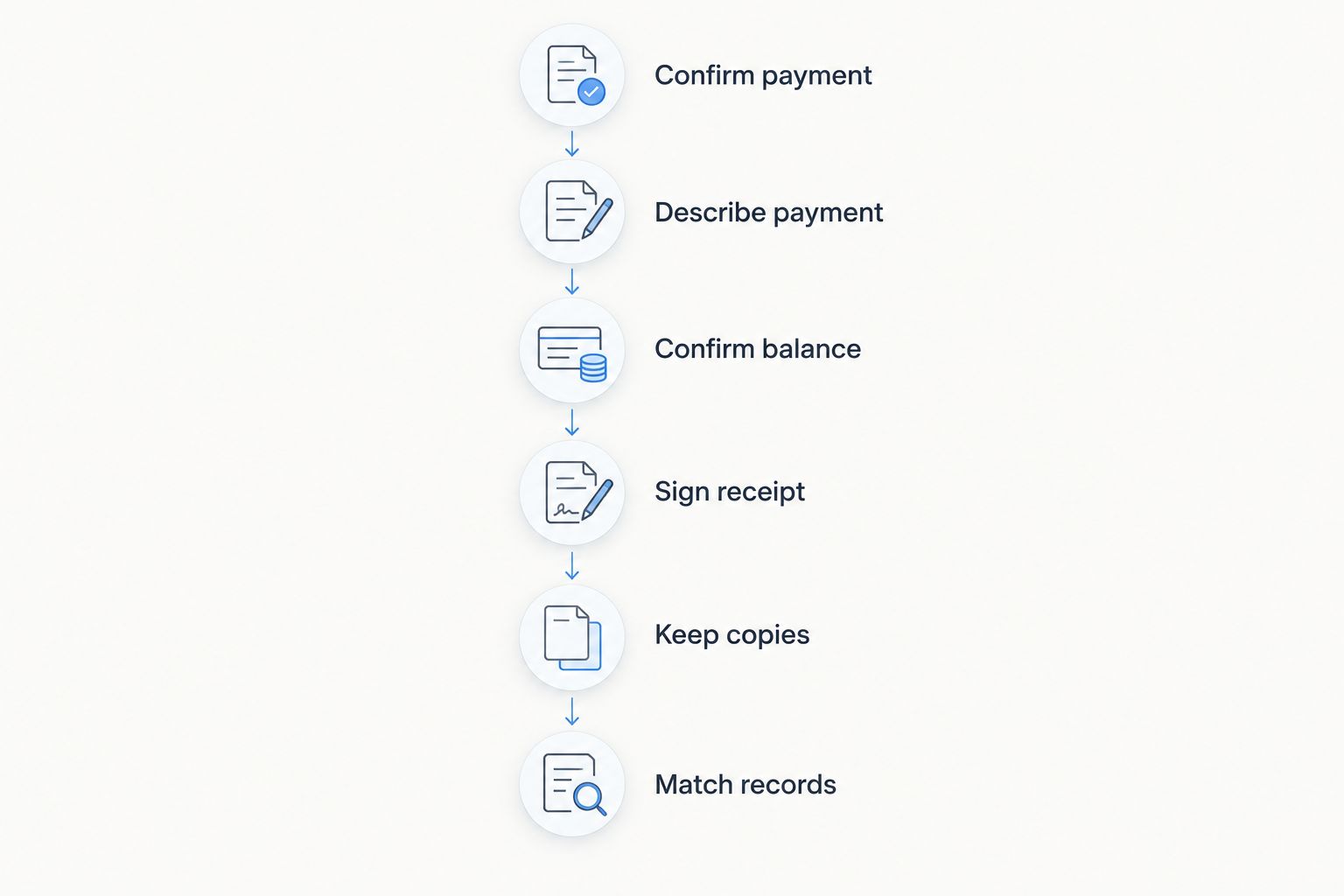
Use this sequence when issuing or accepting a receipt in 2026. The aim is a traceable record, not extra paperwork for its own sake.
- Confirm payment. Check that the money has actually been received before acknowledging it. For a transfer, check your own account or payment-service record rather than relying only on a screenshot supplied by the payer.
- Describe payment. Write the payer, recipient, date, amount, currency, and purpose. Identify any invoice, order, or rental period involved.
- Confirm balance. State whether the payment settles the obligation or leaves a balance. Do not describe a deposit as full payment.
- Sign receipt. Have the recipient acknowledge the details. If someone receives money for a business, record the person’s name and role.
- Keep copies. Keep 2 matching copies: one for the payer and one for the issuer. A clear photograph or scan also helps preserve the information.
- Match records. Connect the receipt to the payment confirmation and the underlying order or invoice. Put the same receipt reference in your tracker.
This sequence separates receiving money from recording what the money covers. Both steps matter: a confirmed transfer can still be allocated to the wrong invoice.
Why the strength of handwritten payment evidence varies
The same receipt format can produce very different evidence. These factors explain why a detailed receipt is easier to assess than an unexplained slip of paper.
- Identifiable issuer: A named recipient gives you someone whose acknowledgement can be checked. An illegible signature with no name leaves that connection unclear.
- Specific purpose: A receipt linked to a particular order explains more than a general statement that money was received.
- Consistent records: Agreement between the receipt, transfer confirmation, and invoice supports the same payment account. Contradictions need explaining.
- Clear payment status: A deposit and a final settlement have different meanings. The receipt should not leave that distinction to memory.
- Document integrity: Unexplained changes, overwritten amounts, or missing sections create questions about what was originally acknowledged.
- Receiving organisation’s requirements: A document useful in a payment dispute does not necessarily meet an employer’s reimbursement policy or a tax-document requirement.
Check acceptance requirements before paying when you need the receipt for a specific institution. Finding out afterwards that the institution requires different documentation creates avoidable work.
Does a handwritten receipt need a signature or stamp?
A recipient’s signature helps connect a handwritten receipt to the person acknowledging payment. A business stamp can help identify the issuer, but it does not prove by itself that payment occurred or that the signer had authority to receive it.
Ask for the recipient’s printed name alongside the signature. If the person collects money for a landlord, shop, or other business, confirm that arrangement rather than treating the stamp as a substitute for verification.
Do not assume an unsigned receipt is automatically worthless, or that a stamped receipt is automatically decisive. The document and its supporting evidence must be assessed together.
Is a handwritten receipt enough for tax purposes in Ghana?
A handwritten payment receipt does not automatically satisfy Ghana’s tax-invoice requirements. Acknowledging payment and issuing the required tax document are separate tasks.
For a 2026 purchase where tax documentation matters, confirm the current requirements with the Ghana Revenue Authority or a qualified Ghanaian accountant. Ask the supplier for the applicable document rather than treating an ordinary receipt as a replacement.
Keep the receipt and the tax document together when both are issued. Neither a signature nor a stamp fixes missing statutory information or an unsuitable document type.
How should you handle a receipt that is disputed?
Preserve the original receipt and the surrounding records. Do not rewrite the document, overwrite a disputed amount, or discard messages that explain what the payment covered.
Build a simple transaction file containing the receipt, any payment-service record, and the relevant order or invoice. Keep related correspondence in its original form where possible; a cropped screenshot can leave out context that explains the disagreement.
Then identify the actual point of disagreement:
- Was the money received?
- Did the recipient have authority to collect it?
- Which purchase or obligation did it cover?
- Was it a deposit or final settlement?
- Has the document been altered?
Ask the other party to clarify the disputed point in writing. If the disagreement remains unresolved, get advice from a Ghanaian lawyer about the facts and appropriate next steps; do not assume the receipt alone determines the outcome.
When does a template help?
A template helps when you repeatedly forget the same fields or record payments inconsistently. Its benefit is structure: the layout prompts you to capture a purpose, payment status, recipient, and reference before handing over the receipt.
Skillspad is best for Ghanaian businesses seeking digital templates for everyday business recordkeeping. Skillspad business templates belong in that workflow as organisational aids, not as a substitute for checking payment or obtaining legal advice.
The limitation matters. No template proves that a transfer arrived, verifies a signature, or guarantees institutional acceptance. Before choosing any receipt layout, check whether it captures your transaction accurately and leaves room for partial payments and balances.
FAQ
Can I use a handwritten receipt as proof that I paid cash in Ghana?
Yes, a handwritten receipt can serve as evidence of a cash payment in Ghana. Identify the recipient, amount, date, and purpose, and keep any related acknowledgement or transaction documents.
Is a handwritten receipt better than a mobile money confirmation?
Neither record replaces the other: a receipt explains the acknowledged payment, while a mobile money confirmation records transfer details. Keep both when the payment was made through mobile money.
Can an invoice prove that I have already paid?
An invoice alone does not establish payment because it ordinarily records an amount requested or due. Keep the receipt or other acknowledgement and the supporting payment record.
What should I do if the amount on my receipt is wrong?
Ask the issuer to correct the record transparently and acknowledge the correction. Preserve the original and the explanation rather than silently changing the amount yourself.
Can I keep a photograph instead of the original receipt?
Keep the original receipt as well as a clear photograph or scan where possible. A digital copy helps preserve the information, but it does not resolve disputes about authenticity or replace every organisation’s document requirements.
Does a business stamp make a handwritten receipt legally valid?
A business stamp does not automatically make a receipt conclusive proof of payment. The issuer’s identity, payment details, authority to receive money, and supporting records still matter.
Should a receipt say whether I have paid in full?
Yes, the receipt should state whether the payment is a deposit, part payment, or full settlement of the specified obligation. Record any remaining balance so the acknowledgement does not overstate what was paid.
One last thing
The most useful check in your 2026 receipt routine happens after filing: can you trace the receipt back to the payment and the obligation it settled? If not, a signature and tidy handwriting have not solved the recordkeeping problem.
Keep 1 row per receipt in your payment tracker, including its reference, date, payer, purpose, and payment status. A receipt should explain a payment without requiring you to reconstruct the conversation from memory.


