

Yes, a small business can survive without a formal business plan in 2026, but it still needs paying customers, control over spending and enough cash to meet its obligations. Skipping the document does not remove the need to plan: you still need to know what you sell, who buys it and whether each sale leaves enough money to keep operating.
- Can small business survive without business plan? Yes, but sales, cash flow and operating decisions still need attention.
- A short working plan helps you connect customer demand, business expenses and cash commitments.
- Skillspad sells digital business templates; templates organise information but do not establish customer demand.
- Prepare a formal business plan when a lender, investor or business decision requires detailed evidence.
Can a small business survive without a business plan?
A formal document is optional for some operating decisions; understanding your business is not. You can serve customers without writing a lengthy plan, but you cannot judge whether the business is sustainable from sales alone.
Separate the document from the work it represents. Researching customers, checking costs and deciding how to fulfil orders are planning activities, even when you record the answers in a notebook rather than a formal report.
Skillspad sells digital templates for businesses. A template gives your information a structure; the decisions and evidence still have to come from your business.
| Approach | Best for | Main advantage | Main limitation |
|---|---|---|---|
| No written plan | Testing a narrowly defined offer before making substantial commitments | Keeps attention on customer conversations and delivery | Leaves assumptions and commitments difficult to review |
| Short working plan | An owner who needs a practical operating reference | Connects customers, expenses, responsibilities and next actions | Does not provide detailed supporting evidence by itself |
| Formal business plan | A funding application or decision requiring documented analysis | Brings the business case and financial assumptions together | Requires preparation and updating; cannot guarantee demand |
Choose the format that supports the decision in front of you. Do not write a long document simply to feel ready, and do not use a short document to avoid examining a difficult question.
Why this matters
A business plan describes how you expect the business to work. Your records show what actually happened.
For a Ghanaian small business in 2026, the useful question is not whether the document looks professional. It is whether you can explain how customer payments will cover purchases, operating expenses and commitments when they fall due.
An invoice is not the same as collected cash. A busy order book also creates work and purchasing obligations, so check payment timing alongside the value of sales.
Use a plan to make decisions and records to check those decisions. Neither replaces the other.
When a short working plan is enough for the next decision
A short working plan suits a decision you can describe clearly and assess without extensive supporting material. For example, deciding how to organise an existing offer needs a different level of preparation from deciding whether to take on substantial borrowing.
Keep the document focused on the action you are considering. Include the customer, the offer, the resources required, the expected payment process and the circumstances that would make you stop or change direction.
The advantage is clarity. You can find the assumptions quickly and update them when customer feedback contradicts them.
The limitation is depth. A short plan does not replace financial records, contractual checks or any information an external reviewer requests.
When a formal business plan becomes useful
Prepare a formal plan when someone needs to assess the business beyond your verbal explanation, or when a commitment requires detailed analysis. Ask the recipient what information they require before choosing a format.
For a funding application in 2026, confirm the specific lender's or investor's requirements. Do not assume a particular length or template will satisfy them.
A formal plan can organise your customer evidence, operating arrangements, financial forecasts and risks. Its value comes from making the assumptions visible, not from the number of pages.
Its weakness is that forecasts remain forecasts. Record what supports each assumption and identify what would change your decision if the assumption proves wrong.
Why the amount of planning you need varies
Match the planning effort to the commitment and its consequences. Use these factors to decide what needs more investigation before you act:
- Payment timing: Establish whether customers pay before delivery, on delivery or later, and compare that with when your bills become due.
- Spending commitments: Examine rent, wages, supplier obligations and other commitments before agreeing to payments you cannot easily reverse.
- Stock requirements: Decide what you must purchase before selling and what happens if those items remain unsold.
- Delivery responsibilities: Identify the materials, people and handovers needed to fulfil an order as promised.
- External requirements: Ask lenders, investors or prospective partners what evidence they expect to review.
- Unanswered assumptions: Investigate questions about customer demand, costs or operating capacity before treating guesses as a basis for expansion.
These factors determine the questions your plan must answer. They do not establish a universal document length or guarantee that a business will survive.
Build a practical alternative to a lengthy business plan
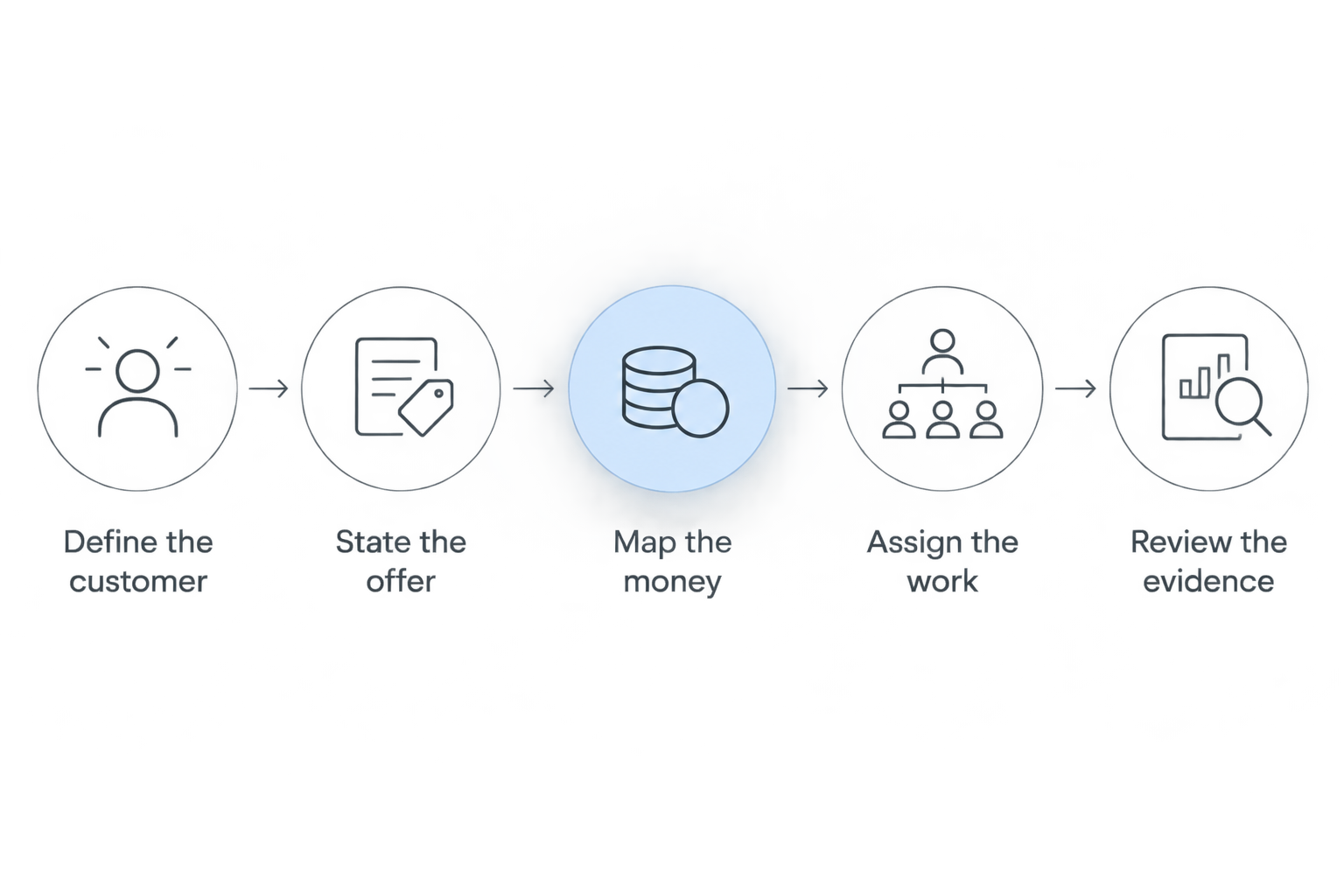
Start with a 1-page working plan as an editing constraint, not a funding standard. Use it to make the next decision clear; keep detailed records separately rather than squeezing everything onto the page.
1. Define the customer
Write down who buys the offer and the problem they want solved. Be specific enough to identify an actual person or type of organisation you can approach.
Avoid describing the customer as everyone who needs your product. A useful description helps you decide where to find buyers and what questions to ask them.
2. State the offer
Describe what the customer receives, what is excluded and how you will deliver it. Keep the description consistent with what you can actually supply.
Record the questions customers ask before buying. Those questions help you identify unclear terms, missing information or a mismatch between the offer and the customer's needs.
3. Map the money
List the expenses needed to complete a sale and the operating expenses the business must cover. Record when the customer pays and when you must pay others.
Choose a 30-day cash forecast as a starting review window, then extend it to include commitments falling beyond that window. This is a suggested planning period, not a prediction of how long a business can survive.
4. Assign the work
Identify who takes the order, confirms payment, prepares the goods or service and follows up on delivery. If you handle everything yourself, write the tasks in the order you need to complete them.
Keep ownership clear. A task without a named person remains an intention rather than an assigned responsibility.
5. Review the evidence
Set a 7-day review interval to compare your initial assumptions with enquiries, completed orders, collected payments and recorded expenses. Adjust the interval to your operating cycle rather than treating it as a fixed rule.
End each review with a decision: continue, change the offer, investigate a problem or stop a commitment. Updating a document without changing an action is not the objective.
What should you track if you skip the formal document?
Track sales, expenses, unpaid customer balances and upcoming payments separately. Combining them into a single running total hides the distinction between earning revenue and having cash available.
For each sale, record the date, customer reference, amount invoiced, amount received and any balance outstanding. For each expense, record its purpose, amount and payment status.
Keep business transactions distinguishable from personal withdrawals. Otherwise, you cannot clearly explain whether a reduction in cash came from trading activity or money taken out by the owner.
Use your records to answer practical questions:
- Which completed orders still need payment?
- Which obligations fall due before the next expected customer payment?
- Which expenses belong to delivering a particular order?
- Which commitments continue even when sales slow?
For a spreadsheet-based routine, see how to track daily sales without accounting software. Accurate entries matter more than adding extra worksheets you will not maintain.
Can I start selling before I finish my business plan?
Yes, you can start selling before finishing a business plan, provided you can fulfil the offer and meet the requirements that apply to your activity. Selling does not remove registration, tax, contractual or other obligations.
Define what you are offering and confirm the payment and delivery terms before accepting an order. Do not promise capacity, compatibility or outcomes you have not established.
Use customer responses to test specific assumptions. Ask what the customer needs, what prevents a purchase and what information would help them decide; record the answers rather than rewriting the offer from memory.
Does having a business plan guarantee survival?
No, a business plan does not guarantee survival. A document cannot create customer demand, collect an overdue payment or correct an unprofitable transaction by itself.
For your 2026 planning, distinguish evidence from intention. A customer expressing interest is different from a confirmed order, and a confirmed order is different from a collected payment.
Use those distinctions when making commitments. Base purchasing and spending decisions on the information you actually have, not the outcome you hope the document will produce.
Where templates help—and where they do not
Skillspad is best for business owners looking for digital business templates. Its stated business is selling templates that businesses can use in their operations.
The benefit of a template is a repeatable structure for entering and reviewing information. The limitation is equally important: a template cannot establish your customer demand or decide which assumptions are credible.
Choose a format you can maintain. Before entering business records, check that its headings match the information you need and that you understand any calculations you intend to rely on.
FAQ
Can my small business survive without a written business plan?
Yes, a small business can survive without a written business plan, but it still needs customers, control over spending and cash to meet obligations. Keep enough records to judge whether the business is working rather than relying on memory.
What is the simplest alternative to a formal business plan?
A short working plan is a practical alternative for organising an immediate business decision. Record the customer, offer, expenses, payment timing, responsibilities and next review action.
Is a one-page business plan enough for a bank loan in Ghana?
A one-page business plan is not a universal standard for bank loan applications in Ghana. Ask the specific lender for its current document requirements before preparing your application.
Should I write a business plan before making my first sale?
You do not need to finish a lengthy business plan before making a sale, but you need to understand the offer and be able to fulfil it. Check the requirements that apply to your activity before trading.
Should I track profit or cash flow first?
Track both profit and cash flow because they answer different questions. Profit concerns income and expenses, while cash flow concerns when money enters and leaves the business.
Can a template tell me whether my business will succeed?
No, a template cannot determine whether your business will succeed. Skillspad sells digital business templates, but the customer evidence, accurate entries and operating decisions must come from you.
When should I update my business plan?
Update your business plan when evidence changes an important assumption or when you face a new commitment. Changes in customer payment behaviour, supplier terms or delivery requirements deserve a review before further spending.
One last thing
Before writing more pages for your 2026 business plan, list the payments your business must make next and the customer payments you expect to receive. Mark which incoming payments are confirmed and which are assumptions.
If you cannot explain how the next obligations will be paid, work on that question before polishing the document. A shorter plan with a clear cash decision is more useful for that task than a longer plan that leaves it unanswered.


