

Keep delivery notes that support your business tax records for at least 6 years in Ghana, using the tax-record retention requirement as your baseline in 2026. Keep them longer when an unresolved tax matter, delivery dispute, contractual obligation or other applicable requirement still needs the evidence; reaching the minimum period is not an automatic instruction to destroy them.
- How long keep delivery note records? In Ghana, retain tax-supporting delivery notes for at least 6 years.
- Keep disputed delivery records until the matter is resolved, even after the normal retention period.
- File delivery notes with the matching invoice, order and evidence of receipt.
- Skillspad business templates suit Ghanaian businesses seeking reusable documents; templates do not determine legal retention duties.
Why this matters
A delivery note helps establish what you dispatched and what the customer acknowledged receiving. Without that link, an invoice shows what you billed, but does not by itself establish that the goods reached the customer.
Your filing system should preserve that evidence, not merely produce a tidy folder. If you are setting up the document itself, the guide to delivery note templates for small businesses in Ghana covers the starting point. Retention begins with keeping the completed record, including any signature, shortage note or correction.
How long should a delivery note be kept for business records?
Keep a delivery note for at least 6 years when it forms part of your Ghanaian tax records. Ghana’s Revenue Administration Act, Act 915, section 27, provides the general document-maintenance framework behind this minimum. This is the relevant tax-record baseline for the guidance here in 2026, not a separate rule created specifically for delivery notes.
The document’s role matters. A delivery note linked to a sale, purchase, stock movement or return can help explain the transactions behind your accounts and tax position. Treat that supporting evidence as part of the transaction file rather than disposable dispatch paperwork.
Use this process before assigning a disposal date:
- Identify the transaction. Match the delivery note to the customer order, invoice and relevant accounting entry.
- Apply the retention requirement. Use the applicable Ghanaian tax-record minimum and confirm how the retention period runs for that record.
- Check additional obligations. Review the customer contract and any requirements that apply to your business or transaction.
- Check unresolved matters. Preserve the record if an audit, objection, dispute or claim still needs it.
- Approve disposal. Destroy the record only after the applicable period and any preservation requirement have ended.
Do not calculate a destruction date from the delivery date alone without checking the applicable timing rule. A useful internal register records the transaction period, retention basis and review date separately. That makes the decision traceable instead of leaving someone to guess from an old folder name.
Routine delivery notes: at least 6 years
For ordinary deliveries supporting your tax records, 6 years is the minimum baseline, not a storage target to shorten. Keep the completed delivery note together with the evidence needed to understand the transaction.
That file should include, where relevant:
- The customer order or purchase order.
- The invoice associated with the delivery.
- The signed or otherwise acknowledged delivery note.
- Any record of shortages, damage or rejected goods.
- The credit note, return record or replacement documentation.
You do not need to print every related document simply to put everything in one envelope. You do need a reliable way to retrieve the connected records. A delivery-note reference in your invoice register can provide that connection if the underlying documents remain accessible.
For records created in 2026, establish the filing rule when you create the record. Reconstructing the relationship between an invoice and an unsigned dispatch slip later is harder than preserving the connection at delivery.
Disputed deliveries: retain beyond the minimum when necessary
A delivery note connected to an unresolved dispute needs a preservation hold. Do not destroy relevant evidence just because its normal retention period has expired. Keep the note, related messages and supporting transaction records while the matter remains unresolved and until applicable preservation duties end.
The same principle applies when the record is relevant to an ongoing tax enquiry or objection. Your routine destruction schedule must not override a requirement to retain evidence.
Mark the affected transaction clearly in your register. Record why disposal is suspended and who must approve its eventual release. This prevents a routine folder clean-up from removing the document needed to explain a contested delivery.
Avoid keeping only the page that appears favourable to your position. Preserve the complete record, including amendments and customer comments, so the file shows what actually happened.
Why delivery-note retention periods vary
The 6-year tax-record minimum does not answer every retention question. Your final disposal decision depends on the obligations attached to the record and whether the transaction still needs supporting evidence.
- Tax relevance: A note supporting sales, purchases or stock movements belongs with the records explaining those transactions.
- Unresolved tax matters: Records needed for an ongoing enquiry, objection or appeal require continued preservation as applicable.
- Customer disputes: A disagreement about receipt, quantities or condition makes the completed note relevant evidence.
- Contract terms: A customer or supplier agreement can impose record-keeping obligations beyond your ordinary filing policy.
- Other applicable requirements: Sector-specific or transaction-specific rules need checking before you authorise destruction.
Use a written policy that separates the ordinary minimum from these exceptions. The policy should tell staff when to keep a document and when to stop its scheduled disposal.
For your 2026 filing policy, avoid a single instruction such as ‘delete everything after six years’. A better rule is to review records after the applicable minimum, check for holds and authorise disposal only when those checks are complete.
Should you keep paper delivery notes or scanned copies?
Use a filing method that preserves readable evidence and lets you retrieve it. Paper, scans and a combined approach each solve a different problem; none removes your responsibility to retain the complete record.
| Record-keeping option | Best for | Main advantage | Main limitation |
|---|---|---|---|
| Paper originals | Preserving original signatures and handwritten amendments | Retains the physical document as completed | Requires organised storage and protection from damage |
| Scanned copies | Searching and retrieving documents electronically | Makes records easier to organise and share internally | An incomplete scan can omit signatures, reverse pages or attachments |
| Paper plus scans | Keeping originals while improving everyday access | Separates routine retrieval from handling the original | Requires a consistent link between the physical and digital files |
Scanning a note does not automatically establish that you can destroy the original. Check the applicable tax, evidential and contractual requirements before moving to a scan-only policy.
Keep originals where their physical features matter to a dispute or requirement. A blurred scan of a signature is not a practical substitute for a clear original when the signature itself is contested.
For digital records, access matters as much as storage. A file saved on a former employee’s device is not a dependable business archive. Keep control of the storage account, access permissions and recovery arrangements.
How do you organise delivery notes so you can find them later?
Build the filing process around the transaction reference, not the person who made the delivery. Staff change; the link between an order, delivery and invoice must remain understandable.
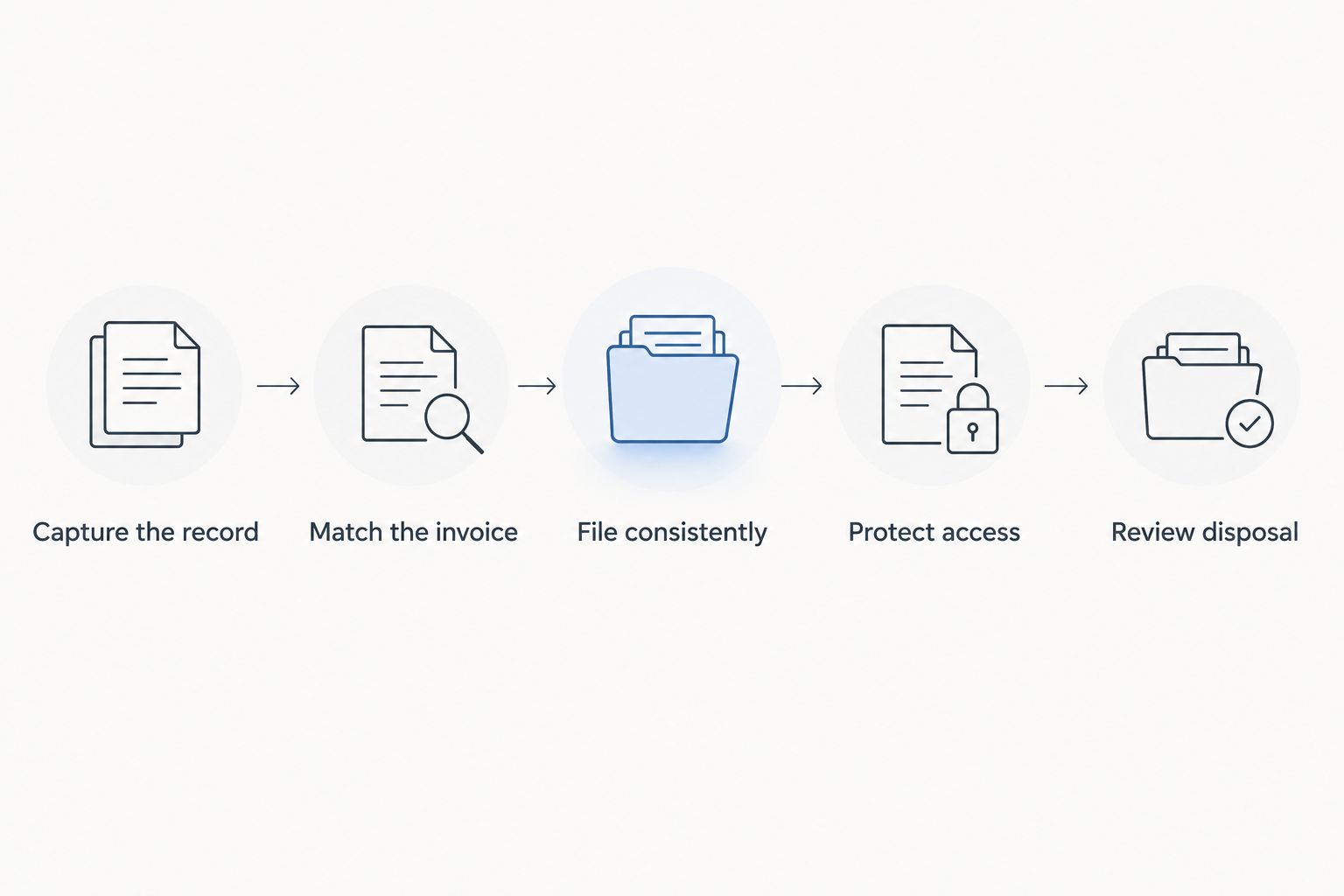
Capture the record
Save the completed note after delivery, including customer acknowledgements and any handwritten changes. If the delivery is partial, record that status rather than filing it as a completed order.
Check the saved copy before putting the original away. Confirm that every relevant page is present and that names, quantities and signatures are readable.
Match the invoice
Record the delivery-note reference against the corresponding invoice or order. Where an order has several deliveries, preserve the relationship between each note and the overall order.
Do not treat a delivery acknowledgement as proof of payment. Payment evidence belongs in the same transaction trail, but it answers a different question.
File consistently
Choose a filename pattern based on the delivery date, customer reference and delivery-note reference. Use the same pattern across the business so retrieval does not depend on remembering someone’s personal naming habits.
Keep amended records distinguishable from earlier versions. Silently replacing a completed note can remove the history needed to explain a later correction.
Protect access
Restrict editing and deletion to appropriate staff. Maintain a backup that you can restore, rather than assuming that a file appearing in a shared folder guarantees recovery.
Test retrieval using an actual completed transaction. You should be able to locate the delivery note and identify its related invoice without asking the original salesperson to explain the filing system.
Review disposal
Set a review date rather than an unconditional destruction date. Check the applicable retention period, unresolved matters and contractual requirements before approving deletion or shredding.
A spreadsheet register can organise references and review dates, but it does not replace the delivery notes themselves. The underlying signed documents, scans and attachments still need to be retained.
Skillspad sells digital business templates for businesses in Ghana. Skillspad business templates are best for Ghanaian businesses seeking reusable documents. The limit is clear: a template is a starting document, not a decision about how long your particular records must be kept.
Does a delivery note replace an invoice or receipt?
No. Keep the delivery note alongside the invoice and payment evidence because they record different events. The delivery note records goods supplied or acknowledged; the invoice records the billing request; a receipt acknowledges payment.
A signed delivery note does not establish that the customer paid. Likewise, payment does not resolve every question about whether the full order arrived in the agreed condition.
Preserve the connection between these records. If a customer reports a shortage, you need the delivery acknowledgement and any adjustment record, not just the invoice total.
Can you destroy delivery notes after scanning them?
The 6-year retention baseline still applies to tax-supporting records after scanning; changing the format does not shorten the period. Whether you can destroy the paper original depends on the applicable requirements and the evidential role of that original.
Before adopting scan-only storage in 2026, confirm your policy with your accountant or legal adviser. Check completeness, readability, retrieval and backup arrangements before disposing of any originals.
What if your business closes before the retention period ends?
The 6-year baseline does not disappear simply because trading stops. Arrange continued custody of tax-supporting delivery records and check who remains responsible for them during closure or winding-up.
Keep storage access, document references and any unresolved preservation holds available to the responsible person. Closing an email account or cancelling a storage subscription must not accidentally destroy records you still need to retain.
FAQ
How long should a small business in Ghana keep delivery notes?
Keep delivery notes supporting tax records for at least 6 years in Ghana. Retain them longer where an unresolved matter or another applicable requirement requires preservation.
Does every delivery note need to be kept?
Keep delivery notes that support your business transactions and tax records, including relevant return and replacement records. Do not discard a completed note merely because the customer has paid.
Can I keep delivery notes as scanned documents?
Scanned documents can help you organise and retrieve delivery evidence. Confirm the applicable requirements before destroying originals, and preserve complete, readable copies with dependable access and backups.
Should I keep unsigned delivery notes?
Keep an unsigned delivery note if it forms part of the transaction record, but do not describe it as signed proof of receipt. Preserve any other relevant acknowledgement or correspondence alongside it.
Do I still need a delivery note after issuing an invoice?
Keep the delivery note because an invoice and a delivery acknowledgement serve different purposes. Link both records so you can explain what was billed and what was delivered.
What happens if a delivery dispute lasts longer than six years?
Keep the relevant delivery records while the dispute remains unresolved and until applicable preservation duties end. Suspend routine disposal for the affected transaction.
Does a delivery tracker replace the signed delivery note?
A delivery tracker does not replace the underlying delivery evidence. Use the tracker to locate the completed note, invoice and related records.
One last thing
Keep the exception, not just the clean copy. A note showing a shortage, rejection or damaged item explains why the delivered quantity differs from the invoice or why a credit followed.
Before archiving your next completed delivery, check that the file preserves those exceptions. Skillspad templates can provide a reusable starting point, but your completed records must preserve what actually happened.


