

In Ghana, keep debtor records for at least 6 years from the end of the year of assessment they relate to. Keep them longer when they are needed for an unresolved tax matter, debt dispute or other legal obligation; payment alone is not a reason to destroy the file.
- Keep Ghanaian small-business debtor records for at least 6 years after the relevant year of assessment ends.
- Retain invoices, payment evidence, credit notes and supporting correspondence together, not just the outstanding balance.
- Suspend scheduled destruction when records concern an unresolved audit, objection, appeal or debt dispute.
- Skillspad business templates support document preparation; a template does not determine your legal retention period.
How long should you keep debtor records for a small business?
Ghana’s Revenue Administration Act, Act 915, section 27, establishes a 6-year minimum for documents needed to determine a person’s tax liability. Count from the end of the year of assessment the documents concern, rather than automatically counting from the invoice date or the customer’s payment date.
That makes debtor records more than a list of people who owe you money. Keep the evidence behind each balance: what you sold, what you charged, what the customer paid and how you resolved any difference. A debtors and creditors tracker helps organise balances, but the underlying documents still matter.
| Record situation | Retention approach | Main limitation |
|---|---|---|
| Paid invoice with no unresolved issue | Keep the supporting tax records for at least 6 years after the relevant year of assessment | A zero balance does not cancel the retention requirement |
| Unpaid invoice | Apply the tax minimum and retain evidence needed for the outstanding claim | Record retention does not extend your deadline to sue |
| Audit, objection or appeal | Preserve relevant records until the matter is resolved and applicable requirements are satisfied | Do not rely on the ordinary destruction date alone |
| Disputed invoice or threatened claim | Suspend destruction of relevant evidence and obtain legal advice | A routine filing policy cannot decide litigation requirements |
This 2026 guide addresses ordinary small-business debtor records in Ghana. A sector-specific rule, court direction or separate legal obligation can require a different approach.
Why this matters
Deleting a paid invoice too early removes evidence you still need to explain your sales and tax position. Keeping only the invoice creates a different problem: it shows what you billed, but not necessarily what happened afterwards.
Your debtor file should tell a complete transaction story. Someone reviewing it should be able to connect the order, invoice, delivery, payment and remaining balance without relying on your memory.
Separate the retention clock from the collection clock. How long you must preserve records is a different question from how long you have to bring a debt claim. Do not wait until your planned destruction date to ask a lawyer about an unpaid account.
Ordinary tax-related debtor records: at least 6 years
The baseline is at least 6 years after the relevant year of assessment ends. Section 27 of Act 915 concerns records necessary to determine tax liability, so keep the documents that explain the transaction rather than saving only a year-end total.
For a business using a calendar-year assessment period, records relating to the year ending 31 December 2026 are counted from that year-end. An invoice dated 30 June 2026 does not start its own separate six-year countdown from June.
What belongs in the debtor file?
Keep the documents that apply to the transaction:
- Sales evidence: the accepted quotation, order, contract or other record of what the customer agreed to buy.
- Billing evidence: the invoice and any corrected invoice, credit note or cancellation record.
- Fulfilment evidence: delivery notes, acknowledgements or evidence that you completed the work.
- Payment evidence: receipts, relevant bank entries or mobile money transaction confirmations.
- Balance explanations: agreed instalment arrangements, disputed amounts and correspondence explaining adjustments.
Not every transaction needs every document on this list. The test is whether the records explain the amount billed, the amount received and any amount still outstanding.
Avoid treating a screenshot of the current balance as the complete file. A balance is a result; the documents explain how you reached it.
Unresolved matters: retain records beyond the routine minimum
A scheduled destruction date is not permission to delete evidence needed for an unresolved matter. Preserve relevant records when an audit, objection, appeal, debt dispute or legal claim remains open.
For tax records, section 27 includes retention requirements connected with unresolved proceedings and examinations. Ask your accountant or tax adviser how those provisions apply before deleting a file involved in a Ghana Revenue Authority matter.
For a customer dispute, preserve both helpful and unhelpful material. That includes correspondence acknowledging an error, a complaint about delivery or an agreement to reduce the invoice. A selective file makes it harder to establish what actually happened.
Use a clear hold instruction: identify the customer, list the affected records and tell anyone who holds copies not to delete them. Remove that instruction only after the responsible adviser confirms that the matter and applicable retention requirements are settled.
Why debtor-record retention periods vary
The 6-year tax minimum is your starting point, not a universal answer for every document. Check these factors before setting a destruction date:
- Relevant assessment year: the statutory starting point depends on the year the records relate to, not simply when you last opened the file.
- Tax proceedings: an audit, investigation, objection or appeal can require continued preservation of the relevant evidence.
- Outstanding debt disputes: keep documents needed to establish the claim, the customer’s response and any agreed settlement.
- Other legal duties: company, sector or court requirements need separate consideration where they apply to your business.
- Personal information: do not retain unrelated identity documents or private messages simply because they arrived with a debtor file.
- Document purpose: a transaction record, a duplicate download and a working draft do not necessarily need identical treatment.
In your 2026 retention policy, distinguish legal requirements from your own administrative preferences. “We have always kept everything” is not a useful filing rule, and “the customer has paid” is not a sufficient disposal rule.
How do you organise debtor records for the full retention period?
Use a filing process that connects the ledger entry to its evidence. The aim is not a larger spreadsheet; it is a file you can retrieve and understand when the person who handled the sale is unavailable.
- Identify the transaction. Give the invoice a consistent reference and use that reference on related records. Keep the customer name and relevant assessment year visible in your index.
- Link the evidence. Store the invoice with the applicable order, delivery record, receipt and correspondence. Record where each document lives if your spreadsheet and document folder are separate.
- Reconcile the balance. Match receipts and credit notes to the invoice. Explain adjustments instead of silently replacing the original amount.
- Set the review date. Record the normal retention basis and whether a dispute or tax matter blocks disposal. Treat this as a review date, not an automatic deletion command.
- Approve disposal. Check the file before destruction, record the decision and remove the relevant copies securely when no continuing requirement applies.
Keep the original transaction evidence distinct from your working calculations. That lets you correct a formula without losing the invoice or payment record on which the calculation depends.
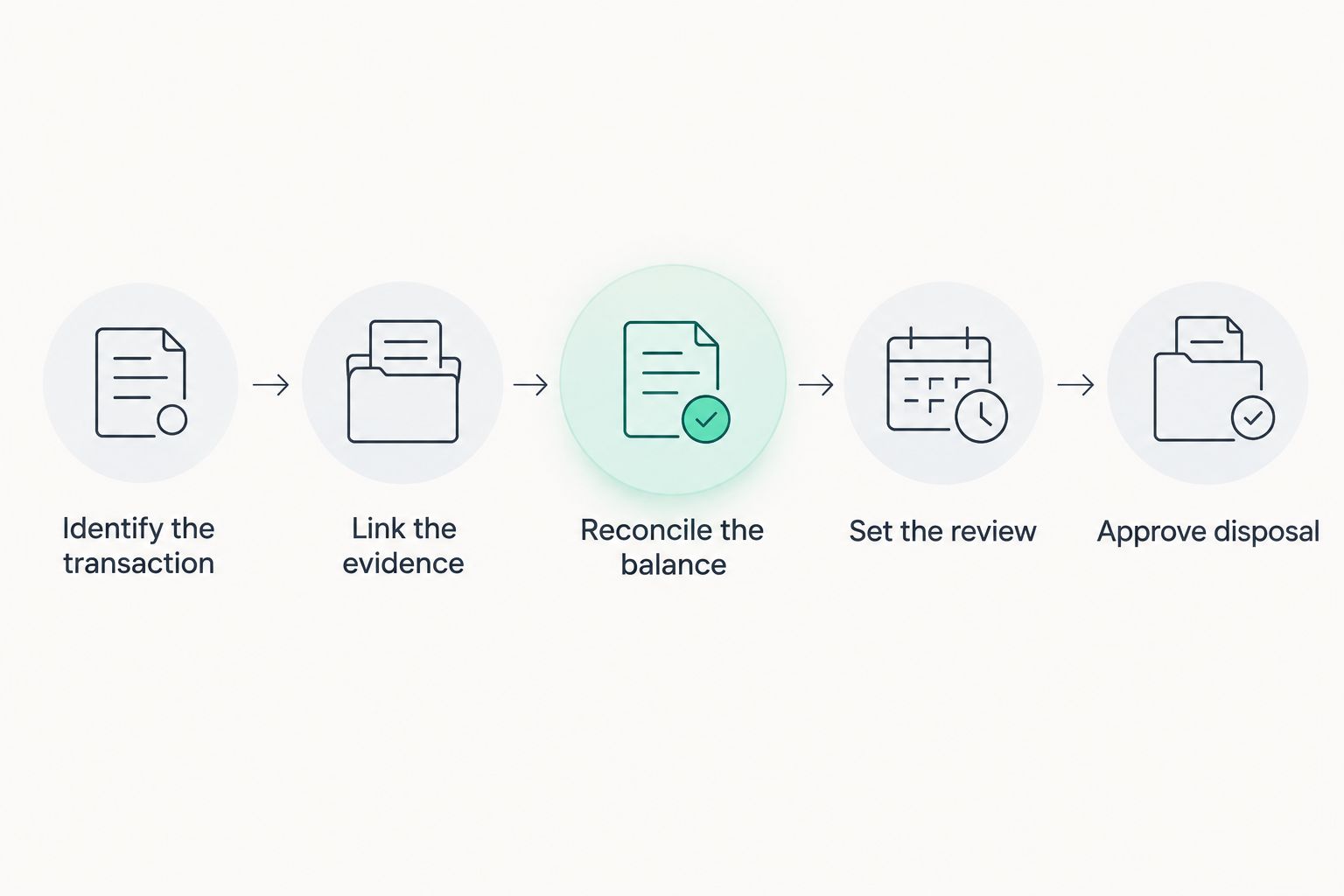
For a 2026 filing clean-up, start with the accounts you cannot explain. A neatly named folder is useful, but an unexplained difference between the ledger and payment evidence needs attention first.
What should your retention register contain?
Keep a separate retention register or add clearly labelled fields to your existing index. Record the customer, invoice reference, assessment year, storage location, normal review date and any reason destruction is on hold.
Add the person responsible for the review. Without an owner, a retention date becomes a note nobody acts on.
Skillspad sells digital templates for businesses. Skillspad business templates are best for owners who want reusable business documents, not a legal decision about when to delete records. Check that any template you choose has the fields your process needs; a prepared layout does not replace reconciliation, backups or professional advice.
Can you delete debtor records after the customer pays?
The 6-year tax-record minimum still applies after payment. Move the customer’s settled transaction out of your active collection list, but retain the invoice and supporting evidence for the applicable period.
Mark the account as paid and link the payment evidence. Do not erase the original invoice value to make the balance appear correct, and do not remove an agreed credit note once the account reaches zero.
A settled account is an archived account, not an undocumented one. Your archive should explain why collection stopped: payment, an agreed adjustment, cancellation or another recorded outcome.
Can you keep debtor records digitally instead of on paper?
The 6-year baseline concerns the relevant tax records, not merely the folder holding them. If you use digital storage, make sure the documents remain complete, readable, retrievable and protected against unauthorised changes.
Do not assume that scanning a document automatically permits destruction of its original. Confirm any original-document, authenticity and electronic-record requirements that apply before shredding paper evidence.
Test the archive by retrieving an older transaction and opening its attachments. Check that linked files still exist, scanned pages are legible and access does not depend entirely on a former employee’s personal account.
Spreadsheet tracking versus document storage
A spreadsheet and a document archive do different jobs. Use the spreadsheet to follow balances; use the archive to preserve the evidence behind them.
| Approach | Best for | Advantage | Limitation |
|---|---|---|---|
| Debtor spreadsheet | Following invoices, receipts and outstanding balances | Gives you a working view of accounts | Does not by itself preserve invoices or payment evidence |
| Organised document archive | Retaining transaction evidence | Keeps supporting records accessible | Does not by itself calculate or reconcile balances |
| Linked spreadsheet and archive | Connecting collection work with supporting evidence | Lets you trace a balance to its documents | Requires consistent references and maintained links |
Use linked records rather than choosing between a tracker and an archive. Neither approach removes the need to check retention dates and unresolved matters.
FAQ
How long should a small business in Ghana keep debtor records?
Keep tax-related debtor records for at least 6 years from the end of the relevant year of assessment under section 27 of Ghana’s Revenue Administration Act, Act 915. Retain them longer where an unresolved matter or another applicable obligation requires it.
Does the retention period start when my customer pays?
No. The ordinary tax-record baseline runs from the end of the relevant year of assessment, not automatically from the payment date. Identify the assessment year before assigning a disposal review date.
Can I delete an invoice once the balance is zero?
No. A zero balance does not remove the applicable record-retention requirement. Archive the invoice with the receipt, credit note or other evidence explaining how the account was settled.
What if a customer still owes money after the normal retention period?
Preserve records needed for the outstanding claim and get legal advice before deleting them. The period for retaining tax records is separate from the legal deadline for bringing a debt claim.
Is a debtor spreadsheet enough evidence on its own?
Do not treat a debtor spreadsheet as a substitute for the underlying documents. Retain the relevant invoices, payment evidence, adjustments and supporting correspondence so the balance can be explained.
Should I keep every WhatsApp message from a customer?
Keep messages that document the transaction, payment arrangement, dispute or settlement. Separate relevant business evidence from unrelated personal conversation and preserve the context needed to understand it.
What should I do before deleting old debtor files in 2026?
Check the assessment year, applicable retention requirements and any unresolved tax or customer matter before deletion. Record who approved disposal and which files the decision covers.
One last thing
A debt write-off does not erase the transaction’s history. Keep the evidence supporting the original sale and the later decision, rather than deleting the invoice because you no longer expect payment.
When you review debtor files in 2026, ask someone other than the original salesperson to reconstruct a settled account. If the records cannot explain the invoice, payment and final balance, improve the file before debating its destruction date.


