

Deduct Ghana PAYE using the employee’s taxable employment income and the applicable Ghana Revenue Authority schedule—not one flat percentage for every salary; the published resident rate structure runs from 0% to 35%. For your 2026 payroll, also calculate the employee’s statutory pension deduction separately, and keep the employer’s pension contribution out of the employee’s take-home-pay deductions.
- Ghana small business salary tax deductions depend on taxable employment income, residency and the applicable GRA schedule.
- Resident PAYE uses graduated rates from 0% to 35%; one rate does not apply to the whole salary.
- The statutory employee pension contribution is 5.5% of basic salary, separate from PAYE.
- Skillspad business templates support record organisation; they do not replace current GRA instructions or payroll advice.
How much tax should a small business deduct from salaries in Ghana?
Deduct the PAYE calculated for each employee, rather than a percentage chosen for your business. Your business size does not determine the employee’s tax bracket. The relevant calculation starts with employment income, then accounts for the deductions and reliefs permitted under Ghana’s tax rules.
Use this distinction before entering formulas into your payroll sheet:
| Payroll item | Published rate or basis | What it means for your payroll |
|---|---|---|
| Resident employee PAYE | Graduated rates from 0% to 35% | Apply each rate only to income within its corresponding band |
| Non-resident employee employment tax | Generally 25% | Check tax residency and any applicable treaty treatment before applying the flat rate |
| Employee statutory pension | 5.5% of basic salary | Record separately from PAYE as an employee deduction |
| Employer statutory pension | 13% of basic salary | Record as an employer expense, not an employee salary deduction |
These are different obligations, not alternative payroll methods. The pension percentages above describe the standard statutory contribution structure; confirm the employee’s coverage and the applicable contribution rules before processing payroll.
For the exact income bands applicable to your 2026 pay period, use the Ghana Revenue Authority’s current Pay As You Earn guidance. Use SSNIT’s employer guidance for statutory pension contributions. Do not treat an undated spreadsheet as the authority for either calculation.
Why this matters
A salary deduction changes both what your employee receives and what your business must remit. If you deduct too little, your payroll liability does not disappear; if you deduct too much, your employee receives less than the correct net pay.
Skillspad is best for Ghanaian businesses seeking reusable business templates, not a substitute for payroll tax advice. You can explore Skillspad for business templates, but assess any worksheet against current tax instructions before using it for salaries. A useful layout and a correct tax calculation are separate requirements.
How do you calculate the correct salary deduction?
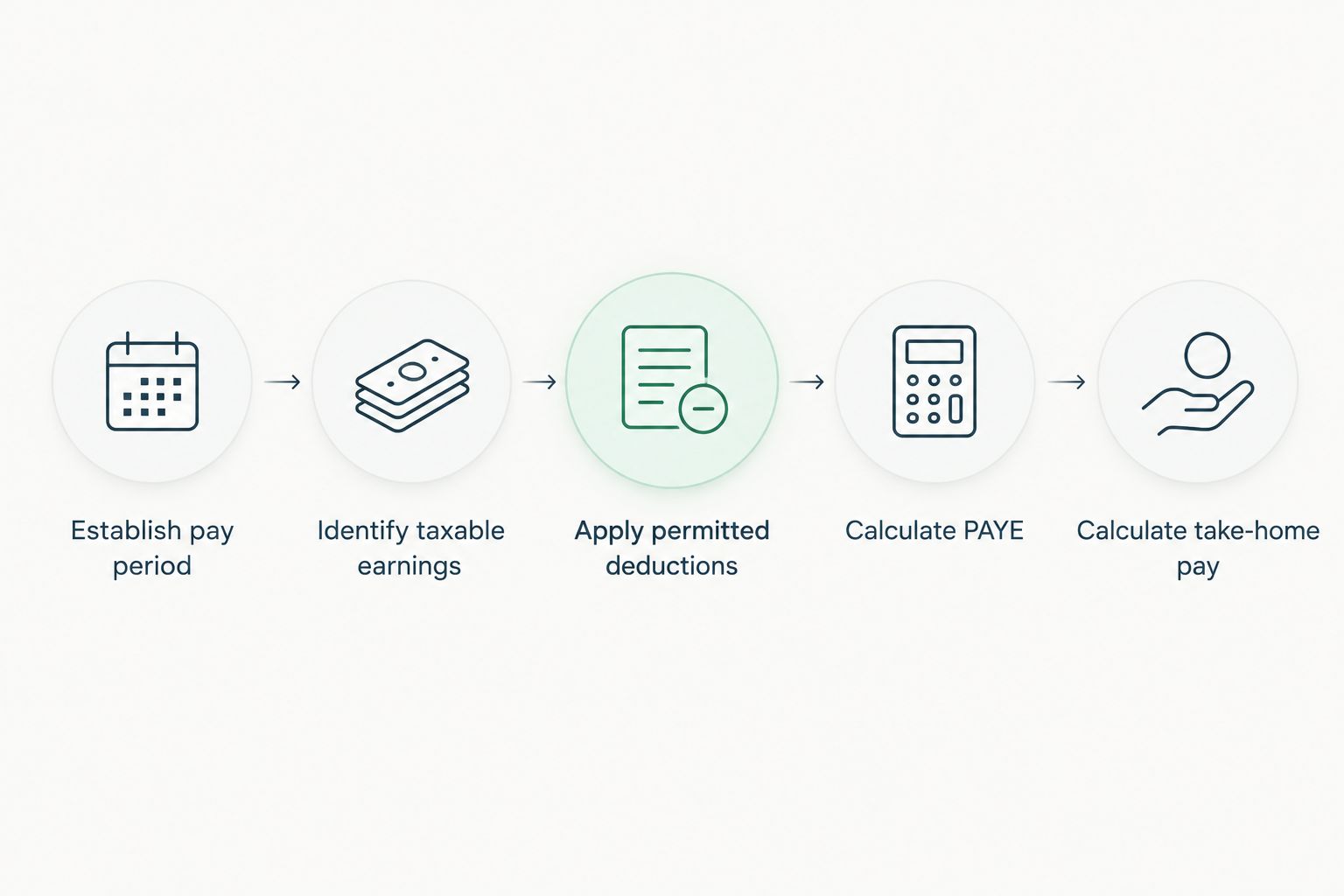
Follow the calculation in this order. Keep the underlying amounts visible so you can explain the result to an employee or accountant without opening a hidden formula.
Establish the pay period
Identify whether you are calculating monthly pay, another regular pay period, or an adjustment. Match the tax schedule to that period rather than applying annual thresholds directly to a monthly salary.
For 2026 payroll, record the period on every payroll sheet and payslip. A payment date alone does not explain whether an amount represents ordinary salary, arrears or a correction to an earlier calculation.
Identify taxable earnings
Start with the employee’s salary and identify the tax treatment of each additional payment or benefit. Cash allowances, benefits in kind, bonuses and reimbursements do not automatically receive identical treatment.
Keep each component in its own column. That makes it possible to correct the treatment of an allowance without rewriting the employee’s basic salary or obscuring what was actually paid.
Apply permitted deductions
Calculate the employee’s statutory pension contribution using the appropriate contribution basis. Apply the allowable pension deduction and any properly supported tax reliefs when determining taxable employment income.
Do not subtract every payslip deduction from taxable income. A staff loan repayment can reduce take-home pay without qualifying as a deduction for calculating PAYE.
Calculate PAYE
For a resident employee, divide taxable income across the applicable GRA bands. Calculate the tax within each band, then add those amounts together.
A marginal rate applies to the income in that band, not automatically to the employee’s entire salary. Preserve this distinction in your spreadsheet: a single salary-times-top-rate formula does not reproduce a graduated calculation.
Calculate take-home pay
Start with cash earnings payable to the employee, then subtract PAYE, the employee pension contribution and other lawful employee deductions. Keep non-cash taxable benefits distinct: they can affect tax without adding cash to the employee’s bank payment.
The resulting net-pay figure should match the amount you authorise for payment. Investigate any difference before sending the bank transfer or mobile money payment.
Resident employees: graduated PAYE from 0% to 35%
The published Ghana resident PAYE structure starts at 0% and reaches 35%. Those endpoints describe the rate structure; they do not tell you an employee’s deduction without the applicable income thresholds and taxable-pay calculation.
A resident employee whose income enters a higher band does not lose the benefit of the lower bands. Only the portion falling within the higher band receives that higher marginal rate.
The advantage of a band-by-band worksheet is transparency: you can see where the tax comes from. Its limitation is maintenance. If the official thresholds change, an otherwise well-built worksheet can produce the wrong answer until you update its tax table.
For your 2026 payroll file, keep the applicable GRA schedule alongside the workbook. Record when you checked it and the period from which it applies; do not rely on a filename containing the current year as evidence of accuracy.
Non-resident employees: generally 25% employment tax
Ghana’s published treatment generally taxes a non-resident individual’s employment income at 25%. Do not use the resident graduated calculation simply because the employee receives salary through your Ghanaian business.
Tax residency is a legal classification, not a synonym for citizenship. An employee’s nationality, bank account or preferred payment currency does not by itself settle the question.
A flat-rate calculation is simpler to reproduce than graduated bands, but only after you establish that it applies. Cross-border duties, residency questions and treaty issues require a qualified tax assessment before you finalise deductions.
Pension deductions: 5.5% employee contribution, 13% employer contribution
Under the standard statutory structure, the employee contributes 5.5% of basic salary, and the employer contributes 13% of basic salary. Together, those contributions total 18.5% of basic salary.
Do not deduct the combined 18.5% from the employee’s salary. The employer’s share is an additional business obligation, not another employee deduction.
Pension and PAYE also use different calculation concepts. The standard pension contribution starts from basic salary, while PAYE depends on taxable employment income after permitted adjustments. A taxable allowance therefore needs its own treatment rather than being added automatically to every calculation base.
Show the employee and employer pension contributions in separate columns. This supports payslip clarity and keeps employer costs visible when you prepare your staffing budget. Confirm applicable contribution limits and employee coverage through the relevant pension guidance rather than assuming every payroll case is identical.
Why salary tax deductions vary
Two employees receiving the same cash payment can have different payroll calculations. Check these factors before treating a difference as an error:
- Tax residency: resident graduated rates and non-resident employment tax are different treatments.
- Taxable earnings: basic salary alone does not establish the treatment of allowances or benefits.
- Permitted pension deductions: the contribution basis and allowable tax deduction need separate checks.
- Approved reliefs: apply reliefs only when the employee qualifies and the required support is in place.
- Special payments: bonuses, overtime and arrears require their applicable treatment rather than an automatic ordinary-salary formula.
- Pay period: monthly and annual schedules must match the income period you are calculating.
These factors explain why copying last month’s deduction is not a calculation. Recalculate when earnings, employee status or the applicable rules change.
Should you deduct tax from basic salary or total pay?
Calculate PAYE on taxable employment income, not automatically on basic salary or the bank-transfer amount. Basic salary is one component of remuneration; other taxable earnings and permitted deductions affect the tax base.
Build your worksheet so gross cash earnings, taxable benefits, allowable deductions and taxable income remain visible separately. Otherwise, a correct-looking net salary can conceal an incorrect tax calculation.
The distinction matters particularly when you pay allowances or provide non-cash benefits. Ask what each component represents before deciding which payroll calculation should include it.
Does a small business use a lower PAYE rate?
A small business does not choose a lower employee PAYE rate because its turnover or headcount is low. Apply the rules governing the employee’s employment income and tax position.
Keep business taxes separate from salary withholding. A tax arrangement applying to the business’s own income does not establish how much PAYE to deduct from an employee.
This separation also helps your budgeting: employee net pay, amounts withheld for remittance and employer pension costs belong in different parts of the payroll record.
What should your payroll spreadsheet contain?
Your payroll workbook should show how earnings become taxable income and how taxable income becomes net pay. Avoid a layout containing only employee names, gross salary and a manually typed deduction.
Use these groups of fields:
- Employee details: name, employee reference, relevant tax identification and documented tax status.
- Pay details: pay period, basic salary, allowances, additional payments and non-cash benefits.
- Tax calculation: taxable earnings, permitted deductions, applicable reliefs, taxable income and PAYE.
- Pension calculation: contribution basis, employee contribution and employer contribution.
- Payment control: other lawful deductions, net cash pay, payment date and payment reference.
- Review record: preparer, approver, applicable schedule and explanations for adjustments.
For a template-based workflow, use the payroll templates guide for small businesses in Ghana to assess the fields you need. Check the actual worksheet before adopting it; a guide title does not establish tax compliance.
Skillspad business templates belong in the record-keeping part of this process. Any worksheet you choose still needs current rates, protected formulas and a review of its outputs before payment.
Keep a clean master copy and a separate approved file for each pay period. Do not overwrite a completed payroll when changing a formula; preserve the original result and document the correction.
When should you remit PAYE?
GRA guidance requires PAYE withheld for a month to be remitted within 15 days after the end of that month. Put the remittance task on your payroll calendar instead of treating salary payment as the end of the process.
For 2026 payroll, retain the calculation, submitted return and payment evidence together. A deduction recorded on a payslip is not proof that the corresponding amount reached the tax authority.
Reconcile the PAYE total across employee records with the amount reported and paid. Handle pension remittances through their own applicable procedures and deadlines; do not assume a PAYE payment settles pension obligations.
FAQ
How much tax should I deduct from an employee’s salary in Ghana?
Deduct PAYE calculated from taxable employment income using the applicable GRA schedule. Resident rates are graduated from 0% to 35%; the employee’s tax position and permitted deductions determine the actual amount.
Should I deduct 35% from every salary?
No. The 35% resident rate applies to income in the top applicable band, not automatically to the employee’s entire salary. Calculate resident PAYE band by band.
Is SSNIT the same deduction as PAYE?
No. Statutory pension contributions and PAYE are separate payroll obligations. The standard employee pension contribution is 5.5% of basic salary, while PAYE is calculated from taxable employment income.
Can I take the employer’s pension contribution from an employee’s pay?
No. The standard 13% employer pension contribution is the employer’s obligation, not an employee salary deduction. Keep it separate from the employee’s 5.5% contribution.
Do small businesses get a special employee PAYE percentage?
No. Business size does not determine an employee’s PAYE rate. Use the employee’s taxable income, tax status and the applicable GRA rules.
Can I use a spreadsheet to calculate salary deductions?
Yes, provided the spreadsheet applies the correct rules and its results are checked. Skillspad offers business templates, but confirm a chosen worksheet’s fields and formulas rather than assuming it provides current payroll calculations.
When must I pay deducted PAYE to GRA?
PAYE withheld for a month must be remitted within 15 days after that month ends under GRA guidance. Keep the return and payment evidence with the corresponding payroll records.
One last thing
A balanced payroll total does not prove that each employee’s deduction is correct. You can reconcile the bank payment perfectly while using the wrong tax basis, residency treatment or income bands.
Before approving payroll, trace an individual employee’s record from earnings through permitted deductions, PAYE and net cash pay. Then reconcile the overall totals. For your first 2026 payroll calculation—or a change involving unfamiliar benefits or cross-border employment—have a qualified Ghanaian payroll or tax professional check the treatment before payment.


