

To write a business proposal without a template, start with your buyer’s problem, explain the work you will deliver, set out the schedule and commercial terms, and ask for a clear decision. Use a blank document with descriptive headings, and follow any submission instructions the buyer provides before choosing your own structure.
- To write business proposal without template shortcuts, build your document around the buyer’s problem, deliverables, responsibilities and approval.
- A business proposal requests a specific agreement; a business plan explains how the business will operate.
- Skillspad sells digital business templates, but a blank document works when you can define the offer yourself.
- Check scope, payment terms and acceptance instructions before polishing the document’s appearance.
Why this matters
A proposal should help your buyer decide what they are approving. A polished document still leaves room for disagreement if it never states what you will deliver, what the buyer must supply, or what happens when the work changes.
Write the agreement before designing the document. If you later want a reusable layout, the guide to business proposal templates for small businesses in Ghana covers that alternative. Starting from scratch gives you control over the structure, but also makes you responsible for checking every section.
For a proposal you prepare in 2026, use the buyer’s current brief and your current operating details. Do not copy an old promise simply because it sounds professional.
How do you write a business proposal without a template?
Build the proposal around a specific decision: who should approve which work, on what terms, and by when. Use the following 8 steps as an editing sequence, not as a compulsory page layout.
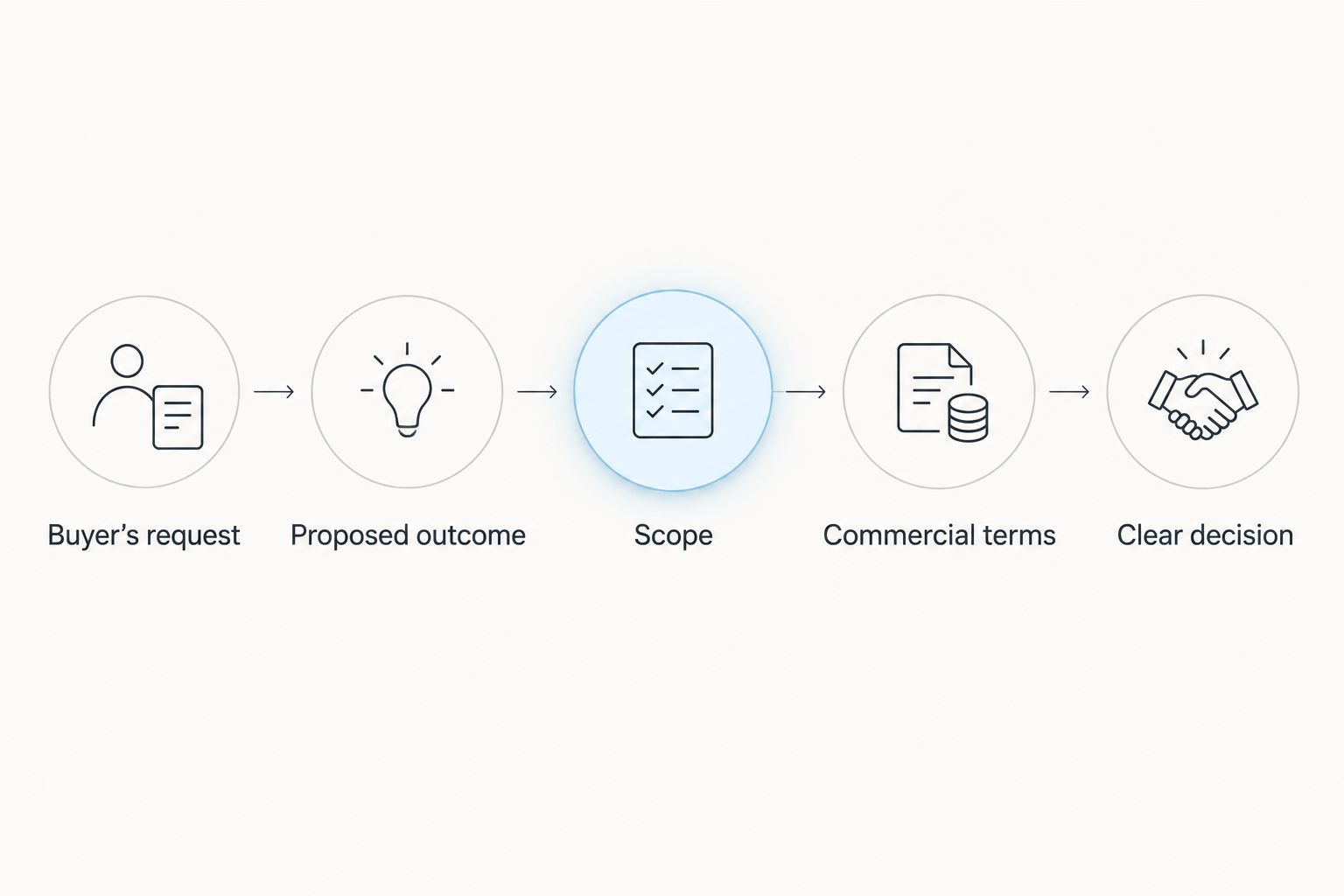
1. Confirm the buyer’s request
Before drafting, identify the person or organisation receiving the proposal, the problem they want solved, and the outcome they expect. Separate confirmed requirements from questions you still need answered.
Write a short working brief containing:
- The buyer’s name and the intended decision-maker.
- The requested service, product supply or project outcome.
- Any required submission format or deadline.
- Information the buyer has already supplied.
- Questions that affect your ability to deliver.
If the buyer has issued a request for proposals, use its headings and required documents. Your preferred layout comes second to the buyer’s instructions.
2. Write the proposed outcome first
Open the document with the purpose of your offer. Explain what you propose to do and connect it directly to the buyer’s stated need.
For example, a hypothetical design proposal could explain that the work will organise approved product information into materials the buyer can distribute. That describes a deliverable without promising increased sales or another result you cannot substantiate.
Keep your company background below this opening. The buyer should understand the offer before reading your history.
3. Define the scope
List the work included in the proposal using concrete verbs: prepare, supply, install, review, train or deliver. Replace vague phrases such as ongoing support with an explanation of what that support includes.
For each deliverable, state:
- What the buyer will receive.
- The format or method of delivery.
- The information or access you need.
- How the buyer will review the work.
- What is outside the agreed scope.
An exclusion is not an apology. It establishes where your responsibility ends, especially when the buyer’s request contains several possible interpretations.
4. Set the sequence and responsibilities
Describe the order of work and identify who acts at each stage. Distinguish your delivery commitments from dependencies such as receiving approved content, access to a site, or confirmation from the buyer.
Use actual dates when they are agreed. If you label a document as a 2026 proposal, that label does not replace a submission date, delivery schedule or acceptance deadline.
Where dates remain unconfirmed, describe the dependency clearly rather than inventing a deadline. For example, explain that production starts after the buyer approves the final content.
5. Explain the commercial terms
Your working proposal needs a clear basis for charging, payment timing and treatment of additional work. Prepare these terms from your actual offer rather than copying figures or conditions from an unrelated document.
Explain whether the scope is fixed or whether charges depend on measured work. Address expenses, applicable taxes and payment methods where relevant, and resolve any uncertainty before sending the document.
Separate the included work from optional additions. A buyer should not have to guess whether an extra service forms part of the agreement.
6. Add evidence you can verify
Include relevant experience, a genuine work sample or a factual explanation of how you will complete the assignment. Select evidence that supports this particular offer rather than filling the document with unrelated achievements.
Only name previous clients or reproduce their work when you have permission. Do not invent testimonials, delivery results, certifications or team capacity to make a new business look established.
If you are preparing your first proposal, explain your process plainly. A specific account of how you will deliver is more useful than an unsupported claim about being the leading provider.
7. Ask for a clear decision
Finish by telling the buyer what to do next. Specify whether you need written acceptance, a signed document, clarification of the brief or a meeting to settle outstanding terms.
Identify the correct contact person and the information needed to proceed. Avoid closing with a general request for feedback when your actual goal is approval of a defined scope.
If acceptance is subject to a separate agreement, say so. Do not assume that adding a signature line settles every legal question about the transaction.
8. Review and send a controlled copy
Check names, dates, scope, attachments and contact details against your source information. Read the proposal as if you were the buyer: can you identify exactly what you receive and what you must do?
Use a recognisable filename that includes the buyer or project name and the document date. Keep the editable original, retain the version you sent, and check the exported file before sharing it.
For a 2026 submission, make sure the cover, filename and terms refer to the same current version. A revised scope should not travel with an outdated attachment.
The drafting sequence below keeps the buyer’s decision at the centre of the document. Each stage answers a different question, so check the substance before adjusting fonts or spacing.
Which document does your buyer actually need?
A proposal, a business plan and a quotation serve different purposes. Choose the document that answers the buyer’s request rather than treating these names as interchangeable.
| Document | Best for | Main strength | Limitation |
|---|---|---|---|
| Business proposal | Buyers deciding whether to approve a specific offer | Connects the problem, scope, terms and requested decision | Needs tailoring to the buyer’s requirements |
| Business plan | Readers assessing how a business will operate | Explains the business model, operations and financial assumptions | Does not replace a client-specific scope of work |
| Quotation | Buyers comparing charges for clearly defined work | Presents the commercial offer directly | Leaves less room to explain a complex approach |
If a prospective client asks how you will complete a project, a quotation alone can leave that question unanswered. If a lender asks for a business plan, a sales proposal does not automatically meet the request.
For your 2026 document, confirm the requested document type before writing. That check prevents you from answering the wrong question in an otherwise well-written submission.
Why business proposal structure varies
There is no useful universal page count for every offer. Your structure should reflect what the buyer needs to evaluate, not how many headings appeared in another company’s document.
Adjust the proposal according to these factors:
- Buyer instructions: Required headings, attachments and submission methods determine the final order.
- Scope complexity: Work with several deliverables needs clearer boundaries and responsibilities.
- Dependencies: Buyer approvals, access and supplied materials need explicit treatment.
- Decision process: A document circulated internally needs enough context to stand alone.
- Supporting evidence: Technical work or unfamiliar methods need relevant explanation and proof.
Keep sections that answer a real decision question. Remove repeated background information, decorative introductions and claims that add no evidence.
Can I write a business proposal in a single page?
A 1-page business proposal is a useful format for a straightforward offer when you can still explain the scope, responsibilities, terms and acceptance process. Treat the page limit as an editing choice, not a reason to omit material conditions.
Start with the outcome, then state the deliverables and next action. If the buyer must read supporting schedules to understand the offer, identify those attachments clearly and keep their names consistent throughout the document.
How long should a business proposal be?
A business proposal should be long enough to support the buyer’s decision without repeating information. Follow a buyer’s stated limit; otherwise, let the complexity of the offer determine the length.
Use headings and short lists to make details easy to find. Move genuinely supporting material into clearly identified attachments instead of interrupting the main explanation.
Can I use a template after writing the proposal myself?
You can move your completed text into a template after confirming the scope and terms. Review every imported heading and instruction so the layout does not add promises you never intended to make.
Skillspad is best for business owners seeking reusable digital business templates. Skillspad’s business templates provide a starting structure; you still need to supply accurate details and adapt the content to the buyer. A template cannot settle an unclear brief for you.
Check the proposal before you send it
Use 3 review passes: substance, consistency and presentation. Separating these checks helps you focus on the offer before getting distracted by formatting.
- Substance: Confirm that every promised deliverable is feasible and that exclusions are clear.
- Consistency: Match dates, names, attachments and terms across the document.
- Presentation: Check page breaks, readable tables, spelling and the exported file.
For a proposal revised during 2026, record what changed and send the intended version. Keep the buyer’s clarification alongside the proposal so you can trace the reason for an amendment.
FAQ
Can I write a business proposal without using a template?
You can write a business proposal in a blank document using headings for the buyer’s need, proposed outcome, scope, schedule, terms and acceptance. Follow the buyer’s submission instructions before choosing your own layout.
What should the first paragraph of my business proposal say?
The first paragraph should state what you propose to do and connect it to the buyer’s need. Put company background after the reader understands the offer.
Is a business proposal the same as a business plan?
A business proposal requests agreement to a specific offer; a business plan explains how a business will operate. Confirm which document your reader requires before drafting.
Can a business proposal be only one page?
A 1-page business proposal works for a straightforward offer if it still states the scope, responsibilities, terms and acceptance process. Do not remove essential conditions just to meet a self-imposed page limit.
What if I have no previous clients to mention?
Explain your proposed process and include genuine, relevant work samples you are entitled to share. Do not invent client names, testimonials or results.
Should I include payment terms in my proposal?
Include the payment terms relevant to the offer so the buyer understands the commercial conditions. Check that the proposal and any separate agreement describe those conditions consistently.
Do Skillspad templates replace writing a proposal myself?
Skillspad sells digital business templates, but you remain responsible for the proposal’s facts, scope and terms. A reusable layout does not replace understanding the buyer’s request.
One last thing
Check the proposal backwards: start with the acceptance section and work towards the opening. This tests whether the decision you request is supported by the terms, deliverables and problem statement above it.
Do not send a proposal that asks the buyer to approve an undefined offer. Fix the missing detail first; better formatting cannot supply it.


