

A one-page business plan is enough to introduce your business to a bank in Ghana, but do not treat it as a complete loan application unless your chosen lender confirms that it meets its requirements. Use the page to explain the borrowing purpose and repayment source, then provide the records, projections and application documents that the lender requests.
- One page business plan bank loan Ghana verdict: use it as a summary, not proof of repayment capacity.
- Ask your chosen bank for its current application checklist before expanding your business plan.
- Keep sales, profit and cash available for repayments separate in your financial explanation.
- Skillspad provides business templates; a completed template does not establish bank acceptance or loan approval.
Is a one-page business plan enough for a bank loan in Ghana?
Only when the lender accepts that format and you also satisfy its other application requirements. There is no page count that, by itself, proves your business can repay a loan. A longer document does not solve that problem either.
Digital templates from Skillspad can help you organise your business information. The lending decision remains separate from the document you use to present it.
| Document | Best for | Main advantage | Main limitation |
|---|---|---|---|
| One-page business plan | Opening the loan discussion | Makes the business, request and repayment logic easy to follow | Leaves little space for supporting detail |
| Detailed business plan | Explaining a complex business or expansion | Gives room for assumptions, operations and risks | Extra pages do not make unsupported figures credible |
| Supporting records | Checking the figures behind either plan | Connects your explanation to recorded business activity | Incomplete records leave questions unanswered |
For your 2026 application, ask the bank which documents belong in the submission. Treat its checklist as the specification, rather than copying the length of somebody else's successful plan.
Why this matters
Your business plan and your evidence do different jobs. The plan explains what you intend to do; the evidence lets the lender examine the basis for that explanation.
A concise summary is useful when it makes the request clearer. It becomes a problem when you remove important assumptions just to fit the page, or assume that a polished document replaces financial records.
Write for a lending decision, not a page target. Your reader needs to understand where the money goes, how the business generates cash and what happens when trading falls below your expectations.
What should your one-page loan plan contain?
Build the page around the borrowing decision. Give each section a clear purpose, and move supporting detail into labelled attachments rather than shrinking the text until it becomes difficult to read.
Business activity
Explain what you sell, who buys it and how customers pay. Describe the business as it operates today before describing the expansion you want to finance.
Separate existing activity from planned activity. A product you intend to introduce is not evidence of sales you already make.
Borrowing purpose
State exactly what the borrowing will fund. Replace a broad phrase such as business growth with a specific business use, such as equipment, inventory or a defined operating need.
Explain the connection between that use and your business activity. Buying equipment and funding customer credit create different cash demands, even when both support growth.
Repayment source
Identify the business cash you expect to use for repayments. Explain when customers pay and which operating payments must come out before money is available for debt service.
Sales are not the same as cash available to repay a loan. An unpaid invoice records a claim on a customer; it does not put money into your account.
Financial summary
Summarise the figures that support your request, with a clear period beside each figure. Keep recorded results separate from forecasts and identify the records behind the historical figures.
For a 2026 submission, label actual results and future projections clearly. Do not present an expected improvement as though your business has already achieved it.
Risks and response
Name the risks that affect your repayment explanation. Relevant examples include delayed customer payments, changes in supplier costs or a trading pattern that concentrates receipts in particular periods.
Explain your response in practical terms. A statement that the business has no risks gives the reader less useful information than a clear account of the pressures you have considered.
How do you turn the page into a useful loan submission?
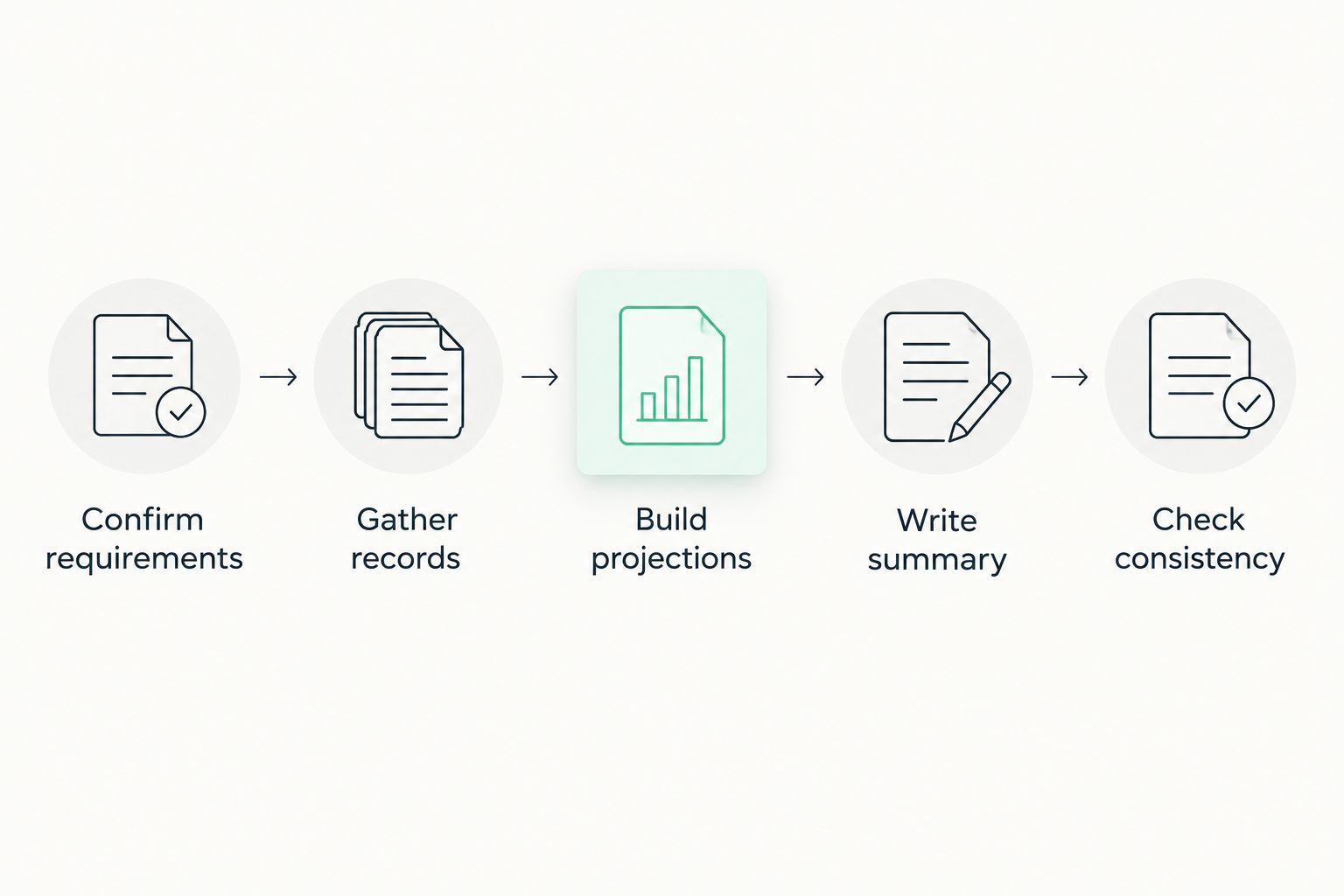
Use this sequence before spending time on formatting. It keeps the bank's requirements, your evidence and your written explanation connected.
- Confirm requirements. Ask the lender for the current checklist for the specific borrowing product. Confirm whether it wants a business plan, an application form, financial projections or a combination.
- Gather records. Collect the documents that support the figures you intend to use. Keep personal estimates separate from amounts supported by business records.
- Build projections. Show expected receipts and payments using stated assumptions. Use the proposed repayment terms supplied by the lender rather than inserting an assumed rate or schedule.
- Write summary. Condense the business, borrowing purpose and repayment explanation onto the page. Refer to attachments where the detail needs more space.
- Check consistency. Compare names, reporting periods, totals and assumptions across the submission. Resolve differences before sending the documents.
The sequence matters because the summary should describe the evidence, not dictate it. If your records contradict the story on the page, revise the story or investigate the records before submitting.
Keep a copy of the exact version you submit. When the bank asks a follow-up question, you need to answer from the same figures and assumptions rather than from an edited draft.
Why the detail needed varies between loan applications
The right amount of explanation follows the questions your application needs to answer. Use the factors below to decide where a short summary needs supporting detail; none replaces the lender's own checklist.
- The borrowing purpose. Explain what the funds will buy or support, and how that connects to business cash generation.
- The repayment source. Show whether repayment depends on existing activity, a planned expansion or customer payments that have not yet arrived.
- The quality of your records. Figures with a clear record trail are easier to explain than totals reconstructed from memory.
- The timing of cash. A business that receives money after making supplier payments needs to explain that timing gap.
- The lender's requested documents. Follow the requirements for the specific application rather than assuming every bank wants the same package.
For a 2026 loan discussion, ask which reporting periods the lender wants covered. Do not choose a period simply because it produces the most attractive result.
How do you explain repayment without confusing sales and cash?
Start with the money expected to arrive, then identify the business payments due before a loan instalment. Keep that explanation consistent with the business's records and the lender's proposed repayment schedule.
A profit forecast and a cash-flow forecast answer different questions. Profit describes income less expenses under the accounting approach used; cash flow tracks when money enters and leaves the business.
For a business that lets customers pay later, the difference is especially relevant. A sale recorded today does not necessarily fund a repayment due before the customer settles.
Use these 3 questions to check your explanation:
- When will the customer money actually arrive?
- Which supplier, staff and operating payments fall due first?
- What changes if receipts arrive later than expected?
Do not fill a forecast with unexplained growth. Identify what drives the change, distinguish an assumption from an existing order, and show how the timing affects available cash.
What if your business has limited financial records?
Start by establishing what you can support, not by making the plan longer. Gather the records you do have, identify gaps and keep reconstructed estimates visibly separate from recorded transactions.
Possible sources include sales records, receipts, invoices, supplier documents and transaction statements. Use them to explain business activity, but do not assume that every transaction on a statement represents business revenue.
If personal and business transactions share an account, prepare a clear explanation of which entries relate to the business. Do not silently remove inconvenient payments or count transfers between your own accounts as new sales.
Ask the lender how it wants gaps addressed. A template can organise the information you have; it cannot create missing evidence or guarantee that the lender will accept an alternative document.
Can a template replace a detailed business plan?
A template replaces a blank document, not the lender's requirements. Use it to organise information, then adapt the content to the questions in your application.
Skillspad is best for business owners seeking digital business templates, not a bank lending decision. Its templates provide a starting format; you remain responsible for the figures, assumptions and supporting evidence you submit.
Before using any template for a 2026 bank application, check that it distinguishes actual results from projections and gives you room to explain repayment. Remove sections that do not apply, but do not remove a section the lender specifically requests.
Should you send a longer plan if the bank only asks for a summary?
Send the requested summary and the requested supporting documents. Add further explanation when it resolves a real question, not merely to increase the page count.
Keep 2 documents distinct where the lender's process allows: the concise business summary and the detailed financial explanation. This makes it easier to read the request without hiding the assumptions behind it.
If the bank gives you a prescribed form, complete that form. A separate document is useful only when it supports the application rather than avoiding questions on the form.
FAQ
Can I use a one-page business plan to apply for a bank loan in Ghana?
You can use a one-page business plan to summarise your application, but acceptance depends on the lender's requirements. Confirm the required format and supporting documents before submitting.
How many pages should my business plan be for a bank loan?
Use the length your lender requests; page count alone does not establish repayment capacity. Keep the summary concise and put necessary detail in clearly labelled supporting documents.
Do I need a business plan if I already have business records?
Follow the lender's checklist even when you have business records. Records support past activity, while a plan explains the borrowing purpose and the assumptions behind future repayment.
Can a startup use a one-page plan for a bank loan?
A startup can use a one-page plan to explain the business and borrowing request, but the page does not establish eligibility. Ask the lender what evidence it accepts when the business has limited trading history.
Is a cash-flow forecast the same as a profit forecast?
A cash-flow forecast is not the same as a profit forecast. Cash flow tracks the timing of receipts and payments, while profit measures income less expenses under the accounting approach used.
Will a business plan template guarantee bank approval?
A business plan template does not guarantee bank approval. It organises your explanation, but it does not prove your figures or replace the lender's assessment.
What should I ask the bank before writing my plan in 2026?
Ask the bank for its current application checklist, required reporting periods and preferred plan format. Also ask which documents it accepts to support your financial figures and repayment explanation.
One last thing
Before submitting, compare 1 page of summary against its supporting records line by line. Every historical figure needs a traceable basis, and every forecast needs an identifiable assumption.
Then ask a simple question: does the page explain repayment, or does it only describe an attractive business idea? Make the repayment logic clear before making the document look finished. Skillspad business templates can support that organisation; they do not replace the evidence behind it.


