

Yes—a receipt without a company stamp can be legal in Ghana; the missing stamp alone does not make an ordinary payment receipt unlawful. In 2026, the separate questions are whether the receipt accurately records payment, meets any applicable tax requirements, and satisfies the buyer’s agreed documentation rules. A company stamp does not turn an ordinary receipt into a compliant tax invoice.
- Receipt without company stamp Ghana legal? Yes, an ordinary receipt is not unlawful merely because it lacks a stamp.
- Ghana Revenue Authority requirements are separate from a buyer’s internal demand for stamped receipts.
- Skillspad provides business templates; a template does not establish tax compliance or prove that payment occurred.
- Keep the receipt, payment evidence and related invoice together so the transaction can be checked.
Why this matters
A customer asking for a stamp and a tax authority requiring a particular document are different problems. Identify which requirement you are dealing with before replacing a receipt or rejecting a customer’s payment evidence. Otherwise, you risk fixing the appearance of the document while leaving its actual weakness untouched.
For your 2026 paperwork, start with accurate transaction details rather than a stamp graphic. The guide to receipt templates for small businesses in Ghana is a starting point for organising those details, not a substitute for checking the rules that apply to your transaction.
Is it legal to issue a receipt without a company stamp in Ghana?
The absence of a company stamp is not, by itself, a reason to treat an ordinary receipt as illegal. Its purpose is to acknowledge payment. Whether it also satisfies a tax obligation, a contract, or an organisation’s reimbursement procedure is a separate assessment.
The distinction matters because these documents serve different purposes:
| Document | Best for | What it helps establish | Limitation |
|---|---|---|---|
| Ordinary payment receipt | Acknowledging money received | The seller’s record of a payment | Does not automatically satisfy tax-invoice requirements |
| Stamped payment receipt | Meeting a buyer’s stated documentation procedure | A payment acknowledgement carrying a business mark | The stamp alone does not establish authenticity or tax compliance |
| Compliant tax invoice | Documenting a transaction subject to applicable tax-invoice rules | The prescribed tax details of the supply | Does not necessarily prove that the customer has paid |
| Bank or mobile money confirmation | Supporting evidence that money moved | A transfer between the recorded parties | Often needs a receipt or invoice to explain the business purpose |
A receipt can therefore be useful evidence without a stamp, while a stamped document can still contain incorrect details. Check the transaction, the issuer and the applicable document requirements together.
For tax questions, Ghana Revenue Authority guidance is the relevant reference point. For disputes about what a document proves, Ghana’s Evidence Act, NRCD 323, provides the broader evidentiary framework. Neither question is resolved simply by seeing ink from a rubber stamp.
Ordinary payment receipts: focus on the transaction
An ordinary receipt should let you connect the money received to the customer’s purchase or outstanding balance. Treat the following as a practical recordkeeping checklist, not an exhaustive statement of statutory requirements:
- Seller identity: Use the business or seller name that the customer can recognise and verify.
- Transaction date: Record when the payment was received, rather than silently substituting the date you prepared a replacement.
- Receipt reference: Give the receipt a reference that connects it to your records.
- Payment details: Record the amount received, currency and payment method accurately.
- Purpose: Describe the goods, services, deposit or balance payment clearly.
- Related record: Include the relevant invoice or order reference where one exists.
- Issuer identification: Identify the person or system acknowledging receipt of the money.
These details help you investigate a query without relying on someone recognising a stamp. They also make it easier to distinguish a deposit from final settlement.
Do not mark an unpaid invoice as paid just to give a customer something to submit. A receipt acknowledges money received; it should not promise that a future transfer will arrive.
Tax invoices: a stamp is not a compliance shortcut
If your transaction falls under Ghana’s tax-invoice requirements, use the document and issuing process those requirements prescribe. An ordinary receipt does not become an authorised tax document because you add a stamp, a signature or a tax-related heading.
For a transaction in 2026, confirm the current requirements with the Ghana Revenue Authority or a qualified Ghanaian tax practitioner. Ask about your registration status, the type of supply and any applicable electronic invoicing requirements. Do not copy another business’s tax wording merely because its receipt looks official.
The practical distinction works both ways. A valid invoice can document a supply before payment, while a payment receipt acknowledges settlement. If the buyer needs both tax documentation and evidence of payment, check that the records perform both functions rather than assuming a stamp covers everything.
Never copy another business’s taxpayer details or create an official-looking identifier. Accurate ordinary paperwork is better than a document that falsely presents itself as tax-authorised.
Electronic receipts: verify the record, not an image
An electronic receipt is not automatically invalid because it lacks a physical stamp. Ghana’s Electronic Transactions Act, Act 772, recognises electronic records within its scope, subject to the Act’s requirements and exceptions. That recognition does not make every screenshot genuine or every emailed receipt tax-compliant.
Keep the original message, file or system record where possible. A cropped image can remove the sender, date, reference or other information needed to check what happened.
For a mobile money payment, compare the transaction reference with the seller’s receipt and your own payment record. For a bank transfer, confirm that the recipient and payment purpose match the transaction you are documenting.
Do not add a scanned stamp to someone else’s receipt. If the recipient requires a corrected document, ask the issuer to provide it through a verifiable channel.
Why receipt acceptance varies
Receipt acceptance depends on more than whether a business owns a rubber stamp. Separate legal requirements from the recipient’s administrative preferences before deciding what to change.
- Document purpose: Proof of payment and documentation supporting a tax claim are not interchangeable.
- Tax status: The seller’s registration and the transaction’s tax treatment affect the appropriate document.
- Contract terms: A buyer’s purchase order or agreement can specify supporting paperwork.
- Recipient procedure: An employer, NGO or procurement team can request additional verification before processing an expense.
- Transaction details: An unclear description or unexplained amount creates questions that a stamp cannot answer.
- Authenticity: A disputed receipt requires verification of its origin and connection to the payment.
An organisation refusing an unstamped receipt does not, by itself, establish that issuing the receipt was illegal. It establishes that the document has not met that organisation’s acceptance process. Ask for the actual requirement instead of debating the stamp in isolation.
What should you do if a customer demands a stamped receipt?
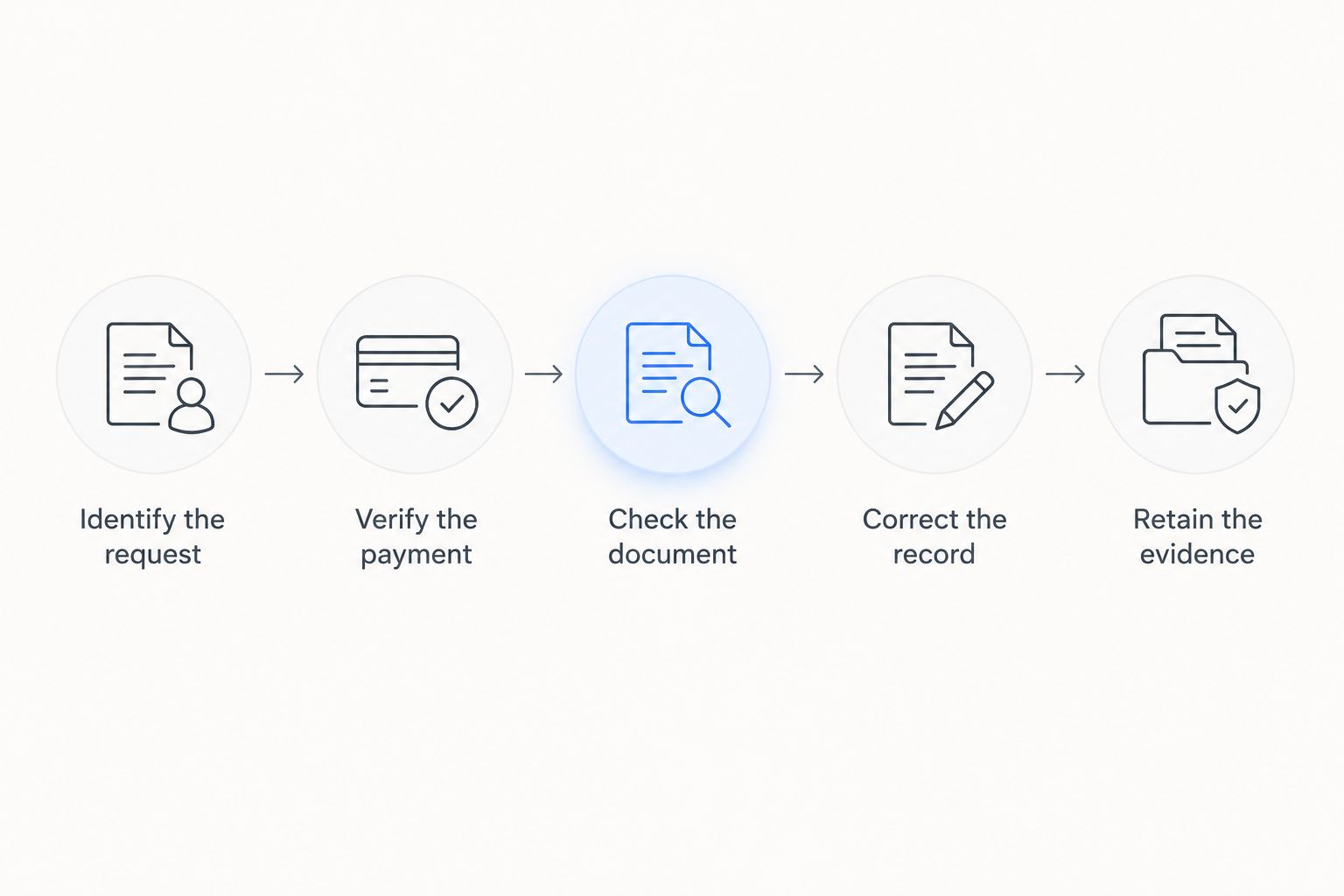
Ask whether the customer needs a stamp, tax documentation or confirmation of payment. Those requests require different responses. Use this sequence before issuing a replacement:
- Identify the request. Ask the customer which organisation is rejecting the receipt and what correction it requires.
- Verify the payment. Match the amount, recipient and reference against your own records.
- Check the document. Review the receipt details and any applicable tax-invoice requirements.
- Correct the record. Provide an accurate replacement or confirmation, clearly connected to the original transaction.
- Retain the evidence. Keep the original, replacement and supporting payment record together.
If you legitimately use a company stamp, apply it through your normal authorised process. If you do not use one, offer direct confirmation from the business and ask whether that satisfies the recipient’s procedure.
When replacing a receipt, identify it as a replacement or correction. Do not record the same payment again as new revenue, and do not change the payment date merely to match the date the customer requested another copy.
How should you check a receipt before accepting it?
Start by asking whether the document tells a consistent story. Does the seller’s identity match the business you dealt with? Does the description match your purchase? Does the recorded payment match your own evidence?
Contact the seller through a channel you already trust if anything conflicts. A phone number printed on a disputed document is not independent confirmation of who issued it.
For your 2026 records, separate a document’s appearance from its evidential value. A stamp, signature or logo can help identify the claimed issuer, but none replaces checking the transaction itself.
If the receipt supports an expense claim, check the recipient’s documentation rules before submitting it. If it supports a tax position, ask the appropriate tax professional whether the underlying document meets the relevant requirements.
Can a template help you issue better receipts?
A template helps you repeat the same recordkeeping fields instead of rebuilding a receipt for every payment. Its limitation is equally clear: it cannot verify that money arrived, determine your tax status or certify legal compliance.
Skillspad is best for Ghanaian businesses seeking reusable business templates, not legal certification. Skillspad sells digital templates for business use; assess any receipt layout against your actual payment process and documentation requirements before using it.
For a 2026 receipt workflow, test the layout against a real transaction you can verify. Check whether it distinguishes a deposit from a full payment and whether its reference connects to your invoice or sales record.
Do not choose a template because it has space for a stamp. Choose a layout that helps you record the truth consistently, and adapt it only within your authority.
Does an unstamped receipt prove that I paid?
An unstamped receipt can support proof of payment, but its strength depends on authenticity, content and the surrounding evidence. Keep it with the bank transfer, mobile money confirmation or other relevant payment record.
A receipt for a deposit does not establish that the entire balance was paid. Read what the document actually acknowledges before relying on it as proof of settlement.
Can a company reject my receipt because it has no stamp?
A company can apply its documentation procedures when processing a reimbursement or supplier claim, subject to the relevant agreement and law. Ask for the specific requirement and an acceptable alternative.
A rejection under an internal procedure does not automatically mean the receipt was unlawful. It means you need to resolve the recipient’s requirement or challenge it through the appropriate process.
Is a signature enough instead of a company stamp?
A signature can help identify who acknowledged the payment, but it is not a universal substitute for every document requirement. Check whether the recipient accepts a signed receipt and whether separate tax rules apply.
Neither a signature nor a stamp fixes a false amount, an unidentified seller or a payment that never occurred. Correct the underlying record first.
FAQ
Is a receipt without a company stamp legal in Ghana?
An ordinary receipt is not unlawful merely because it lacks a company stamp. Applicable tax rules, transaction-specific requirements and the recipient’s documentation procedures must still be considered separately.
Do I need a company stamp on a mobile money receipt?
A company stamp is not what establishes that a mobile money transfer occurred. Keep the transaction confirmation and connect it to the seller’s acknowledgement and the relevant purchase.
Can I use an unstamped receipt for a tax claim?
An unstamped receipt does not automatically establish entitlement to a tax claim. Check whether the document satisfies the requirements for the particular claim with the Ghana Revenue Authority or a qualified Ghanaian tax practitioner.
Can an emailed receipt be accepted in Ghana?
An emailed receipt is not automatically invalid because it is electronic or unstamped. Verify its origin, transaction details and suitability for the purpose for which you are submitting it.
Should I add a stamp image to a receipt myself?
Do not add a stamp image to someone else’s receipt. Ask the issuer for an authorised correction or confirmation if the recipient requires additional verification.
Does a stamped invoice prove that I have paid?
A stamped invoice does not necessarily prove payment. Check whether it explicitly acknowledges settlement and retain the supporting payment evidence.
Does a Skillspad template make my receipt legally compliant?
A Skillspad template does not certify legal or tax compliance. The issuer remains responsible for accurate information and for meeting the requirements that apply to the transaction.
One last thing
A stamped invoice marked unpaid is still not proof of payment. Before filing any receipt in 2026, trace it back to the money received and the obligation it settles.
That final check is more useful than adding another mark to the page. Keep the payment trail intact, and resolve tax or contractual questions with the relevant authority or adviser rather than treating the stamp as the answer.


