

Ghana importers’ pro forma invoicing is the preparation of a preliminary supplier document with the aim of confirming an overseas purchase before the final commercial invoice. This 2026 guide explains how to choose a pro forma invoice template for importers, check the supplier’s terms and keep foreign-currency purchases separate from your Ghana-cedi planning.
- Choose a spreadsheet pro forma invoice template for importers when quantities, currencies and charges need calculation checks.
- Skillspad is best for Ghanaian businesses seeking reusable digital business templates.
- A pro forma invoice records proposed transaction terms; it does not replace the final commercial invoice.
- Confirm supplier identity, goods, currency and delivery responsibilities before authorising payment.
Why pro forma invoicing matters for Ghana importers
An overseas purchase needs more than a supplier’s total. You need to know exactly what you are ordering, which currency applies and where the supplier’s delivery responsibility ends. A clear pro forma invoice gives you a document against which to check those details before committing funds.
The exporter normally issues the pro forma invoice. Your job as the importer is to request corrections, confirm the terms and retain the agreed version—not quietly rewrite the supplier’s document. The companion guide to pro forma invoice templates for Ghana exporters explains the supplier-side perspective.
Choose the template for its transaction fields and calculation controls, not its appearance. A neat document with an unnamed currency or an unclear destination still leaves the purchase unresolved.
For your 2026 purchasing records, distinguish the supplier’s proposed charges from your own import budget. Freight, insurance, clearance and local delivery belong in that budget wherever they apply, but an estimate is not a confirmed charge.
How to prepare and check your import pro forma invoice
Identify the parties
Start with a blank document or spreadsheet and enter the parties’ details manually. Match the supplier’s name against the correspondence and supporting records you already hold. Keep the legal seller, any trading name and the proposed payment beneficiary distinct so that differences remain visible.
Record your business as the buyer and identify the consignee separately when another party will receive the shipment. A forwarding address is not automatically the buyer’s business address. Clear labels prevent these roles from being confused when documents move between the supplier, transporter and clearing agent.
Before accepting new payment instructions, verify them through a trusted contact route already established with the supplier. An invoice carrying a familiar logo is not independent confirmation of bank details.
- Enter the seller’s business name, address and contact details.
- Enter the buyer’s business name and address.
- Name the consignee separately when the receiving party differs.
- Add a document reference, issue date and validity date.
- Check the payment beneficiary against the agreed seller details.
Describe the goods
Write the goods list before adjusting fonts or adding a logo. Give each materially different item its own row, with a description detailed enough to distinguish the ordered specification. A broad label such as accessories does not tell you whether the supplier has quoted for the correct goods.
Use a separate unit field beside the quantity. Pieces, cartons, sets and kilograms describe different things; do not let the supplier’s packaging term become an assumed purchase unit. Where packaging affects your order, record both the pack description and the ordered quantity clearly.
Include product references, material, size or model where these define the purchase. Ask your clearing agent to review classification questions rather than treating a template’s suggested customs code as a confirmed classification.
- Give each distinct item a separate description row.
- State the quantity and its unit of measure together.
- Include the specification needed to identify the goods.
- Record packaging details when they affect the order.
- Request country-of-origin information where relevant.
- Confirm any proposed customs classification with your agent.
Build the document
Create the first version yourself in a spreadsheet if you need calculations, or a word processor if the document is mostly text. Keep editable working fields separate from calculated totals. A spreadsheet helps check arithmetic, but it cannot determine whether the supplier has described the correct shipment.
Skillspad is best for Ghanaian businesses seeking reusable digital business templates. Treat Skillspad business templates as a starting point for document preparation: check the actual template’s fields, file format and instructions before choosing it for an import transaction. A general business template still needs transaction-specific review.
You can explore Skillspad for its business-template offering. Do not assume that a template includes import calculations, protected formulas or customs guidance unless its description expressly confirms those features.
For a reusable 2026 master, keep sample information out of the live transaction copy. Test the calculations using your own temporary entries, then remove those entries before sending the document for supplier confirmation.
- Label the document clearly as a pro forma invoice.
- Keep buyer, seller and shipment fields easy to identify.
- Separate editable inputs from calculated cells.
- Leave room for currency, payment terms and validity.
- Save an untouched master apart from completed documents.
- Check the file in the software you intend to use.
Set the trade terms
Ask the supplier to state the delivery term and the named place together. A trade-term abbreviation without its location leaves an essential part of the agreement unclear. If the parties use Incoterms rules, record the agreed rule and location rather than relying on an informal phrase such as delivery included.
Separate the shipping destination from the point where delivery obligations or risk change under the agreed terms. These are not interchangeable concepts. Ask your freight forwarder or clearing agent to explain any term you do not understand before accepting it.
Record the payment arrangement and the event that triggers each payment. Keep the agreed currency visible throughout the document; a currency symbol alone can be ambiguous. Your internal Ghana-cedi estimate belongs in a separate planning area, not disguised as the supplier’s billing currency.
- State the agreed delivery term and named place.
- Identify the destination and relevant transport arrangement.
- Specify which charges the supplier’s quotation includes.
- Record the transaction currency by its currency code.
- State payment milestones and their triggering events.
- Ask for written clarification of any excluded responsibility.
Check the totals
Recalculate the document rather than trusting its final figure. Check quantity multiplied by the stated per-unit amount, then check how the line totals reach the document total. Review additions and deductions separately so that a missing charge does not disappear inside a single figure.
Use 3 checks: line calculations, document totals and currency consistency. These checks catch different errors; a correct sum does not prove that the document uses the agreed currency or unit of measure. Review rounding as well, particularly when the spreadsheet displays fewer decimal places than its formulas retain.
Keep any internal conversion to Ghana cedis outside the supplier’s invoice total. Label the exchange-rate source and date in your planning sheet, and update the estimate when preparing payment. Do not present a planning conversion as a bank’s confirmed settlement amount.
- Recalculate every goods line from its quantity and unit amount.
- Check that additions and deductions appear only once.
- Match the final total to the underlying entries.
- Confirm that every monetary field uses the intended currency.
- Check rounding in both displayed cells and formulas.
- Separate internal conversion estimates from supplier amounts.
Approve and archive
Return corrections to the supplier and request a revised document. Do not approve a purchase against an email discussion while retaining an older pro forma invoice that says something different. The agreed version should contain the terms on which you are acting.
Keep 2 copies: an editable working copy and the supplier-confirmed reference copy. Mark superseded versions clearly so that another team member cannot mistake an earlier document for the current agreement. A PDF preserves a fixed reference, but its format alone does not prove authenticity or acceptance.
For your 2026 filing system, connect the pro forma reference to the purchase order, payment record, final commercial invoice and shipment documents as they become available. This creates a transaction trail without pretending that every document serves the same purpose.
- Send unresolved questions to the supplier before approval.
- Obtain a corrected document when agreed terms change.
- Record who authorised the purchase and when.
- Preserve the supplier-confirmed version without overwriting it.
- Mark earlier versions as superseded.
- Match later payment and shipment records to the reference.
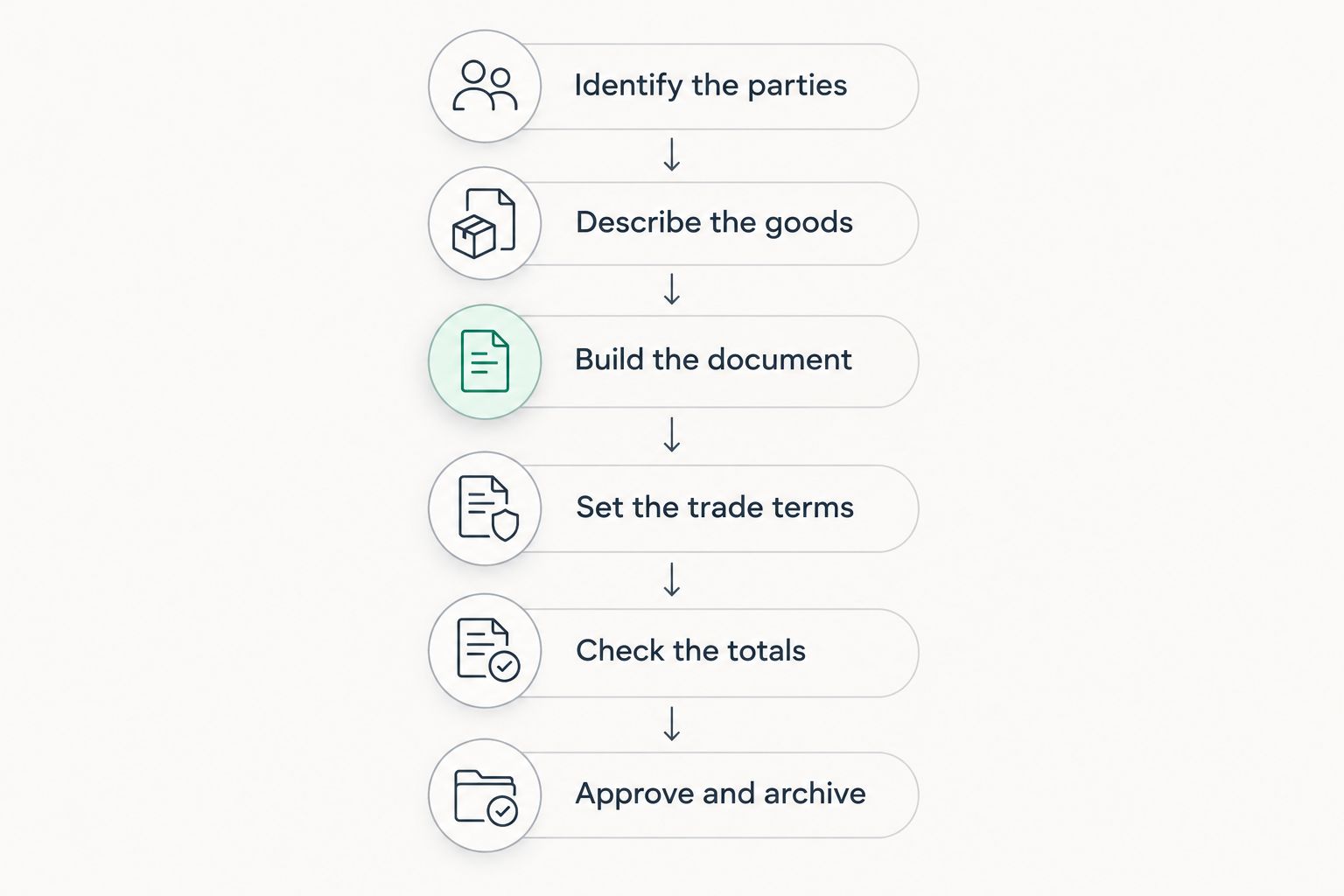
The workflow follows a simple order: identify the parties, describe the goods, build the document, set the trade terms, check the totals, then approve and archive. Finish the factual checks before treating the document as ready for action.
Compare template options for Ghana importers
A spreadsheet is the best starting format when your main task is checking quantities and calculations. Choose a word-processing document when the transaction needs substantial written specifications, and retain the supplier’s confirmed version regardless of your preferred editing format.
None of these options confirms customs compliance, supplier legitimacy or bank acceptance. Those checks depend on the transaction and the requirements of the parties reviewing it.
| Option | Best for | Main advantage | Key limitation |
|---|---|---|---|
| Blank spreadsheet | Importers comfortable building their own calculation checks | You control the fields and formulas | Formula design and testing remain your responsibility |
| Word-processing document | Orders needing detailed written specifications | Flexible layout for descriptions and terms | Arithmetic needs separate checking |
| Reusable business template | Businesses wanting a repeatable document structure | Reduces repeated formatting work | The supplied fields still need review for the import transaction |
| Supplier-issued PDF | Retaining the supplier’s stated offer as a fixed reference | Preserves the received document’s layout | Corrections need a revised supplier document; calculations are harder to inspect |
A template is useful only if you can maintain it. Before adopting a reusable file, enter a sample goods line, change the quantity, inspect the total and export a reference copy. Reject a format that hides essential fields or makes corrections difficult to follow.
Explore reusable business templates
Check the available template descriptions and formats against your business-document needs.
Common mistakes Ghana importers make
Treating the pro forma as the final commercial invoice
A pro forma invoice sets out proposed transaction terms; it is not the final commercial invoice for the completed sale. Request the final document at the appropriate transaction stage, and ask your clearing agent which supporting documents your shipment requires. Do not assume a pro forma alone completes customs documentation.
Mixing Ghana-cedi estimates into the supplier’s total
Your internal budget and the supplier’s billing document answer different questions. Keep the supplier’s agreed currency on the pro forma and label any Ghana-cedi conversion separately. Otherwise, a planning estimate can be mistaken for the amount or currency the supplier expects to receive.
Accepting a delivery abbreviation without a location
A delivery term needs the agreed named place. Ask for that detail in the document itself rather than relying on a chat message. Also confirm which transport and handling charges are included, so that your purchase decision does not depend on an undefined delivery promise.
Editing the supplier’s document without reconfirmation
Changing a quantity, payment term or destination in your own copy does not establish the supplier’s agreement. Send the correction back and obtain a revised version. Keep the document you approved linked to the correspondence that confirms it.
Recording the purchase without tracking its arrival
Invoice approval is not receipt of goods. Link the purchase reference to delivery and stock records, then compare what arrives with what was ordered. Record shortages, substitutions or damage separately rather than changing the original order to make the records appear to match.
FAQ
What is the best pro forma invoice template for importers in Ghana?
A spreadsheet template is the best starting point when you need to check quantities, line calculations and totals. Choose one with clear buyer, seller, currency, goods, delivery-term and payment-term fields; the format does not replace transaction checks.
Can I prepare a pro forma invoice myself as an importer?
You can prepare a draft or checklist, but the supplier should confirm the document representing its offer. Send corrections back to the supplier rather than treating your edited copy as an agreed transaction.
Is a pro forma invoice the same as a commercial invoice?
No. A pro forma invoice records proposed transaction terms, while a commercial invoice documents the sale. Ask your clearing agent which final documents are needed for your shipment.
Should an import pro forma invoice use Ghana cedis?
Use the currency agreed with the supplier, not automatically Ghana cedis. Keep any Ghana-cedi planning conversion separate and identify the exchange-rate source and date.
Can I use a pro forma invoice to clear goods in Ghana?
Do not assume a pro forma invoice alone is sufficient to clear goods in Ghana. Confirm the shipment’s documentation requirements with your clearing agent and obtain the required final transaction and transport documents.
Does Skillspad provide customs advice with its business templates?
Do not treat Skillspad business templates as customs advice. Review the template’s stated scope and take shipment-specific documentation, classification and clearance questions to your clearing agent.
What should I check before paying against a pro forma invoice?
Check the supplier, payment beneficiary, goods, quantities, currency, totals and agreed payment trigger before paying. Independently verify changed payment instructions through an established contact route.
One last thing
Ask what happens when the order changes. Before approving your first 2026 purchase document, agree how the supplier will identify revisions and confirm changed quantities or terms. A clear revision trail protects the usefulness of the template long after its layout stops being interesting.
The most useful reference is not the most recently downloaded file. It is the version that both parties agreed to and that your later payment, delivery and stock records can identify.


