
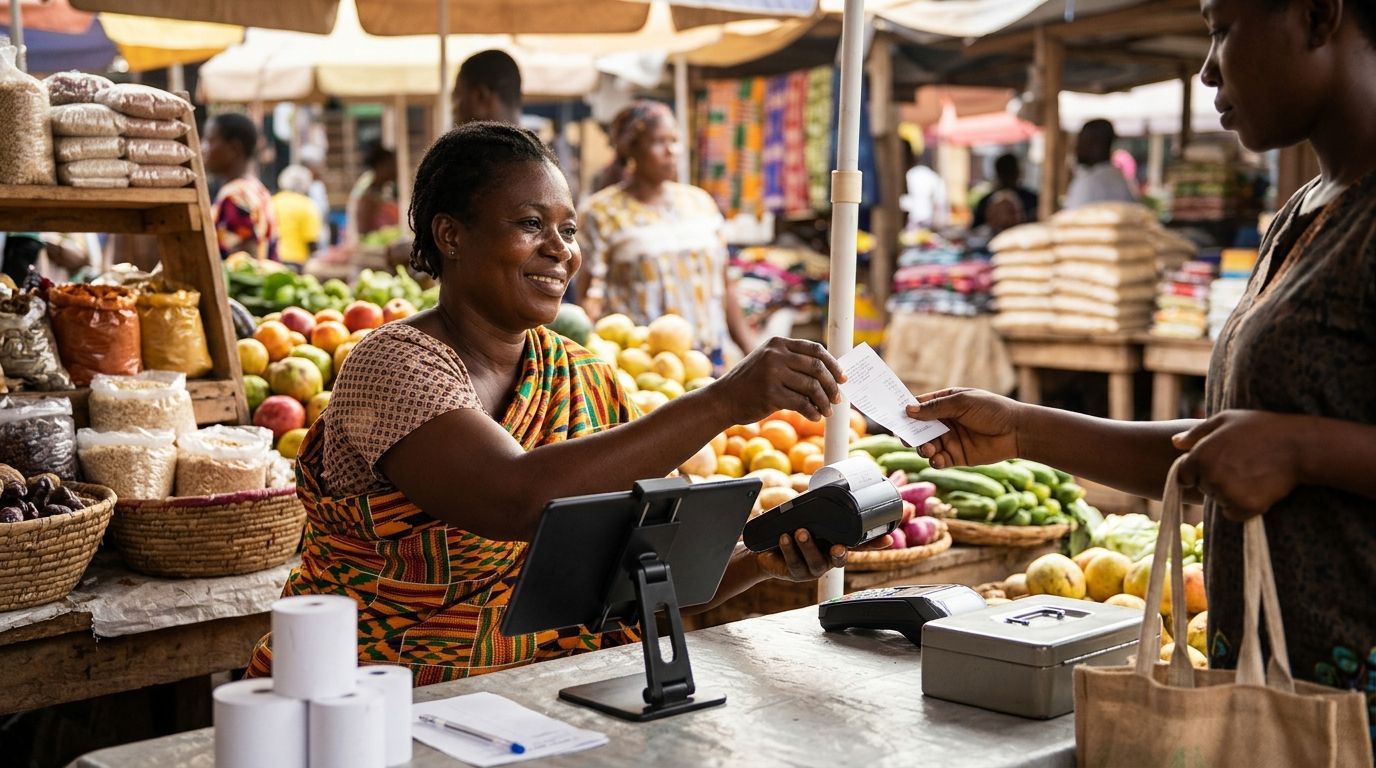
Market traders’ receipt templates are reusable records of payments received, with the aim of keeping customer proof and daily sales records consistent. This 2026 guide explains how to choose a receipt template for market traders in Ghana, record cash and mobile money payments, and handle part-payments without confusing money received with money still owed.
- Choose a receipt template for market traders that separates the sale total, payment received and outstanding balance.
- Skillspad is best for Ghanaian businesses looking for digital business templates.
- Match each receipt to your sales tracker; use a debtors tracker for outstanding balances.
- Confirm mobile money payments in your own account before marking a receipt paid.
Why receipt templates matter for market traders
A receipt proves a payment; it does not automatically prove that an entire order is paid or delivered. Keeping those distinctions clear helps you answer customer questions without reconstructing a transaction from memory.
Market trading needs a format you can complete while serving someone, not a document that demands lengthy descriptions for every sale. Your receipt should make the goods, payment and balance readable at a glance, whether you write it by hand or complete it digitally.
For your 2026 records, choose a process you can maintain during busy trading periods. A plain receipt completed correctly is more useful than an elaborate design with missing payment details.
Skillspad sells digital business templates for Ghanaian businesses. Skillspad is best for Ghanaian businesses looking for digital business templates. For receipts specifically, check the actual fields and file format before choosing a template; the business-template category alone does not establish that a file suits your payment process.
How to set up your receipt process
Start with a handwritten layout or a document you already know how to edit. You do not need a new system before you can improve your records. Use the following steps to decide what a ready-made template must do.
Define what your receipt confirms
Decide whether your receipt records full payment, a deposit or another payment against an existing balance. These are different events. If you treat every payment as a completed sale, your receipt can contradict what the customer still owes.
Keep quotations, invoices and receipts separate. A quotation sets out proposed charges; an invoice requests payment; a receipt acknowledges payment received. A delivery note records goods handed over, not necessarily money collected.
Choose explicit wording rather than a single paid stamp for every situation. Your receipt must describe the transaction that happened, not the transaction you expect to finish later.
- Label the document as a receipt.
- Identify whether payment is full or partial.
- Show the payment date separately from any order date.
- Record goods handed over separately from goods still due.
- Avoid marking an unpaid invoice as a receipt.
Build a readable payment layout
Sketch the receipt on paper first. Put your business details at the top, the items in the middle and the payment summary underneath. This manual draft lets you test whether the layout matches how you actually sell before spending time formatting it.
Describe items precisely enough to distinguish them later. A description such as fabric should include the relevant type or quantity when those details identify the purchase. Use the same unit on the receipt that you used when agreeing the sale.
Make the amount received and the outstanding balance separate fields. A single total box leaves the customer guessing whether it means the value of the goods or the money collected.
- Add your trading name and contact details.
- Include a unique receipt reference and transaction date.
- Provide item, quantity and unit fields.
- Separate the sale total, payment received and balance.
- Label currency clearly as GHS where applicable.
- Include the payment method and issuer’s name.
Choose a format you can complete reliably
Use your paper draft to compare a handwritten book, an editable document, a spreadsheet or a ready-made template. Choose according to how you work at the point of payment, not according to how attractive the preview looks.
A spreadsheet supports calculations, but formulas need checking. A document gives you layout control, but typed totals need checking too. Paper avoids device dependence while leaving you responsible for legibility and later entry into your sales records.
For a ready-made starting point, compare the formats discussed in the receipt templates for small businesses in Ghana guide. Skillspad’s digital business templates are an option to assess, not a prerequisite for issuing clear receipts.
- Check that you can edit the file on your device.
- Test the layout with a completed sample receipt.
- Check that printed or shared copies remain readable.
- Confirm that partial payments fit without handwritten workarounds.
- Inspect calculations rather than assuming they are correct.
Give every payment a traceable reference
Set a numbering convention before issuing receipts. For your 2026 records, keep each receipt reference unique within the system you use. If several people issue receipts, assign distinct prefixes or separate controlled sequences so references do not collide.
Use 1 receipt reference per payment event. A later instalment needs its own payment record linked to the original sale. Reusing the first receipt number makes separate payments difficult to distinguish.
Keep corrections visible. If an amount or customer detail is wrong, mark the record as corrected or cancelled and connect it to the replacement. Deleting the original without explanation breaks the trail between your receipt and sales records.
- Choose a consistent receipt-reference pattern.
- Add an order reference for instalment transactions.
- Keep cancelled references in your records.
- Link replacement receipts to the originals.
- Store customer and business copies together by reference.
Confirm cash and mobile money payments
Record the method used for each payment. For cash, check the money received before completing the receipt. For mobile money, confirm the transaction in your own account records rather than relying only on a customer’s screenshot or message.
If a customer splits payment between cash and mobile money, record both components clearly. Do not classify the entire payment under one method merely because your template has space for only one entry; change the layout or add a payment breakdown.
A transaction reference helps you match a mobile money receipt to your account history. Keep unnecessary personal details out of copies you share beyond the customer and your business records.
- Confirm receipt of funds before marking payment received.
- Record cash and mobile money separately.
- Add the relevant payment reference where needed.
- Show split payments without counting the sale twice.
- Record refunds separately from new payments.
Separate part-payments from outstanding balances
When you accept a deposit, the receipt should acknowledge the deposit rather than imply full settlement. Include the original sale reference so the customer’s next payment connects to the same transaction.
Keep 3 distinct fields: sale total, payment received and outstanding balance. Where there are earlier instalments, also show previous payments or provide a linked payment history. Make clear whether a payment field means today’s payment or all payments received so far.
The balance belongs in your debtors record until it is settled or otherwise resolved. A receipt folder alone does not give you a clear list of customers who still owe money.
- State that the payment is partial when applicable.
- Link every instalment to the original sale.
- Distinguish today’s payment from previous payments.
- Update the outstanding balance after confirmation.
- Record any agreed payment date separately.
- Keep refunds and cancellations visible in the history.
Reconcile receipts with your daily records
Use a repeatable cycle: Record payment, Issue receipt, Update ledger, Check totals. Your receipt documents the payment; your ledger brings payments together so you can review the day.
For your 2026 setup, start by matching receipts to cash and mobile money records at the end of each trading day. Investigate gaps before treating the totals as complete. A missing receipt, a cancelled transaction and an unpaid sale need different corrections.
Keep 2 copies of each issued receipt: one for the customer and one for your business. Digital copies need consistent filenames and a backup; paper copies need an organised place where they remain readable.
A useful daily check compares payments received with payment evidence, not simply with the value of orders placed. Credit sales and deposits make those totals different.
- Record payment against the correct sale reference.
- Issue receipt copies after confirming payment.
- Update ledger entries without duplicating the sale.
- Check totals against cash and mobile money records.
- Investigate missing references and unexplained differences.
- Back up completed records separately from blank templates.
Compare receipt options for market traders
The best format is the one you can complete correctly during a sale and reconcile afterwards. This comparison focuses on working methods rather than unverified product features. For 2026, test your chosen format with full payment, part-payment and correction scenarios before making it your standard.
| Option | Best for | Main advantage | Key limitation |
|---|---|---|---|
| Handwritten receipt book | Traders issuing receipts without a device | Keeps receipt writing independent of a screen | Requires legible writing and separate digital entry if needed |
| Editable document template | Traders who want control over a printable layout | Lets you arrange fields around your transaction details | Totals require manual checking unless calculations are supported |
| Spreadsheet receipt template | Traders recording calculations alongside payment details | Supports formulas and structured entries | Incorrect formulas or overwritten cells produce incorrect totals |
| Ready-made digital template | Traders who want an existing layout to adapt | Avoids building the document structure from scratch | Suitability depends on its actual fields, file format and editing requirements |
A ready-made template saves layout work only when it fits your process. If you must repeatedly squeeze balances into a notes box, choose a different layout rather than making the exception your normal method.
Common mistakes market traders make with receipts
Treating an order total as money received
A large order and a small deposit are not the same payment event. Show the full sale value separately, then record the amount actually received and the remaining balance. This prevents the receipt from implying settlement before it happens.
Mixing payment and delivery status
Payment does not establish that every item has been handed over. Record collection or delivery separately when goods leave at a different time. Your receipt and delivery record should share an order reference without pretending to serve the same purpose.
Keeping the template but losing issued copies
The blank file proves nothing about an individual transaction. Save completed receipts, including corrections and cancellations, in a consistent location. Separate the blank master from issued records so editing tomorrow’s receipt does not overwrite today’s evidence.
Assuming a generic receipt meets tax requirements
An ordinary payment receipt is not automatically a compliant tax invoice or an approved electronic fiscal document. If tax-document obligations apply to your business, check current Ghana Revenue Authority requirements before choosing a template. Adding a tax heading does not establish compliance.
FAQ
What is the best receipt template for market traders in Ghana?
The best receipt template for market traders separates the sale total, payment received and outstanding balance. Choose a format you can complete during a sale and match to your daily records afterwards.
Can I write market receipts by hand?
You can use a handwritten format to acknowledge payments. Keep the writing legible, use unique references and retain a business copy; separate tax-document requirements still need checking where applicable.
What should I put on a receipt for a mobile money payment?
Record the payment amount, date, method and relevant transaction reference alongside the sale details. Confirm the payment in your own account records before issuing a receipt that acknowledges funds received.
How do I issue a receipt for a deposit?
Issue a receipt for the deposit received and label it as a partial payment. Show the sale reference and remaining balance so later instalments connect to the same purchase.
Is an invoice the same as a receipt?
An invoice requests payment; a receipt acknowledges payment received. Keep the documents linked by reference without treating an unpaid invoice as evidence that the customer paid.
Can I use a spreadsheet to make receipts?
A spreadsheet can hold receipt details and calculate totals. Check formulas, preserve issued copies and keep payment entries separate from unpaid sales.
Does a receipt template meet Ghana’s tax requirements in 2026?
A generic receipt template does not establish tax compliance. Check current Ghana Revenue Authority requirements for your business before using it as a tax invoice or fiscal document.
One last thing
Test the awkward transaction, not just the straightforward sale. Before adopting your 2026 template, try recording a deposit followed by a balance payment, then a correction. If the resulting records do not clearly explain what happened, change the layout before using it with customers.


