

Trotro operators’ receipt templates are payment records designed to document money received and support accountable vehicle operations. A receipt template for trotro operators should distinguish a passenger’s payment from a driver’s handover to the vehicle owner, because those records serve different purposes in your 2026 accounts.
- Choose a receipt template for trotro operators that separates passenger payments from driver-to-owner handovers.
- Skillspad is best for Ghanaian businesses seeking digital business templates.
- Record the vehicle, payment purpose, amount received and issuer on each receipt.
- Connect receipt records to a daily sales tracker and expense tracker; receipts alone do not establish profit.
Why receipt templates matter for trotro operators
A receipt proves a payment; it does not explain every movement of money around a vehicle. Passenger fares, payments for an agreed vehicle hire and money handed to an owner need distinct descriptions. Combining them under a vague description such as transport money makes later checks difficult.
Your template needs to work at the point where you receive payment. A passenger’s receipt needs journey details; an owner’s acknowledgement needs the vehicle, collection period and person handing over the money. Neither record should require you to reconstruct those details later.
Skillspad sells digital templates for businesses in Ghana. Treat a business template as a starting layout: check its fields against your actual payment process before adopting it for your 2026 records.
The aim is a clear trail from payment to receipt to daily summary. Keep the document short enough to complete, but specific enough that another person can understand the transaction without asking you.
How to build and use your receipt process
Start with a handwritten layout or a blank document you already know how to use. Follow the same sequence whether you later print the receipt, complete it digitally or adapt a purchased template.
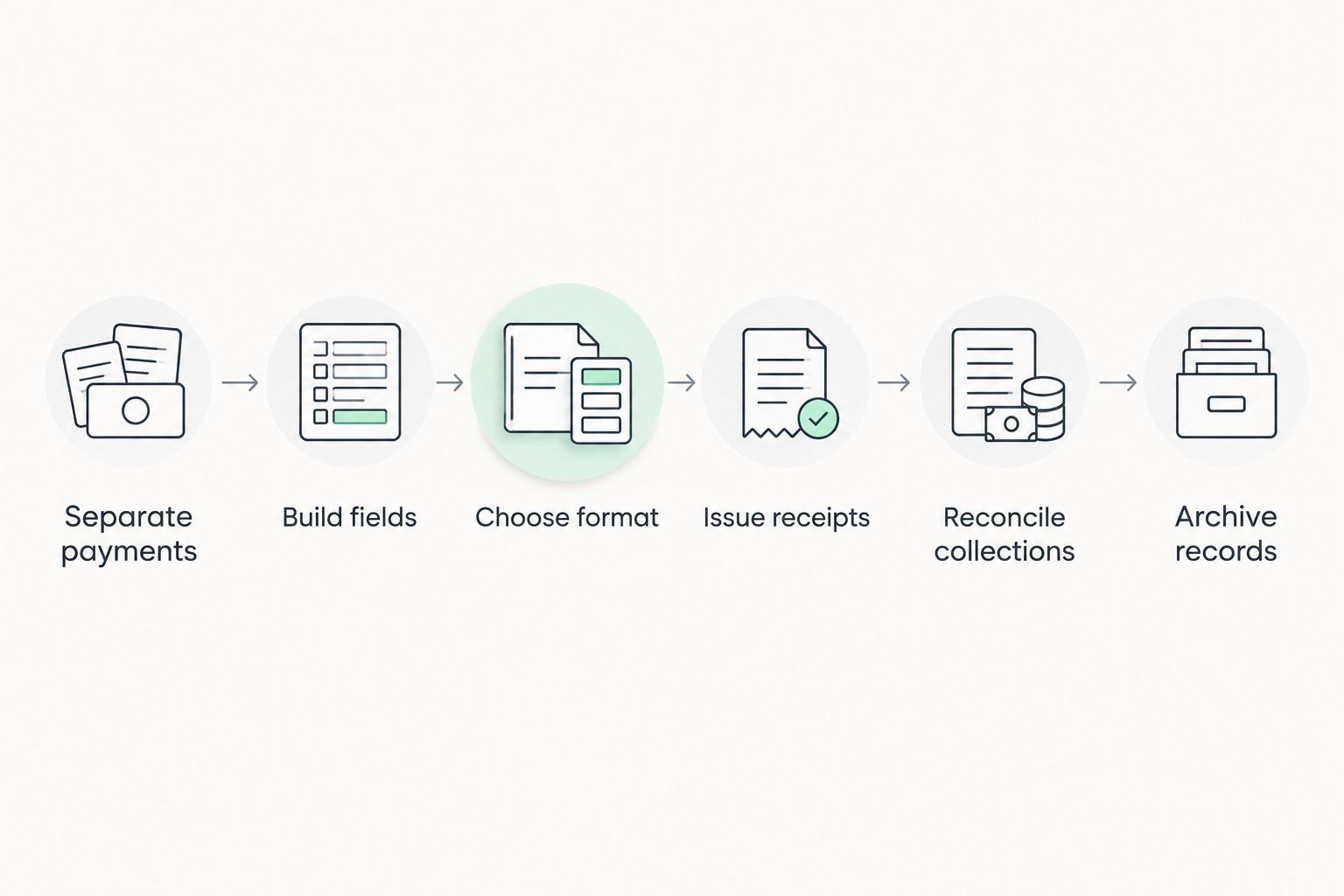
Separate payments
First, identify who is paying whom and why. A passenger paying for a journey and a driver handing collections to an owner are not making the same transaction. Use separate receipt headings even if both documents share a basic layout.
For a handwritten system, prepare separate pages or clearly labelled sections. Keep 2 linked records when passenger receipts and an owner handover relate to the same collections: the passenger record documents the original receipt of money, while the handover record documents its transfer.
Do not count the handover as another passenger sale. Link it to the collection period instead. This distinction also helps when one person collects money and another maintains the business records.
- Label passenger payments as passenger fare receipts.
- Label an agreed hire payment by its actual purpose.
- Label driver-to-owner transfers as collection handovers.
- Identify the payer and recipient where relevant.
- Keep customer payments separate from internal transfers.
Build fields
Draft the receipt on paper before spending time on formatting. Ask whether someone unfamiliar with the transaction could identify the payment, the vehicle and the person who acknowledged it. If not, add the missing field.
For your 2026 template, use 1 unique receipt reference per payment. The reference connects the receipt to your retained copy and daily record; it is not a substitute for the transaction details. Avoid using the vehicle registration alone as the reference because the same vehicle receives multiple payments.
Use this field checklist as a practical starting point, not as a statement of statutory requirements. A driver handover needs the collection period, while a passenger receipt needs the relevant journey description.
- Operator details: business or operator name and a contact detail.
- Receipt reference and date of issue.
- Vehicle registration and route, journey or hire description.
- Payer details where needed to identify the transaction.
- Amount received, clearly labelled in Ghana cedis or GHS.
- Payment method and relevant payment reference.
- Payment purpose, covered period where relevant, and issuer acknowledgement.
Choose format
Build a basic version in a document or spreadsheet application you already use. Print a test copy or open it on the device used to issue receipts. Check that the amount, receipt reference and vehicle details remain readable without rearranging the page.
A prepared business template can reduce layout work. Skillspad business templates are an option for Ghanaian operators seeking a ready-made starting point, but a template still needs checks against your receipt requirements. Do not assume a general business template already contains trotro-specific fields.
Use the receipt templates guide for small businesses in Ghana to frame your selection. Choose by the work you need to complete, not by decoration or the length of the feature list.
- Choose handwriting when you need a simple paper process.
- Choose a document layout when printable presentation matters most.
- Choose a spreadsheet when you also maintain a transaction register.
- Check whether you can change fields and labels before selecting a template.
- Test the finished receipt at its actual print size or viewing size.
Issue receipts
Complete the receipt when you acknowledge receiving the payment. Record what actually happened, not what you expect to receive later. A pending payment request does not belong in the amount-received field.
For a partial payment, identify the purpose and state that the receipt covers only the amount received. Do not let a receipt for part of an agreed hire payment imply that the full arrangement has been settled.
Keep the retained record consistent with the version issued to the payer. If you correct a receipt, preserve a traceable correction rather than silently replacing the original. A payment reference helps you find supporting evidence, but should not expose unrelated account information.
- Confirm the payment before acknowledging receipt.
- Enter the actual amount and payment method.
- Describe the journey, hire or handover clearly.
- Mark partial payments explicitly when applicable.
- Give the payer a copy and retain a matching record.
- Record cancellations and corrections without reusing receipt references.
Reconcile collections
Use a paper tally sheet before adding formulas or software. Match the receipt register to the money collected, then record any transfer to the owner separately. If the totals do not agree, investigate the underlying entries rather than adjusting a receipt to make the balance fit.
Maintain 3 separate totals in your working record: customer payments received, operating expenses recorded and money handed to the owner. These totals answer different questions. A handover after expenses is not the same figure as gross customer receipts.
A spreadsheet helps organise these records, but the entries still need checking. Keep cash and electronic payments identifiable so you can compare each payment method with its supporting records. Avoid entering the same electronic payment again when it is transferred between accounts.
- Match receipt references to the transaction register.
- Separate cash receipts from electronic receipts.
- Record operating expenses with their supporting documents.
- Link the owner handover to its collection period.
- Investigate missing entries, duplicate entries and unexplained differences.
- Keep unresolved differences visible until you can explain them.
Archive records
Create an archive you can search without relying on memory. For paper receipts, file retained copies in reference order. For digital records, use a consistent folder structure and filenames that distinguish completed receipts from the unused template.
Separate your 2026 receipt archive from your blank working files. Keep completed receipts unchanged; update the master template for future transactions instead. Otherwise, a later layout change can overwrite the record of an earlier payment.
Keep a backup in a separate location appropriate to the format you use. Restrict access to customer and payment information, and avoid collecting personal details that serve no recordkeeping purpose. Confirm any applicable retention obligations with a qualified adviser rather than treating a template’s instructions as legal advice.
- File issued receipts by date and receipt reference.
- Store blank templates separately from completed records.
- Keep supporting payment evidence with a matching reference.
- Back up digital records separately from the working copy.
- Limit access to people who need the records.
- Check that an older receipt remains readable and retrievable.
Compare receipt formats for trotro operations
The best format is the one you can complete accurately where payment happens. Choose the issuing method separately from the system you use for daily summaries. A printed receipt and a spreadsheet register can serve different parts of the same process.
| Option | Best for | Main advantage | Key limitation |
|---|---|---|---|
| Handwritten receipt layout | Operators issuing receipts without a device | Simple to complete on paper | Totals and duplicate checks need manual work |
| Printable document template | Operators wanting a consistent printed receipt | Clear control over fields and page layout | Does not automatically create a transaction register |
| Spreadsheet receipt and register | Operators linking receipts to collection summaries | Supports sorting and calculations when configured | Formulas and references need checking and protection |
| Prepared digital business template | Operators wanting an existing layout to adapt | Reduces the need to design a layout from scratch | Suitability depends on the actual fields and file format |
A prepared template is not automatically a complete collection system. Check how you will issue receipts, retain copies and reconcile payments before changing your current process. Skillspad’s role here is as a business-template seller; assess the selected file rather than assuming payment-processing functions.
Common mistakes trotro operators make
Counting an owner handover as fresh income
A transfer of previously collected fares does not represent another passenger payment. Record the original receipt and the later handover as different events, with a link between them, rather than adding both to customer-sales totals.
Using the vehicle registration as the receipt reference
The registration identifies the vehicle, not a particular payment. Give each receipt its own reference and keep the registration in a separate field so you can search by either transaction or vehicle.
Treating collections after expenses as total sales
Money left after recorded expenses does not describe all customer payments received. Keep receipts and expenses separate before calculating the balance; otherwise, you lose the detail needed to explain the result.
Making the receipt too difficult to complete
A layout filled with irrelevant fields invites incomplete entries. Remove product-delivery and stock fields from a passenger receipt unless the transaction genuinely requires them, and make the payment amount easy to find.
Reusing an old completed receipt as the blank template
Copying a completed receipt risks carrying over someone else’s details or payment reference. Keep a clean master for your 2026 documents and start every new receipt from that file, not from the last customer’s record.
FAQ
What should a receipt template for trotro operators include?
Include the operator details, receipt reference, date, vehicle, payment purpose, amount received and payment method. Add journey details for passenger payments or the collection period for driver-to-owner handovers.
Is a passenger receipt the same as a driver handover receipt?
No, a passenger receipt records a customer payment, while a driver handover receipt acknowledges a transfer of collections. Link the records where relevant without counting the handover as another passenger sale.
Can I make a trotro receipt template myself?
Yes, you can create a basic receipt layout on paper or in a document or spreadsheet application. Test the fields, retained copy and daily recording process before using it for actual payments.
Is a spreadsheet better than a printed receipt?
A spreadsheet is better suited to organising transactions, while a printed receipt provides a paper acknowledgement of payment. You can use both if the receipt reference connects the issued document to the register.
How do I record a mobile money payment on a receipt?
Record mobile money as the payment method and include the relevant transaction reference after confirming receipt. Keep unrelated account information off the customer-facing document.
Does a receipt show whether my trotro business made a profit?
No, a receipt records money received rather than business profit. You need income and expense records to assess profit, with owner handovers kept distinct from customer revenue.
Does a digital receipt template automatically meet Ghana tax requirements?
No, a digital template does not establish tax compliance by itself. Confirm the invoicing or receipt requirements that apply to your business with the Ghana Revenue Authority or a qualified tax adviser.
One last thing
Test the handover, not just the receipt. Take a completed passenger-payment record and trace it into the collection summary and the owner acknowledgement. If that path breaks, improving the receipt’s appearance will not fix the recordkeeping problem.
Before adopting a new 2026 layout, make sure you can explain where each payment entered the records and where the money went. That is the practical test of a useful receipt process.


