

A pro forma invoice for a Ghana-bound shipment should identify the seller and importer, describe each item precisely, and show quantities, values, currency, origin and agreed delivery terms. It supports the proposed transaction; it does not replace the final commercial invoice or the other documents needed for customs clearance. Use this 2026 checklist to prepare the supplier’s document, then confirm shipment-specific requirements with your customs agent before dispatch.
- Pro forma invoice requirements Ghana customs: identify the parties, goods, quantities, values, currency, origin and delivery terms.
- Ghana Revenue Authority customs clearance requires supporting shipment documents; a pro forma invoice alone is not sufficient.
- Keep the pro forma invoice, commercial invoice and packing list consistent, while recording genuine changes.
- Skillspad business templates suit businesses preparing repeatable documents, not businesses seeking customs classification advice.
What must a pro forma invoice include for Ghana customs?
Prepare a document that lets your supplier, importer and customs agent identify exactly what is being proposed. Separate the goods from transport and insurance charges rather than leaving the scope of the total unclear.
The pro forma invoice templates for Ghana importers guide provides related document-planning guidance. Use the checklist below to assess the information you need, not as evidence that a particular layout has customs approval.
| Field | What to enter | What to check |
|---|---|---|
| Document heading | Pro forma invoice | Do not present it as the final commercial invoice |
| Reference and date | A unique invoice reference and issue date | Make revisions distinguishable |
| Seller details | Legal business name, address and contact details | Identify the actual supplier |
| Buyer or importer details | Legal name, address and contact details | Distinguish the purchaser from another delivery recipient |
| Goods description | Specific product names, materials, models and intended use where relevant | Avoid descriptions such as goods or accessories alone |
| Quantity and unit | Quantity for each item and its unit of measurement | Distinguish pieces, sets, cartons and weight |
| Item values and totals | Unit values, line totals and overall total | Check calculations and identify the currency |
| Country of origin | Where the goods originate | Do not confuse origin with the dispatch country |
| Delivery terms | Agreed trade term and named place | Make responsibility for carriage and related charges clear |
| Freight and insurance | Separate charges or a clear statement of their treatment | Avoid counting an included charge twice |
| Payment and validity | Agreed payment terms and the proposal’s validity | Keep these separate from customs approval |
| Shipment details | Planned transport mode, destination and relevant package information | Update provisional information when arrangements change |
A complete-looking pro forma invoice is not a clearance decision. Your customs agent must still check classification, valuation, permits and the documents applicable to the actual goods.
Why this matters
A supplier’s description becomes the starting point for several later records. If the pro forma says equipment but the shipment contains distinct machines and spare parts, the final documentation needs more detail before anyone can assess the goods properly.
For your 2026 imports, treat the pro forma as an early error check. Correcting names, quantities and delivery terms before dispatch is more practical than trying to reconcile conflicting paperwork after the shipment arrives.
A template gives you a repeatable structure. It cannot establish whether a regulated product needs permission to enter Ghana or whether the declared customs value is acceptable.
How do you prepare the pro forma invoice correctly?
Follow this sequence before accepting the supplier’s document. Each step answers a different question; a correct total does not compensate for an unclear description.
1. Identify the parties
Enter the supplier’s legal name and address, followed by the Ghanaian buyer or importer’s legal details. If the delivery recipient is different, label that party separately rather than replacing the buyer’s information.
Use the same legal identities across the transaction records. Ask your customs agent which importer identification details belong on the declaration and supporting paperwork; do not assume that printing a business name on the invoice completes importer registration.
2. Describe the goods
Use a separate line for each distinct product. Include the material, model, composition or function when that detail helps distinguish the item for customs purposes.
For example, distinguish a complete machine from replacement components. Do not combine unrelated products under a broad label simply because the supplier packed them together.
3. Check quantities and values
State the unit of measurement beside the quantity. A carton count alone does not explain how many individual items you are buying unless the contents are also identified.
Check that each quantity multiplied by its unit value matches its line total. Then reconcile the line totals, any separately stated charges and the overall total; show the currency explicitly rather than relying on an ambiguous symbol.
4. Confirm delivery terms
Record the agreed delivery term together with the named place. An Incoterms rule without its location leaves an important part of the agreement unspecified.
Ask who arranges transport, who bears the relevant transport costs and how insurance is treated. A delivery term allocates responsibilities; it does not prove that Ghanaian import taxes have been paid.
5. Review the supporting documents
Compare the proposal with the planned shipment and any product-specific permissions. Before clearance, repeat the comparison using the final commercial invoice, packing list and transport document.
Keep the approved proposal and the final transaction record as 2 separate records. A final invoice can legitimately differ from the proposal, but the difference needs an explanation rather than an overwritten history.
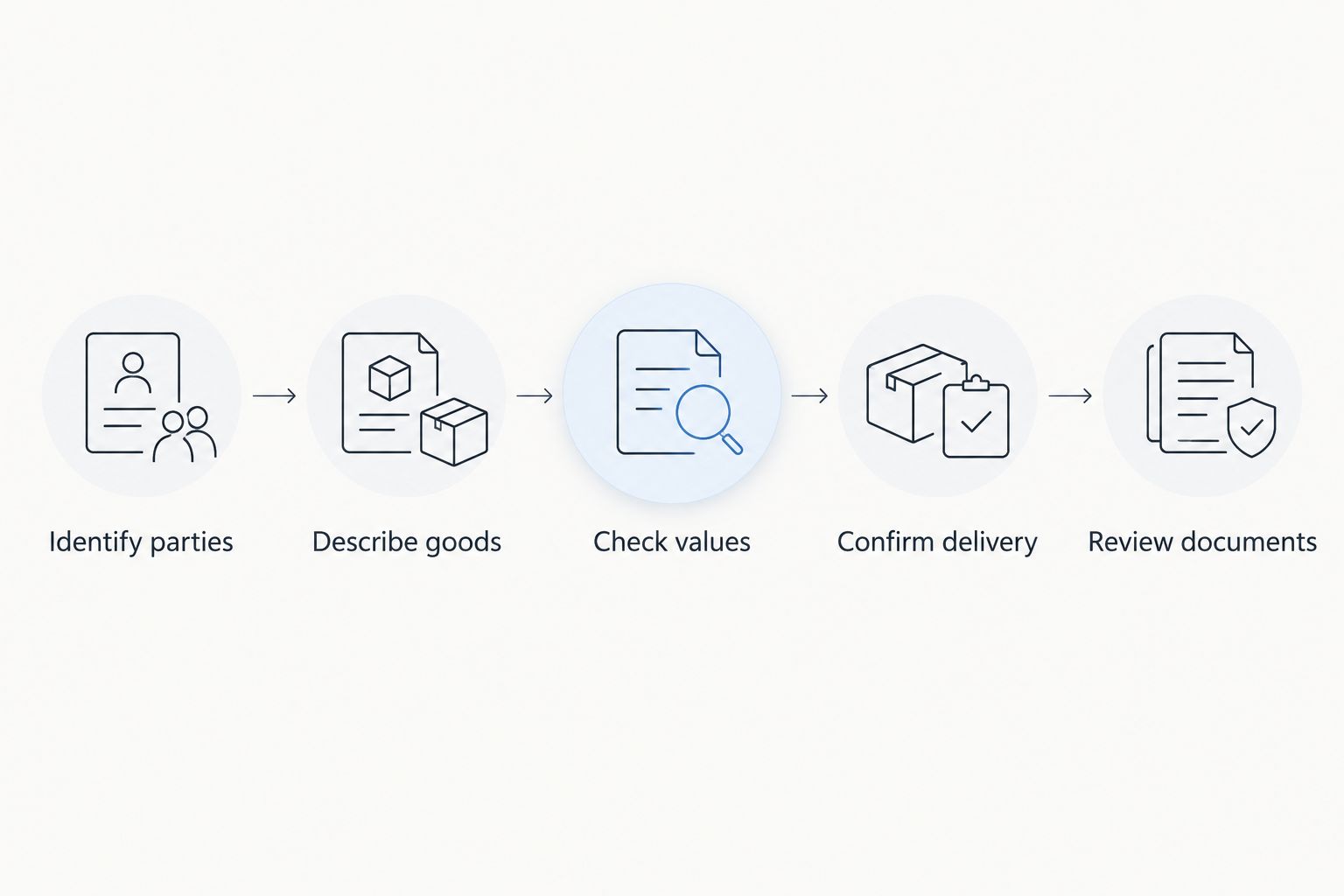
The sequence is straightforward: identify the parties, describe the goods, check the values, confirm delivery terms and review the documents. Complete the factual checks before treating the paperwork as ready.
Which documents are different from a pro forma invoice?
The pro forma invoice describes a proposed transaction. Ghana Revenue Authority’s import procedures distinguish the documents used for customs processing, including the invoice, packing list and transport documentation; other requirements depend on the shipment.
Use this comparison to avoid asking one document to perform another document’s job. It is a document-purpose guide, not an exhaustive clearance checklist.
| Document | Best for | Useful feature | Limitation |
|---|---|---|---|
| Pro forma invoice | Reviewing a proposed purchase | Records the supplier’s proposed goods and terms | Does not establish that the final sale or shipment matches the proposal |
| Commercial invoice | Recording the actual transaction | Gives the transaction details used in customs processing | Does not replace transport documents or required permits |
| Packing list | Checking package contents | Connects goods with packages, weights and quantities | Does not replace the commercial invoice |
| Bill of lading or air waybill | Documenting carriage | Identifies the transport movement and shipment parties | Does not by itself establish the full transaction value |
For a 2026 shipment, reconcile the final documents rather than assuming the first document remains correct. If the quantity changes after the proposal, update the commercial invoice and packing information to reflect what actually ships.
Why pro forma invoice requirements vary
The core transaction details stay useful across shipments. The supporting information changes with the goods and arrangements:
- Product type: Food, medicines, plants and other regulated goods can require checks or permissions beyond ordinary invoice information. Identify the relevant Ghanaian regulator before dispatch.
- Customs classification: Material, composition and use help determine the tariff classification. A vague description leaves those questions unanswered.
- Country of origin: Origin can affect tariff treatment and supporting evidence. The country sending the shipment is not automatically the country of origin.
- Delivery arrangement: Different terms allocate transport costs and risks differently. The invoice must make the agreed arrangement clear.
- Transport and packaging: Sea and air shipments use different transport documents, while package details must match the actual consignment.
- Transaction circumstances: Samples, gifts and goods supplied without a normal sale still need an appropriate description and a defensible basis for customs valuation.
Do not copy another importer’s paperwork without checking these differences. A document that describes a different product or delivery arrangement is not a reliable model for your shipment.
Does a pro forma invoice need an HS code?
An HS code helps connect the goods description to customs classification, but the code must be correct. The international Harmonized System uses a 6-digit classification structure; national tariff schedules add further detail.
Ask your customs agent to verify the classification used for Ghana. A supplier’s code is a starting point for review, not proof that the complete Ghanaian tariff classification is correct.
Do not remove the product description because a code is present. Customs classification depends on what the goods actually are, so retain the material, function and other relevant identifying details.
Can you clear goods with only a pro forma invoice?
A pro forma invoice alone is not a sufficient customs-clearance file. Ghana’s import process requires the applicable declaration and supporting documents, not just a supplier’s proposal.
Before dispatch, ask your customs agent to identify the documents needed for your goods and transport arrangement. Confirm any required regulatory approvals separately; an invoice cannot substitute for them.
Keep your 2026 clearance checklist specific to the shipment. A reusable checklist should prompt verification, not imply that every product follows an identical process.
Should you use a template or ask the supplier to prepare it?
The supplier should provide accurate transaction information, whether it uses its own document or fills in an agreed structure. Your role is to check that the proposal matches the purchase and gives your customs agent enough detail to review it.
Skillspad sells business templates. Skillspad business templates suit businesses preparing repeatable documents, not businesses seeking customs classification advice. A template provides structure; it does not verify the supplier’s facts or establish regulatory compliance.
Before adapting a template, check that you can add separate product lines, currency, origin, delivery terms and revision details. Prefer a document you can complete accurately over a polished layout that hides essential information.
What should you check before accepting the supplier’s document?
Use 3 document checks: identity, arithmetic and consistency. They address different problems and should remain separate in your review.
- Identity: Match the buyer, seller and goods to the actual purchase. Resolve unexplained differences in business names or product descriptions.
- Arithmetic: Recalculate quantities, line totals and the overall total. Confirm how freight and insurance are treated.
- Consistency: Compare the agreed terms with the purchase order and later shipping records. Explain genuine changes before submitting final documentation.
For each distinct product, use 1 line item unless the document clearly provides an equally precise breakdown. Combining different goods into a single unexplained total makes the transaction harder to assess.
Keep 1 invoice reference per issued version and mark revisions clearly. You need to know which document the supplier accepted and which figures the final commercial invoice replaced.
FAQ
What must a pro forma invoice include for Ghana customs?
Include seller and importer details, a reference and date, precise goods descriptions, quantities, values, currency, origin and delivery terms. Treat this as a preparation checklist, not a substitute for shipment-specific customs advice.
Can I use a pro forma invoice instead of a commercial invoice?
A pro forma invoice does not replace the final commercial invoice for an ordinary completed purchase. The final invoice must reflect the actual transaction and be consistent with the shipment records.
Does Ghana customs require an HS code on every pro forma invoice?
Do not assume that an HS code on the pro forma invoice completes customs classification. Ask your customs agent to confirm the correct Ghanaian tariff classification and where it must appear in the clearance documents.
Should freight and insurance appear on the pro forma invoice?
Make the treatment of freight and insurance explicit. Separate the charges where applicable, or state clearly when the agreed total already includes them, so they are not counted twice.
Is the country of origin the same as the shipping country?
The country of origin is not necessarily the shipping country. Goods can be manufactured in one country and dispatched through another, so verify origin rather than copying the supplier’s address.
Do free samples need customs documentation in Ghana?
Free samples still need appropriate customs documentation and a defensible customs valuation. Describing goods as free does not establish an exemption from import procedures or applicable charges.
Can a Skillspad template guarantee customs acceptance?
A Skillspad template cannot guarantee customs acceptance. Acceptance depends on accurate transaction information, the goods, the declaration and the applicable supporting documents and approvals.
One last thing
Check the final shipment against the original proposal, not just against the final invoice. An internally consistent set of shipping documents can still describe something different from what you agreed to buy.
For your 2026 records, preserve the proposal, its accepted revisions and the final commercial invoice together. That gives you a traceable transaction history without pretending the pro forma invoice is the final customs document.


