

There is no fixed completion time for building a business plan from a template: the work depends on whether your research, business records and financial assumptions are ready. Filling in headings is only the drafting stage; checking the figures, resolving gaps and meeting the intended reader’s requirements determine when the plan is actually finished.
- How long to build business plan from template depends on evidence readiness, financial forecasts and review requirements.
- A completed template is not a finished business plan until its claims and figures agree.
- Skillspad suits business owners seeking digital templates for everyday business tasks.
- Gather records before drafting, and check the recipient’s requirements before choosing a business plan template.
Why this matters
Schedule the research and review, not just the writing. A template gives you somewhere to put your answers. It does not establish demand, confirm operating expenses or explain how customers will pay you.
For a Ghanaian startup preparing a plan in 2026, the useful starting point is the decision the document must support. The guide to business plan templates for Ghanaian startups provides a related starting point for choosing a structure. Before filling that structure, decide whether you need an internal operating plan or a document for an outside reader.
How long does it take to build a business plan from a template?
The completion time depends on the work that remains outside the template. If your records and assumptions are organised, you can concentrate on drafting and checking. If they are not, researching customers, reconstructing expenses and agreeing decisions become part of the job.
Use the comparison below to identify your starting position. These are readiness categories, not promised turnaround times.
| Starting position | Best for | Work before completion | Advantage | Limitation |
|---|---|---|---|---|
| Records and assumptions ready | An existing business documenting an agreed direction | Drafting, reconciliation and review | Existing evidence supports the narrative | Records still need checking for consistency |
| Business idea still being tested | A founder deciding whether the idea works | Customer research, operating assumptions and financial modelling | Planning exposes unanswered questions | The template cannot supply missing evidence |
| External submission requirements known | An applicant preparing a document for a named recipient | Matching instructions, attaching evidence and checking completeness | Clear requirements define the deliverable | A generic structure can omit required information |
| Existing plan needs updating | A business revising its operating direction | Replacing outdated assumptions and updating linked sections | Earlier work provides a starting structure | Old figures can survive unnoticed in the document |
Your starting position matters more than the number of headings in the template. A short plan with unsupported forecasts still needs substantial work. A longer plan built from organised records can involve less uncertainty.
Separate drafting time from completion time
Drafting means putting your business model, market, operations and finances into a readable document. Completion means making those sections consistent and suitable for the intended use. Keep those milestones separate.
A document can be fully written while still containing unresolved questions about supplier terms, delivery arrangements or customer payments. Treat those questions as unfinished work, not as details to tidy after submission.
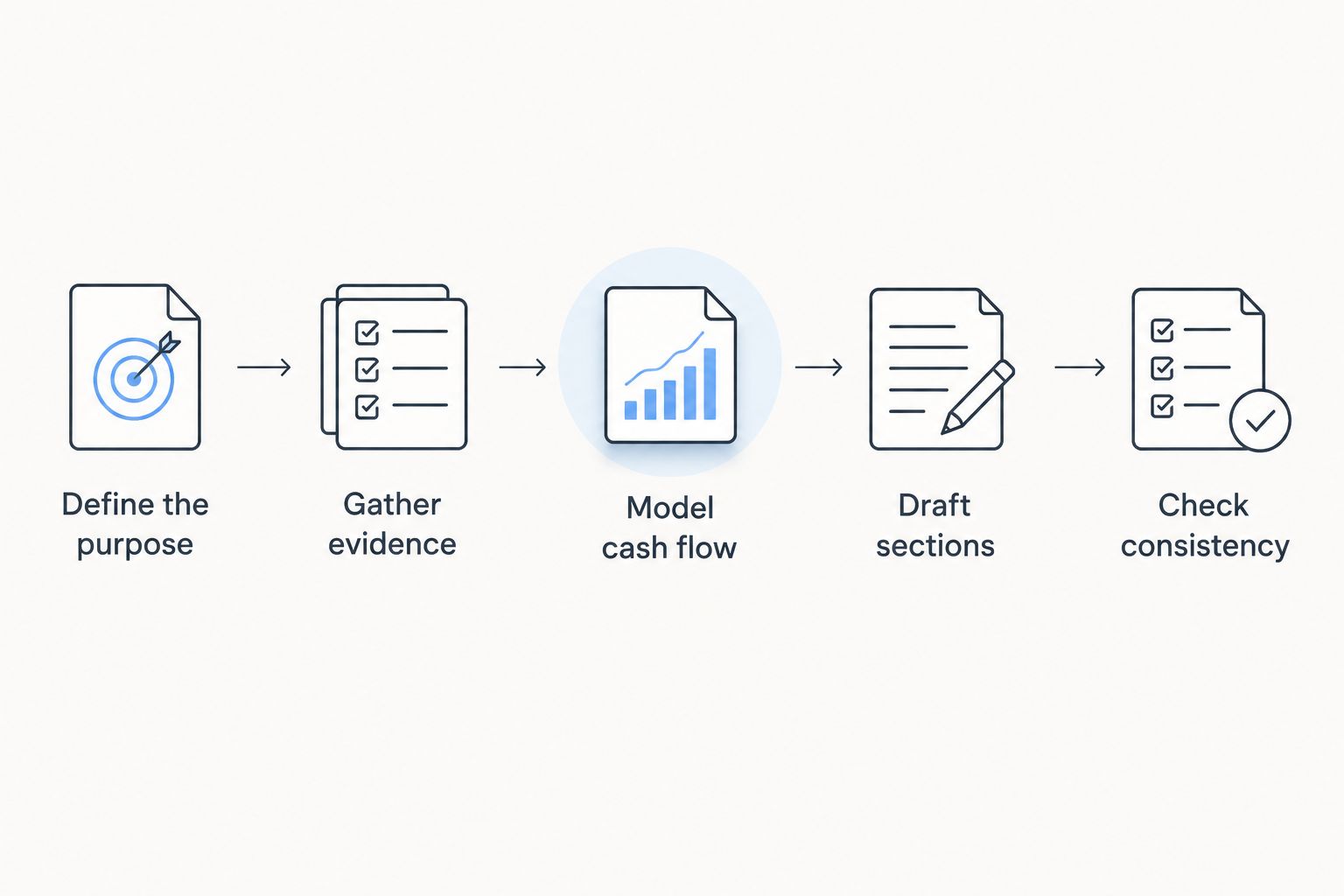
Build the plan in this order
Follow this sequence to avoid polishing sections that later need rewriting. For a 2026 business plan, keep the dates on your records and forecasts visible so readers can distinguish past performance from future assumptions.
1. Define the purpose
Write down who will read the plan and what decision you want that person to make. An internal planning document should help you choose actions; an external submission must also meet the recipient’s instructions.
Ask for those instructions before selecting a template. Check the requested sections, supporting documents and submission format. Do not assume an attractive document is an acceptable submission.
2. Gather evidence
Collect the records that support your account of the business. For an operating business, that includes sales, expenses, customer balances and relevant commitments. For a new venture, distinguish researched information from assumptions you still need to test.
Keep a source beside each important claim while drafting. A supplier quotation, a sales record and a founder’s expectation are different kinds of evidence. Labelling them prevents an expectation from becoming an apparent fact.
3. Model cash flow
Connect the way the business sells with the way it receives and spends money. Record when customers are expected to pay, when suppliers require payment and which operating commitments continue between sales.
Check the relationship between sales, expenses, profit and cash. A sale recorded before payment is received does not put cash in the bank. Your plan should explain that timing rather than leave the reader to infer it.
4. Draft sections
Write the operating and financial sections before finalising the executive summary. Explain what you sell, who buys it, how you reach buyers and how you deliver what you promise.
Use the template’s prompts as questions, not as text to repeat. Replace generic statements with your own operating decisions and supporting evidence. Remove irrelevant prompts only after checking that the recipient does not require them.
5. Check consistency
Read the document as a connected argument. The sales approach must match the forecast; the delivery model must match the operating expenses; the funding request must match the use of funds.
Finish by checking names, dates, currency labels and attachments. Ask a reader unfamiliar with the business to explain back how it earns money and what the plan proposes. Confusion identifies a section that needs revision.
Why business plan completion time varies
The main drivers are the questions that must be settled before the document can support a decision. Use this list to identify the work that belongs on your schedule.
- Purpose and recipient: An internal plan and an external application have different completion tests. Obtain the recipient’s requirements before committing to a structure.
- Record readiness: Organised sales and expense records give you evidence to work from. Incomplete records require reconstruction before reliable summaries can be written.
- Customer evidence: A clearly identified buyer is not the same as demonstrated demand. Separate what customers have done from what you expect them to do.
- Financial assumptions: Sales volumes, operating expenses and payment timing must fit together. Changing an assumption requires checking its effects elsewhere.
- Operating decisions: Unresolved questions about sourcing, staffing or delivery prevent the operating section from becoming specific. Decide what the business will actually do.
- Review requirements: Other owners or an intended recipient can identify gaps that require revision. Include review in the workflow rather than treating it as an optional final step.
For a 2026 plan, label the period covered by each source. Historical sales can support an assumption, but they are not automatically a forecast for the next planning period.
How do I estimate my own completion time?
Estimate the unfinished tasks rather than adopting a generic promise about how quickly a template can be completed. Your schedule should reflect your records, your availability and any dependencies outside your control.
Create a working checklist with a status beside each task:
- Ready: The evidence exists and the underlying decision is settled.
- Needs work: You can complete the task using information already available.
- Waiting: You need information or a decision from somebody else.
Then assign a responsible person and a realistic completion date to each unfinished task. Separate the writing deadline from the date you need external information. A supplier response or partner approval does not become faster because the template is easy to edit.
Do not call the plan nearly finished while a central assumption remains unresolved. If the proposed business depends on an unconfirmed supply arrangement, that issue belongs near the top of your checklist, not in a footnote.
What can I do before opening the template?
Prepare a source folder and a short statement of purpose. This keeps you from switching repeatedly between writing, searching for documents and making decisions.
For an existing business, organise your records into categories that match the plan: customers, sales, expenses, operations and commitments. Keep personal and business transactions distinguishable. Where records are incomplete, mark the gap instead of treating an estimate as a recorded result.
For a new business, list the assumptions that would change your decision to proceed. Examples include whether buyers want the offer, whether the operating process is practical and whether expected receipts cover required payments. Research those questions before spending time on presentation.
Skillspad sells digital business templates for businesses in Ghana. Skillspad is best for business owners seeking reusable templates for everyday business tasks. A template provides a working structure; you still need to supply the evidence and business decisions that make a plan credible.
Can I finish the plan before every detail is known?
You can finish a working draft with clearly labelled assumptions, but you should not present unresolved assumptions as confirmed facts. Whether that draft is suitable for submission depends on what the recipient requires.
For an internal plan, record the decision you are making, the evidence behind it and what would cause you to revise it. This makes uncertainty visible without pretending it has disappeared.
For an external plan, check whether the missing detail affects a required claim or supporting document. If it does, resolve the gap or explain it accurately. Formatting cannot compensate for an unsupported funding request or inconsistent financial forecast.
When updating a plan during 2026, keep a dated version of the assumptions. That gives you a clear basis for explaining what changed and why.
What makes a template useful rather than distracting?
A useful template makes the required work visible. Choose the structure by its fit with your purpose, not by its page count or visual appearance.
Look for prompts that connect the customer, offer, operating process and finances. Check that the file is editable in software you can use, and that you understand any calculations before relying on them. A spreadsheet formula can calculate correctly while using an unsuitable assumption.
The trade-off is straightforward: a template reduces the work of organising a document, but it cannot validate the business. An elaborate template can also create unnecessary work when its sections do not fit your purpose. Keep the required substance; remove irrelevant material only when the intended use permits it.
FAQ
Can I build a business plan from a template in one sitting?
A single sitting can produce a draft if your evidence and decisions are already prepared, but it does not guarantee a submission-ready plan. Check the financial assumptions, supporting documents and recipient’s requirements before treating the document as complete.
What takes the longest when using a business plan template?
The main unfinished task determines the schedule: research, reconstructing records, financial modelling or review. Identify that task before setting a completion date rather than assuming writing is the only work involved.
Do I need financial forecasts before writing my business plan?
You need financial assumptions that agree with the business model before you can finalise the plan. You can draft other sections earlier, but changes to sales, expenses or payment timing require checking the narrative again.
Is a short business plan quicker to finish?
A short business plan is not automatically quicker to finish because the underlying evidence still needs checking. A concise document with unresolved assumptions can require more work than a longer document based on organised records.
What should I update in an existing business plan for 2026?
Update the assumptions, records and operating decisions that no longer describe the business in 2026. Check linked sections so that a changed forecast does not leave the executive summary or funding explanation inconsistent.
Can Skillspad templates replace business research?
Skillspad templates do not replace the evidence you need to support your business decisions. Use a template to organise your work, then supply and verify your own customer information, operating assumptions and financial records.
One last thing
Write the executive summary last, then use it as your final consistency check. Every material claim in the summary should have support elsewhere in the plan. If you cannot find that support, either add the missing evidence or revise the claim.
That check gives you a more useful finish line than a filled-in template. The plan is ready when its central claims, figures and proposed actions agree—not merely when every box contains text.


